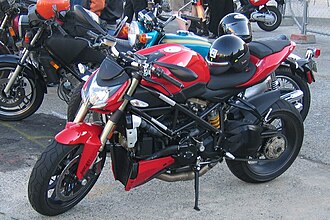
Ducati Streetfighter: The Ultimate Italian Naked Performance Motorcycle
The Ducati Streetfighter has become one of the most recognizable names in the world of high-performance naked motorcycles. It takes the fundamental idea of a superbike and removes much of the bodywork, exposing the engine, chassis and mechanical hardware while creating a riding position that is more upright and aggressive. The result is a motorcycle that combines the raw character of a naked bike with performance levels normally associated with fully faired racing machines. In its current form, the Streetfighter family includes both the V4 and V2, giving Ducati enthusiasts two distinct interpretations of the formula. The flagship Streetfighter V4 uses the 1,103 cc Desmosedici Stradale V4 and produces up to 214 hp in European specification, while the latest Streetfighter V2 uses Ducati’s new 890 cc V2 engine and produces 120 hp.
What makes the Streetfighter particularly appealing is that it does not attempt to be a conventional naked roadster. Its personality is much more extreme. The design philosophy is centered around performance, lightweight construction, sharp handling and electronic technology, but without the full fairing that separates the rider from the engine and the surrounding environment. This creates an unusually direct riding experience. Wind resistance becomes part of the experience at high speed, the engine is visually prominent, and the motorcycle’s aggressive styling makes its sporting intentions obvious. Ducati has effectively created a machine for riders who want superbike performance but prefer the physical presence and riding position of a naked motorcycle.
The Origins of the Ducati Streetfighter
From Superbike to Naked Weapon
The Streetfighter concept was born from an appealingly simple idea: take the performance DNA of a Ducati superbike and transform it into a machine with minimal bodywork and a more upright riding position. Early Streetfighter models established the basic formula, combining a powerful Ducati engine with an exposed chassis, aggressive styling and a distinctive front end.
This approach allowed Ducati to reach riders who loved the performance and technology of its superbikes but did not necessarily want the committed ergonomics of a fully faired sportbike. A naked motorcycle can feel more immediate because there is less visual and physical separation between the rider and the machine. The Streetfighter’s wide handlebar, exposed engine and minimal fairing create an impression of mechanical directness that is difficult to reproduce on a conventional superbike.
The philosophy became considerably more extreme when Ducati introduced the Streetfighter V4. Instead of using a conventional naked-bike engine, Ducati based the motorcycle on the same fundamental 1,103 cc Desmosedici Stradale V4 architecture associated with the Panigale V4. The Streetfighter therefore became a naked superbike in the most literal sense: a machine with extraordinarily high performance that had been stripped of much of its aerodynamic bodywork.
Ducati Streetfighter V4
The Desmosedici Stradale Engine
The current Streetfighter V4 is powered by Ducati’s 1,103 cc Desmosedici Stradale 90-degree V4. It uses a counter-rotating crankshaft, desmodromic valve timing, four valves per cylinder and liquid cooling. In European specification, Ducati quotes 214 hp at 13,500 rpm and 120 Nm of torque at 11,250 rpm. In the United States, Canada and Mexico, the homologated output is listed as 205 hp at 12,650 rpm and 119.7 Nm at 11,500 rpm.
The engine is one of the defining features of the Streetfighter V4 because it gives the naked motorcycle performance that is far beyond what most riders could reasonably expect from a traditional roadster. The engine’s 81 mm bore and 53.5 mm stroke create a highly oversquare configuration designed for high-rpm performance, while the 14.0:1 compression ratio reflects its sophisticated performance orientation. Ducati also uses full ride-by-wire elliptical throttle bodies, twin injectors per cylinder and a variable-length intake system.
The result is an engine with a character very different from an ordinary naked motorcycle. At low speeds it can be surprisingly manageable, but as the revs rise the V4 becomes increasingly intense. The engine’s soundtrack, rapid throttle response and ability to continue accelerating at high rpm are central to the Streetfighter V4 experience.
Performance Without a Fairing
Removing the fairing changes the character of the motorcycle dramatically. A Panigale V4 can use its aerodynamic bodywork to reduce wind resistance and improve high-speed stability, whereas the Streetfighter places the rider directly in the airflow. This means that the motorcycle can feel brutally fast even before reaching the speeds at which a fully faired superbike begins to reveal its true potential.
That is not necessarily a disadvantage. For many riders, the increased wind pressure is part of the attraction. It provides a physical sensation of speed that is difficult to replicate on a fully enclosed motorcycle. The Streetfighter encourages acceleration bursts rather than endless high-speed running, making it particularly entertaining on roads where the rider can accelerate, brake and turn repeatedly.
Ducati has nevertheless retained substantial aerodynamic development. The latest Streetfighter V4 incorporates aerodynamic elements derived from the company’s superbike work, helping manage front-wheel lift and high-speed behavior. The objective is not simply to make the motorcycle faster in a straight line but to give the rider greater stability when exploiting its performance.
Chassis and Handling
A Lightweight Performance Philosophy
A motorcycle producing more than 200 horsepower needs an equally capable chassis. The Streetfighter V4 uses an aluminum Front Frame architecture that works with the engine as a central structural element. The arrangement allows Ducati to create a compact motorcycle while maintaining the stiffness and weight distribution required for serious performance riding.
The current Streetfighter V4 has a 1,496 mm wheelbase, 24.5-degree rake and 99 mm trail. Ducati lists the standard V4 at 191 kg without fuel, while the V4 S is listed at 189 kg. These figures are remarkable considering the size and output of the engine.
The handling philosophy is therefore based on reducing unnecessary mass while preserving stability. The motorcycle needs to remain composed under hard acceleration and braking, but it must also respond quickly when the rider changes direction. This balance is one of the defining characteristics of the Streetfighter.
Streetfighter V4 and V4 S
Ducati offers the Streetfighter V4 in standard and V4 S configurations. The standard version uses a fully adjustable 43 mm Showa BPF fork and Sachs rear shock, while the V4 S receives Öhlins electronic suspension and lighter wheels.
The V4 S is therefore particularly attractive to riders who intend to spend significant time on a racetrack. Electronic suspension allows damping characteristics to be adapted more precisely to riding conditions, while lighter wheels can reduce unsprung and rotating mass. The standard V4, however, remains an extremely sophisticated performance motorcycle and may be the more sensible choice for predominantly road-based riding.
Braking Performance
Brembo Hardware
The Streetfighter V4 uses twin 330 mm front discs with radially mounted four-piston Brembo Hypure monobloc calipers. The system also incorporates Race eCBS, Ducati’s electronically managed braking technology designed to coordinate braking assistance according to riding conditions. A 245 mm rear disc with a two-piston caliper completes the braking system.
Such hardware is necessary because the Streetfighter can arrive at corners at extraordinary speeds. Effective braking is not merely about stopping distance; it is about giving the rider confidence and control during the transition from acceleration to corner entry. The electronics can help manage braking behavior, particularly when the motorcycle is leaned over.
The combination of powerful Brembo hardware and sophisticated electronic management demonstrates how modern performance motorcycles have evolved. A superbike-level braking system is no longer simply a collection of large discs and powerful calipers. Software, sensors and rider inputs are now integrated into the process.
Electronics and Rider Assistance
Technology Designed Around the Rider
The Streetfighter V4 is equipped with a comprehensive electronic package. Ride-by-wire throttle management allows Ducati to control engine response precisely, while traction control, wheelie control and engine-brake management help the rider exploit the engine’s performance. Ducati Quick Shift provides rapid clutchless gear changes in both directions.
These systems are especially important on a naked motorcycle because the Streetfighter’s power can easily overwhelm the available grip if the rider is too aggressive. Electronic assistance can reduce unwanted wheelspin and front-wheel lift while allowing the motorcycle to retain its aggressive character.
The rider can therefore choose how much assistance is appropriate for the circumstances. A conservative setting can provide a smoother experience on public roads, while experienced riders can reduce intervention when riding on a circuit. This configurability makes the Streetfighter much more versatile than its intimidating appearance might suggest.
The 6.9-Inch TFT Display
The current Streetfighter V4 features a large 6.9-inch TFT display with a 1,280 × 480-pixel resolution and an 8:3 aspect ratio. The display provides access to riding information and electronic settings while giving the motorcycle a distinctly modern cockpit.
This large screen is particularly useful because the Streetfighter has so many adjustable systems. Instead of forcing the rider to manage a collection of disconnected controls, Ducati has integrated the motorcycle’s electronic functions into a coherent interface.
The Ducati Streetfighter V2
A Different Interpretation of the Formula
The Streetfighter V4 is the spectacular flagship, but Ducati’s newer Streetfighter V2 provides a fundamentally different interpretation of the naked-sportbike concept. It uses the new 890 cc Ducati V2 engine, a 90-degree twin with four valves per cylinder and intake variable valve timing. Ducati quotes 120 hp at 10,750 rpm and 93.3 Nm of torque at 8,250 rpm.
The lower output does not mean that the V2 is an entry-level motorcycle. Its performance is still substantial, particularly because Ducati has focused heavily on keeping the motorcycle light. The Streetfighter V2 weighs approximately 178 kg without fuel in standard European specification, while the V2 S is listed at approximately 175 kg.
This makes the V2 particularly interesting for riders who prioritize agility and usable performance over outright horsepower. On a winding road, a lighter motorcycle can be extremely entertaining because it responds quickly to steering inputs and allows the rider to exploit more of the available performance.
The New V2 Engine
The 890 cc V2 uses a 96 mm bore and 61.5 mm stroke, with a 13.1:1 compression ratio. Ducati’s variable intake valve-timing system is designed to improve torque delivery and flexibility across the rev range, while full ride-by-wire throttle control provides precise electronic management.
The engine is paired with a six-speed transmission and Ducati Quick Shift 2.0. The combination creates a motorcycle that can be ridden smoothly in ordinary traffic but becomes increasingly aggressive as the rider explores the upper portion of the rev range.
The V2 also illustrates Ducati’s broader strategy. Instead of making every Streetfighter increasingly powerful, Ducati has created different levels of performance within the family. The V2 offers a lighter, more manageable experience, while the V4 exists for riders who want extreme power and the most advanced superbike-derived technology.
Design: Aggression Without a Fairing
The Streetfighter Face
The appearance of a Ducati Streetfighter is perhaps as important as its engineering. The front end is compact and aggressive, with the headlight assembly giving the motorcycle an almost predatory expression. Without the visual mass of a full fairing, the engine and chassis become central elements of the design.
The exposed mechanical components communicate performance without requiring the motorcycle to look excessively complicated. Ducati has traditionally been associated with sculptural motorcycle design, and the Streetfighter follows that philosophy by combining functional elements with carefully controlled proportions.
The motorcycle’s minimal bodywork also reinforces its identity. A Panigale is recognizable as a superbike because of its fairing, while the Streetfighter is recognizable precisely because much of that fairing is absent. The resulting silhouette is shorter visually, more upright and considerably more muscular.
Aerodynamics Still Matter
Although the Streetfighter is a naked motorcycle, Ducati has not ignored aerodynamics. High-performance naked bikes encounter significant aerodynamic forces, particularly when traveling at the speeds the V4 is capable of reaching. Winglets and other aerodynamic surfaces can help manage front-end behavior and improve stability.
This is another example of the Streetfighter’s unusual position in Ducati’s range. It looks like a stripped-down motorcycle, but underneath the minimalist appearance is technology derived from serious superbike development.
Riding the Ducati Streetfighter
The Streetfighter’s riding experience depends heavily on which version is selected. The V4 is an explosive machine that can feel almost excessive on public roads, with its enormous reserve of power always waiting behind the throttle. The V2 is less intimidating but can arguably be easier to enjoy because its performance is more accessible.
Both motorcycles share the same fundamental attraction: the rider is exposed to the engine and environment in a way that creates a particularly direct connection. There is no large fairing separating the rider from the wind, and there is no sense that the motorcycle is merely transporting the rider from one corner to another. Every acceleration, braking maneuver and change of direction feels immediate.
The riding position also helps. Compared with a full superbike, the Streetfighter provides a more upright relationship between the rider and the motorcycle. The wider handlebar gives strong leverage during direction changes, while the relatively compact dimensions encourage active riding.
Streetfighter V2 or Streetfighter V4?
Choosing the V2
The Streetfighter V2 is the logical choice for riders who want Ducati character and serious sporting ability without the overwhelming performance of the V4. Its 890 cc engine produces enough power to be genuinely fast, while its lower weight makes it highly attractive on technical roads.
The V2 is also likely to be easier for a wider range of riders to exploit. Rather than constantly managing enormous reserves of power, the rider can focus on cornering technique, braking and momentum. For many enthusiasts, this can produce a more satisfying real-world riding experience.
Choosing the V4
The Streetfighter V4 is for riders who want the extreme version of the concept. With up to 214 hp in European specification, a 1,103 cc V4 engine and a comprehensive electronic package, it sits close to the performance frontier of production naked motorcycles.
The V4 is particularly compelling for experienced riders who want a motorcycle capable of serious track performance without the full fairing of a Panigale. It is also a machine purchased as much for its emotional appeal as its practical abilities. There are few experiences quite like opening the throttle of a 200-plus-horsepower Ducati naked bike.
Ducati Streetfighter Technical Specifications
The following table summarizes the principal specifications of the current Streetfighter V4. Ducati’s figures vary by market; the European version produces 214 hp, while the U.S., Canadian and Mexican versions are homologated at 205 hp. The table therefore uses the European specification where appropriate.
| Specification | Ducati Streetfighter V4 |
|---|---|
| Engine | Desmosedici Stradale 90° V4 |
| Cooling | Liquid-cooled |
| Valve system | Desmodromic, 4 valves per cylinder |
| Crankshaft | Counter-rotating |
| Displacement | 1,103 cc |
| Bore × stroke | 81 × 53.5 mm |
| Compression ratio | 14.0:1 |
| Maximum power | 214 hp @ 13,500 rpm |
| Maximum torque | 120 Nm @ 11,250 rpm |
| Fuel system | Electronic injection, twin injectors per cylinder |
| Throttle | Full ride-by-wire |
| Intake | Variable-length intake system |
| Transmission | 6-speed |
| Quick shifter | Ducati Quick Shift up/down 2.0 |
| Frame | Aluminum Front Frame |
| Front suspension | Fully adjustable 43 mm Showa BPF fork |
| Rear suspension | Sachs shock |
| Front brakes | 2 × 330 mm discs, Brembo Hypure 4-piston calipers |
| Rear brake | 245 mm disc, 2-piston caliper |
| Front tire | 120/70 ZR17 |
| Rear tire | 200/60 ZR17 |
| Wheelbase | 1,496 mm |
| Rake | 24.5° |
| Trail | 99 mm |
| Seat height | 845 mm |
| Fuel capacity | 16 litres |
| Wet weight without fuel | 191 kg |
| Display | 6.9-inch TFT |
| Electronics | Traction control, wheelie control, engine-brake control, cornering ABS/Race eCBS, ride-by-wire, DQS |
Final Verdict
The Ducati Streetfighter is one of the clearest examples of how a motorcycle can combine two seemingly contradictory ideas: extreme performance and naked-bike simplicity. By taking the technology and engineering of Ducati’s superbikes and presenting them in a more exposed, upright package, Ducati created a motorcycle that feels remarkably different from a traditional faired sportbike.
The Streetfighter V4 is the ultimate expression of that philosophy. Its 1,103 cc Desmosedici Stradale V4, counter-rotating crankshaft, sophisticated electronics, Brembo braking system and advanced chassis give it extraordinary performance. With up to 214 hp in European specification, it is a motorcycle that possesses far more capability than most roads can safely exploit.
The Streetfighter V2, meanwhile, offers a more accessible interpretation. Its new 890 cc V2, 120 hp output and approximately 178 kg weight create a package focused more strongly on agility and usable performance. It demonstrates that the Streetfighter identity does not depend entirely on having the biggest possible engine.
Ultimately, the Ducati Streetfighter succeeds because it is not simply a Panigale with its fairing removed. It has its own identity, its own riding experience and its own appeal. The V4 delivers spectacular superbike performance in an aggressively naked package, while the V2 emphasizes lightness, accessibility and the enduring character of Ducati’s twin-cylinder tradition.
For riders who want a motorcycle that looks dramatic, sounds extraordinary and delivers an intense connection between rider and machine, the Streetfighter remains one of the most compelling choices in the performance-naked category. It is Ducati’s interpretation of what happens when a superbike is stripped down to its essential elements—and then given even more attitude.
