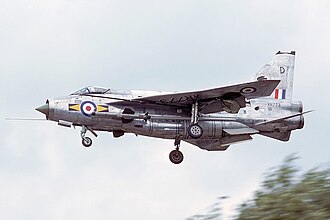
English Electric Lightning: The Extraordinary Story of Britain’s Supersonic Interceptor
The English Electric Lightning was one of the most remarkable fighter aircraft ever developed in Britain. Created during the early years of the Cold War, it was designed to defend the United Kingdom against the threat of high-speed enemy bombers and became the Royal Air Force’s first truly supersonic interceptor. With its distinctive twin-engine arrangement, highly swept delta wings, powerful afterburning turbojets, and astonishing rate of climb, the Lightning was an aircraft unlike almost anything else in military aviation. It was not built to perform every possible combat mission, nor was it designed primarily for long-range patrols or ground attack. Instead, it was developed with a focused purpose: to climb rapidly, reach high altitude, intercept hostile aircraft, and deliver its weapons before the enemy could threaten Britain’s airspace.
The aircraft’s unusual appearance was a direct consequence of its engineering priorities. Its two engines were mounted vertically, one above the other, inside the fuselage, while the air intake occupied the nose. Its wings were short, sharply swept, and shaped around a distinctive “notched delta” planform. This configuration gave the Lightning a combination of acceleration, climb performance, and high-speed capability that made it legendary among pilots and aviation enthusiasts. Yet behind its spectacular performance lay a number of compromises, including limited internal fuel capacity, a demanding maintenance regime, and a relatively narrow operational role. Despite these limitations, the Lightning served the RAF for nearly three decades and also found a home with the air forces of Saudi Arabia and Kuwait. Its story remains an important part of Britain’s Cold War aviation heritage.
The Origins of the English Electric Lightning
From Experimental Research to Fighter Development
The roots of the English Electric Lightning can be traced to the British government’s interest in supersonic flight during the years immediately following the Second World War. In 1947, the Ministry of Supply issued Experimental Requirement ER.103, calling for a manned aircraft capable of exploring the aerodynamic and structural challenges associated with flight at and beyond the speed of sound. Britain was eager to maintain its position at the forefront of aviation technology, and experimental aircraft were seen as essential to understanding the future of high-speed flight.
English Electric, a company with considerable experience in aircraft production, began developing a design under the leadership of aerodynamicist W. E. W. Petter. Petter had previously been involved in the development of successful British aircraft, including the Canberra bomber. His early Lightning concept was not initially intended to become a conventional operational fighter. Instead, it was conceived as a research aircraft that could investigate supersonic performance and provide valuable information for future designs.
The resulting aircraft was designated the P.1. It featured a highly swept wing, a slender fuselage, and an unconventional arrangement of two engines installed vertically. This engine layout was one of the most important characteristics of the eventual Lightning. Rather than placing the engines side by side, English Electric stacked them within the fuselage, allowing the aircraft to retain a relatively narrow frontal profile while accommodating two powerful turbojets. The arrangement also created a distinctive appearance and helped make room for a large central air intake in the nose.
The P.1 first flew on 4 August 1954, with test pilot Roland Beamont at the controls. The flight represented a major achievement for British aviation, and subsequent testing demonstrated that the design possessed exceptional high-speed potential. The aircraft was later developed into the P.1B, which incorporated improvements intended to bring it closer to an operational fighter configuration. The P.1B first flew on 4 April 1957 and helped establish the aerodynamic and systems foundation of the future Lightning.
The Influence of the Cold War
The Lightning’s development was strongly influenced by the strategic conditions of the Cold War. Britain faced the possibility of an attack by high-speed Soviet bombers carrying conventional or nuclear weapons. The RAF therefore required an interceptor capable of reaching hostile aircraft rapidly, operating at high altitude, and using radar-guided interception systems to engage targets in poor weather or at night.
This requirement shaped the Lightning into a specialized machine. Unlike a multirole fighter designed to perform air combat, ground attack, reconnaissance, and maritime operations, the Lightning was primarily intended for air defence. Its emphasis was on speed, climb, altitude, and the ability to carry powerful weapons and interception equipment.
The aircraft’s development took place during a period of rapid technological change. Radar systems were becoming more sophisticated, guided missiles were increasingly important, and military planners were debating whether manned fighters would remain relevant in an age of nuclear weapons and ballistic missiles. These debates influenced British defence policy and created uncertainty about the future of manned combat aircraft. Nevertheless, the Lightning progressed from an experimental design into a frontline interceptor that would serve for many years.
The Distinctive Design of the Lightning
A Unique Twin-Engine Arrangement
The English Electric Lightning’s most recognizable feature was its vertically stacked engine configuration. Two Rolls-Royce Avon turbojets were installed one above the other inside the fuselage, with a common nose intake feeding air toward the engines. This arrangement was unusual among fighter aircraft and gave the Lightning a narrow, streamlined profile.
The decision to stack the engines had several advantages. It reduced the frontal area that would have been required by side-by-side engines, helped preserve the aircraft’s aerodynamic shape, and allowed English Electric to fit substantial power into a relatively compact airframe. The layout also provided a degree of operational redundancy compared with a single-engine aircraft. If one engine failed, the other could continue to produce thrust, although engine-out handling and performance depended on the circumstances.
There were also disadvantages. The engine installation made the fuselage complex and created significant demands for maintenance access. The aircraft’s internal arrangement left limited space for fuel, contributing to the Lightning’s reputation for short endurance. Its air intake, engine ducts, and internal systems had to be carefully designed to support reliable operation across a wide range of speeds and altitudes.
The Lightning’s engines were equipped with afterburners, which injected additional fuel into the exhaust flow to produce a substantial increase in thrust. Afterburning consumed fuel rapidly, but it allowed the aircraft to accelerate quickly and achieve extraordinary climb performance. The combination of two powerful Avon engines and a lightweight, highly aerodynamic airframe was central to the Lightning’s reputation as a high-performance interceptor.
The Notched Delta Wing
The Lightning used a distinctive wing design often described as a highly swept or “notched” delta wing. The wings were short in span and sharply swept, giving the aircraft a compact appearance when viewed from the front or rear. The design was intended to provide favorable high-speed aerodynamic characteristics while also supporting the aircraft’s demanding climb and interception mission.
The wing’s shape was not simply an aesthetic choice. At supersonic speeds, aircraft designers must carefully manage shock waves, drag, stability, and control. A highly swept wing can reduce the aerodynamic penalties associated with compressibility, allowing the aircraft to operate efficiently at high Mach numbers. The Lightning’s wing design also contributed to its distinctive handling qualities.
Later versions incorporated a cambered wing, which improved low-speed characteristics and helped increase fuel and payload flexibility. The F.6, regarded as the definitive RAF fighter variant, featured this improved wing and a larger ventral fuel tank. These changes addressed some of the shortcomings of earlier models, particularly the aircraft’s limited endurance.
The Lightning’s small wings and powerful engines gave it a very high thrust-to-weight ratio under favorable conditions. This allowed it to accelerate rapidly and climb at rates that were exceptional for its time. The aircraft’s ability to reach high altitude quickly became one of its defining operational advantages.
The Fuselage and Cockpit
The Lightning’s fuselage was shaped around its central intake, stacked engines, radar equipment, cockpit, and weapons systems. The pilot sat relatively far forward, immediately behind the nose-mounted intake and radar installation. This arrangement provided the aircraft with a distinctive profile and helped integrate the interception equipment into the nose.
The cockpit was designed for a single pilot in the principal fighter variants. The pilot had to manage a sophisticated collection of systems, including radar, navigation equipment, weapons controls, engine instruments, and flight controls. Although the Lightning was technologically advanced for its period, its cockpit was not comparable to the highly integrated digital environments found in modern fighters.
The aircraft also featured a number of unusual engineering solutions. Electrical power was generated through a system driven by engine bleed air, rather than relying solely on the conventional shaft-driven arrangements common in many other aircraft. Hydraulic systems supported flight controls, landing gear, flaps, and other essential functions. These systems reflected the complexity of designing a supersonic interceptor in the 1950s and 1960s.
Development of the Main Lightning Variants
The Early F.1 and F.1A
The first production Lightning variant was the F.1, which entered RAF service in the late 1950s and early 1960s. No. 74 Squadron at RAF Coltishall became the first operational unit to receive the aircraft. The introduction of the Lightning represented a major leap in capability for the RAF, replacing earlier subsonic and transonic fighters with a machine capable of sustained supersonic performance.
The F.1 was powered by early versions of the Rolls-Royce Avon engine and carried the Ferranti AI.23 airborne interception radar. Its armament typically included two 30 mm ADEN cannons and provision for Firestreak infrared air-to-air missiles. The combination of radar, guns, and missiles gave the aircraft a powerful interception capability for its era.
The F.1A introduced improvements such as an in-flight refuelling probe and updated communications equipment. These changes enhanced the aircraft’s operational flexibility, although the fundamental limitations of its internal fuel capacity remained. The early Lightnings were extremely fast and powerful but could not remain airborne for long periods without external fuel support.
The F.2 and F.2A
The F.2 introduced further improvements in performance and operational equipment. The aircraft continued to use the general Lightning design but benefited from refinements to its systems and structure. The F.2A, which was developed from existing F.2 aircraft, incorporated a cambered wing and a larger ventral fuel tank, helping to improve endurance.
The F.2A was particularly valuable because it addressed one of the Lightning’s most persistent problems: fuel consumption. Even with improvements, however, the aircraft’s range remained modest compared with many later fighters. Its primary purpose was still interception close to the defended area rather than long-distance combat operations.
The F.2 and F.2A also demonstrated the adaptability of the basic Lightning design. Engineers could improve the aircraft’s fuel capacity, wing characteristics, weapons systems, and avionics without abandoning the distinctive configuration that made it so effective at high speed.
The F.3 and F.6
The F.3 introduced more powerful Avon engines, a larger fin, improved radar equipment, and the Red Top infrared air-to-air missile. The Red Top was more capable than the earlier Firestreak and improved the Lightning’s effectiveness against hostile aircraft. The F.3’s increased engine power also enhanced its high-altitude performance.
However, the F.3 initially lacked the internal cannon armament found on some earlier versions. This reflected the growing belief that guided missiles would dominate air combat. The decision was later reconsidered, and subsequent Lightning versions restored cannon capability.
The F.6 became the definitive RAF single-seat Lightning variant. It incorporated the cambered wing, a larger ventral fuel tank, improved engines, and provision for additional fuel tanks mounted above the wings. The F.6 could also carry Red Top missiles and, in its final configuration, two 30 mm ADEN cannons. These improvements made it the most capable and recognizable version of the aircraft.
Although the F.6 offered better endurance and weapons flexibility, it retained the Lightning’s basic character. It remained an exceptionally fast interceptor with limited range compared with larger multirole fighters. Its performance was impressive, but the aircraft’s design philosophy was increasingly out of step with the changing demands of modern air warfare.
Performance and Flight Characteristics
Speed and Climb
The Lightning was famous for its ability to accelerate and climb at extraordinary rates. Depending on the variant and operating conditions, it could reach speeds of approximately Mach 2.0 to Mach 2.27. The aircraft’s high-speed performance was supported by its powerful Avon engines, highly swept wings, and carefully shaped fuselage.
One of the most impressive features of the Lightning was its rate of climb. Under favorable conditions, the aircraft could reach 40,000 feet in approximately two and a half minutes. Its climb performance made it particularly well suited to the interception mission, where time was often critical. A fighter capable of reaching a high-altitude target quickly could significantly reduce the opportunity for an enemy bomber to approach its objective.
The Lightning’s high-altitude performance also gave it an advantage over many earlier fighters. It could operate in the upper reaches of the atmosphere, where aerodynamic and engine performance became increasingly demanding. Its powerful engines and specialized design allowed it to maintain impressive performance at altitudes that were beyond the practical reach of many conventional fighters of the period.
Handling and Pilot Workload
Despite its remarkable speed, the Lightning was not an easy aircraft to operate. Its short wings, powerful engines, high fuel consumption, and sophisticated systems demanded careful management. Pilots had to pay close attention to fuel state, engine operation, speed, altitude, and weapons employment.
The aircraft’s high thrust-to-weight ratio could produce rapid acceleration, but it also required pilots to manage energy carefully. A Lightning could quickly reach speeds at which the surrounding airframe and systems were subjected to significant aerodynamic loads. At the same time, the aircraft’s limited fuel capacity meant that pilots had to plan missions and recoveries with precision.
The Lightning’s handling characteristics made it a rewarding aircraft for experienced pilots. Its performance was often described as exhilarating, and its acceleration and climb were among its most celebrated qualities. However, the same characteristics that made it exciting also demanded discipline and technical understanding.
Armament and Interception Systems
Radar and Guided Missiles
The Lightning’s interception role depended heavily on its radar and weapons systems. Early versions used the Ferranti AI.23 radar, which was installed in the nose intake cone. This radar formed part of the aircraft’s airborne interception system and supported the detection and tracking of hostile aircraft.
The radar was particularly important because the Lightning was designed to operate in all-weather conditions. Unlike a simple daytime fighter, it needed to intercept targets during darkness, poor visibility, and adverse weather. Radar information helped the pilot locate and engage targets without relying solely on visual contact.
The aircraft initially carried Firestreak infrared-guided missiles. Later versions adopted the more capable Red Top missile, which improved the Lightning’s ability to engage airborne targets. The combination of radar-assisted interception, infrared missiles, and cannon armament gave the aircraft a flexible weapons capability for the technological environment of the 1960s and 1970s.
Cannon Armament and Rockets
The Lightning’s armament evolved throughout its service life. Early versions could carry two 30 mm ADEN cannons, which provided a powerful close-range weapon. Some variants also carried additional cannons or rocket systems, depending on their configuration.
The F.3’s initial lack of cannon armament reflected the increasing emphasis on guided missiles, but later versions restored guns. This change acknowledged that missiles could not always be relied upon in every combat situation. Close-range engagements, identification problems, missile limitations, and changing tactical requirements all supported the continued usefulness of cannon armament.
Export versions of the Lightning, including the F.53 operated by Saudi Arabia, were adapted for a wider range of missions. These aircraft could carry additional external stores, including bombs, rocket pods, and other equipment. As a result, export Lightnings demonstrated greater multirole flexibility than the aircraft’s original RAF interceptor role might suggest.
Operational Service in the Royal Air Force
Britain’s Supersonic Air Defence
The Lightning entered RAF service during a period of rapid change in military aviation. It was initially intended to defend British airspace against high-speed bombers and other hostile aircraft. Its speed, climb capability, radar, and missiles made it a valuable component of the nation’s air-defence system.
The aircraft served with several RAF squadrons, including units based in the United Kingdom and West Germany. Its deployment to Germany reflected the broader Cold War strategy of maintaining strong NATO air forces close to potential areas of conflict. Lightnings stationed overseas contributed to the defence of NATO airspace and helped demonstrate Britain’s ability to deploy high-performance interceptors beyond its home territory.
The Lightning was particularly effective in the quick-reaction alert role. Aircraft could be maintained at readiness to respond to unidentified or potentially hostile aircraft approaching defended airspace. The ability to climb rapidly and reach high altitude made it well suited to this mission.
The Changing Strategic Environment
As the Cold War developed, the Lightning’s limitations became increasingly apparent. Its short range and restricted internal fuel capacity made it less suitable for long patrols or extended combat missions. The emergence of more capable multirole fighters also changed the requirements of air forces.
Aircraft such as the McDonnell Douglas F-4 Phantom offered greater range, heavier payloads, and broader mission capabilities. The RAF increasingly required aircraft that could perform interception, air superiority, strike, reconnaissance, and other roles. The Lightning’s specialized design made it difficult to adapt to these changing requirements.
Nevertheless, the aircraft remained in RAF service until 1988. Its long operational career reflected both its continuing value as an interceptor and the considerable affection it earned among pilots, engineers, and aviation enthusiasts. Even as newer aircraft entered service, the Lightning remained a distinctive symbol of British engineering and Cold War air defence.
Export Service and International Operators
Saudi Arabia
Saudi Arabia became one of the most important foreign operators of the Lightning. The Royal Saudi Air Force acquired versions designated F.52, F.53, T.54, and T.55. These aircraft were related to the RAF’s Lightning variants but were adapted for Saudi requirements.
The Saudi F.53 was particularly significant because it offered a broader range of capabilities than the standard RAF interceptor. It could carry additional external weapons and stores, allowing it to undertake ground-attack and other missions. This flexibility demonstrated that the Lightning’s high-performance airframe could support a wider operational role when equipped with appropriate systems and external stores.
Saudi Arabia operated the aircraft for many years, and its Lightnings became an important part of the country’s early modern combat-aircraft capability. The export program also helped extend the aircraft’s international presence beyond Britain.
Kuwait
Kuwait also operated the Lightning, acquiring aircraft for its air force during the Cold War. These aircraft contributed to the development of Kuwait’s modern military aviation capabilities and formed part of the country’s efforts to maintain a capable air-defence force.
Although the Lightning was not exported widely compared with some competing Western fighters, its service with Saudi Arabia and Kuwait showed that the design had international appeal. The aircraft’s speed and distinctive performance made it an attractive option for nations seeking a high-performance interceptor.
Retirement and Historical Legacy
The End of RAF Service
The English Electric Lightning’s final RAF service period came to an end in 1988. By then, the aircraft had been overtaken by newer designs that offered better range, more advanced radar, improved weapons integration, and greater flexibility. The Lightning had fulfilled its original mission for nearly three decades, but the nature of air combat had changed considerably since the 1950s.
The aircraft’s retirement marked the end of an important era in British aviation. The Lightning was the last all-British supersonic fighter to serve with the RAF, and its departure represented the closing of a chapter in the development of Britain’s independent fast-jet industry.
Despite its retirement, the aircraft remained popular with the public. Many examples were preserved in museums, on military bases, and in aviation collections. Its distinctive shape and spectacular performance ensured that it continued to attract attention long after its operational career ended.
Preservation and the Lightning Today
A number of English Electric Lightnings survive in museums and private collections. These preserved aircraft provide valuable insight into the engineering achievements of the Cold War era. Visitors can examine the unusual stacked-engine arrangement, the narrow fuselage, the sharply swept wings, and the weapons systems that once made the aircraft a formidable interceptor.
A small number of Lightnings have also continued to fly in private hands outside the United Kingdom, particularly in South Africa. Their operation is demanding and requires specialist knowledge, maintenance, and access to suitable support infrastructure. Even so, the surviving aircraft help keep the Lightning’s legacy alive.
The Lightning is remembered not only for its speed but also for its character. It was an aircraft with a clear purpose, a distinctive appearance, and a performance envelope that inspired generations of pilots and enthusiasts. Its limitations are an important part of its story, because they reveal the compromises inherent in designing a specialized interceptor during a period of rapid technological change.
Conclusion
The English Electric Lightning remains one of Britain’s most extraordinary contributions to military aviation. Born from postwar research into supersonic flight, it evolved into a highly specialized interceptor designed to protect British airspace during the Cold War. Its vertically stacked engines, notched delta wings, powerful afterburning Avon turbojets, and advanced interception systems gave it an unmistakable identity.
The Lightning was not a perfect aircraft. Its limited range, high fuel consumption, complex maintenance requirements, and specialized role restricted its flexibility as military aviation evolved. Yet these shortcomings do not diminish its importance. The aircraft achieved remarkable speed and climb performance, served the RAF for nearly 30 years, and demonstrated the creativity and ambition of British aerospace engineering.
Today, the Lightning is celebrated as an aviation icon. Its legacy can be found in museums, historical collections, and the memories of those who flew and maintained it. More than simply a fast fighter, it was a symbol of the technological confidence of its era—a machine designed to reach the edge of performance and defend the skies above Britain.
Technical Specifications of the English Electric Lightning
The following table summarizes commonly published specifications for the Lightning F.6, generally regarded as the definitive RAF single-seat interceptor variant. Performance and weight figures can vary according to aircraft configuration, external fuel tanks, weapons load, and the source consulted.
| Specification | English Electric Lightning F.6 |
|---|---|
| Aircraft type | Supersonic, twin-engine interceptor |
| Country of origin | United Kingdom |
| Manufacturer | English Electric; later British Aircraft Corporation |
| Primary operator | Royal Air Force |
| First prototype flight | 4 August 1954 |
| First P.1B flight | 4 April 1957 |
| F.6 first flight | 16 June 1965 |
| RAF service entry | 1959–1960 period |
| RAF retirement | 1988 |
| Crew | 1 pilot |
| Length | 55 ft 3 in / 16.84 m |
| Wingspan | 34 ft 10 in / 10.62 m |
| Height | Approximately 19 ft 7 in / 5.97 m |
| Wing area | Approximately 474.5 sq ft / 44.08 m² |
| Empty weight | Approximately 28,000 lb / 12,700 kg |
| Maximum takeoff weight | Approximately 42,000 lb / 19,000 kg |
| Power plant | 2 × Rolls-Royce Avon 302C afterburning turbojets |
| Dry thrust per engine | Approximately 12,690 lbf / 56.4 kN |
| Afterburning thrust per engine | Approximately 16,360 lbf / 72.8 kN |
| Maximum speed | Approximately Mach 2.27; around 1,500 mph / 2,410 km/h at altitude |
| Typical cruise speed | Approximately 595 mph / 957 km/h |
| Service ceiling | Approximately 55,000–60,000 ft / 16,800–18,300 m, depending on source and conditions |
| Rate of climb | Approximately 50,000 ft per minute under favorable conditions |
| Approximate internal-fuel range | Approximately 800 miles / 1,290 km |
| Combat radius | Approximately 135 nautical miles / 250 km for a high-speed interception mission, depending on conditions |
| Fuel system | Internal fuel plus ventral and optional overwing tanks |
| Radar | Ferranti AI.23 interception radar and later improvements |
| Standard missiles | Firestreak or Red Top infrared-guided air-to-air missiles |
| Cannon armament | Two 30 mm ADEN cannons on applicable F.6 configurations |
| Additional stores | External fuel tanks; selected export versions could carry bombs and rocket pods |
| Landing gear | Retractable tricycle landing gear |
| Wing configuration | Highly swept, notched delta wing |
| Engine arrangement | Two engines mounted vertically, one above the other |
| Main operational role | High-speed, all-weather air defence and interception |
