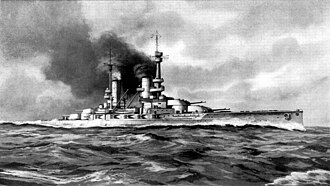
SMS Markgraf: The König-Class Battleship of Imperial Germany
The SMS Markgraf was one of the most powerful battleships operated by the Imperial German Navy during the First World War. A member of the four-ship König class, she combined a heavy main battery of ten 30.5 cm guns with substantial armor protection, a top speed of around 21 knots, and a carefully designed layout intended to maximize her effectiveness in fleet combat. Markgraf entered service in October 1914, only a few months after the outbreak of the First World War, and spent most of her operational career with the German High Seas Fleet. She participated in the great naval confrontation at the Battle of Jutland in 1916, fought in operations in the North Sea and Baltic, and survived the war before being interned at Scapa Flow. There, on 21 June 1919, she was deliberately scuttled by her German crew along with much of the surviving German battle fleet.
Although Markgraf never became as famous as some individual battleships of the First World War, her career provides an excellent illustration of the strengths, limitations, and ultimate fate of German dreadnought warfare. She was built during the intense Anglo-German naval arms race, designed to fight in the heavily contested waters of the North Sea, and repeatedly exposed to the dangers of heavy-caliber gunfire, torpedoes, mines, and close-range fleet actions. Her story also connects naval history with the political collapse of Imperial Germany, because the ship’s final voyage to Scapa Flow occurred in the aftermath of Germany’s defeat and the revolutionary events of 1918.
The Construction of SMS Markgraf
A Product of the German Naval Arms Race
Markgraf was the third battleship of the König class and was ordered as part of Germany’s continuing effort to strengthen the High Seas Fleet. Her construction was entrusted to AG Weser in Bremen, where her keel was laid down in November 1911. She was launched on 4 June 1913 and commissioned into the Imperial German Navy on 1 October 1914. This meant that Markgraf entered service just two months after the outbreak of the First World War, making her one of the newest German capital ships available for wartime operations. Her construction cost approximately 45 million marks.
The König class represented an important stage in the development of German dreadnought battleships. The designers retained the general philosophy of earlier German battleships—particularly their emphasis on armor, underwater protection, and survivability—but introduced a particularly effective arrangement for the main guns. Markgraf carried all ten of her 30.5 cm weapons along the centerline of the hull, distributed among five twin turrets. Two turrets were positioned forward, two aft, and one was located amidships between the funnels. This arrangement allowed the ship to bring a very large proportion of her main battery to bear on either side, avoiding the limitations associated with wing-mounted turrets.
Design and Dimensions
Markgraf was 175.4 meters long and 29.5 meters wide, with a normal displacement of approximately 25,796 tonnes and a full-load displacement of about 28,600 tonnes. Her substantial beam contributed to stability and provided the internal volume necessary for machinery, ammunition, fuel, crew accommodations, and extensive armor protection. The ship’s draft was approximately 9.19 meters. Her crew normally numbered around 1,136 officers and sailors, although the complement could vary depending on operational requirements and whether a ship was serving in a flagship role.
The battleship was powered by three steam turbines driving three propeller shafts. Steam was produced by a mixed group of twelve coal-fired and three oil-fired marine boilers. Different historical references give somewhat different figures for the exact machinery output, but the ship was capable of approximately 21 knots, which placed her among the faster capital ships of her generation. Her intended cruising endurance was roughly 8,000 nautical miles at a moderate speed, giving the High Seas Fleet considerable operational flexibility within the North Sea and adjacent waters.
The Armament of Markgraf
Ten Powerful 30.5 cm Guns
The centerpiece of Markgraf’s offensive power was her battery of ten 30.5 cm SK L/50 guns. These weapons were mounted in five twin turrets and formed the principal means by which the battleship would engage enemy capital ships. The turrets were arranged in a distinctive configuration: two superfiring turrets were placed forward, two were positioned aft, and a fifth turret occupied the center of the ship. This was a major design advantage because it allowed the battleship to concentrate a powerful broadside without sacrificing the ability to fire substantial numbers of guns toward the bow or stern.
The 30.5 cm caliber reflected the German Navy’s approach to battleship construction before the arrival of even larger weapons on some later Allied and German designs. Markgraf’s guns were not simply intended to damage an opposing ship’s superstructure; their primary purpose was to penetrate armor, disable enemy artillery and machinery, and ultimately destroy the fighting capability of another battleship. In a fleet engagement, the concentrated fire of several König-class ships could therefore represent a formidable threat to any opposing battle line.
Secondary Weapons and Torpedoes
Markgraf’s main guns were supported by fourteen 15 cm SK L/45 secondary guns, mounted in armored casemates along the sides of the hull. These weapons gave the battleship an effective defense against lighter warships and provided additional firepower in engagements where using the main battery would have been excessive or impractical. She also carried 8.8 cm guns, including weapons adapted for anti-aircraft duties as the war progressed. Five submerged 50 cm torpedo tubes provided another offensive option, although the battleship’s torpedoes were fundamentally secondary to her heavy artillery.
The precise light-gun arrangement changed during the war. This reflected a wider trend among major warships: as aircraft became an increasingly important military technology, some guns originally intended for use against small surface craft were modified or removed to provide better anti-aircraft capability. Markgraf’s wartime armament should therefore be understood as an evolving system rather than a completely fixed collection of weapons.
Heavy Armor and Survivability
Protection for a Battleship Duel
One of Markgraf’s defining characteristics was her extensive armor protection. The main belt reached approximately 350 mm at its thickest section, providing heavy protection to the ship’s most important machinery and internal spaces. The upper belt was thinner, while the armored decks were designed to protect the interior from shells striking the ship at increasingly steep angles. Her main gun turrets and forward conning tower were also protected by armor reaching approximately 300 mm in thickness.
This protection reflected the German philosophy that a battleship needed to remain capable of fighting after absorbing substantial punishment. German designers devoted considerable attention to internal subdivision and underwater protection as well as conventional side armor. Such measures were particularly important in the North Sea, where mines and torpedoes presented a constant danger.
Markgraf’s protection did not make her invulnerable, of course. No armor scheme could guarantee survival against every hit, particularly as gun ranges increased and shells became more capable of striking decks from above. Nevertheless, the combination of heavy armor, internal subdivision, and damage-control measures gave the König class a strong reputation for endurance.
Markgraf in the First World War
Service with the High Seas Fleet
After commissioning in October 1914, Markgraf became part of the German High Seas Fleet. Her service took place during a period in which Germany possessed a formidable battle fleet but faced an even larger British Royal Navy. The resulting strategic problem shaped almost every major German naval operation. The High Seas Fleet could threaten Britain’s naval forces and attempt to weaken portions of the Grand Fleet, but a direct confrontation under unfavorable circumstances could have catastrophic consequences.
Markgraf therefore spent much of her career participating in fleet sorties and exercises rather than fighting a continuous series of battles. The German strategy relied heavily on concentrated force, rapid maneuver, and the possibility of inflicting disproportionate damage on an opposing formation before disengaging.
The Battle of Jutland
Markgraf’s most important combat experience came during the Battle of Jutland, fought on 31 May and 1 June 1916. She served as the third ship in the German battle line, behind König and Grosser Kurfürst, as the High Seas Fleet confronted the British Grand Fleet. During the battle, the König-class ships were among the first German battleships to engage British battlecruisers at long range.
Markgraf herself came under heavy fire and was hit during the engagement. The battle exposed her to the intense danger faced by ships operating near the front of the German formation. At one point, damage reduced her speed, causing her to turn early during a German maneuver and forcing Grosser Kurfürst to react to the altered formation. Despite the damage, Markgraf continued fighting.
Her gunners also remained active during the night action. According to the Jutland Centenary Initiative, Markgraf engaged British light cruisers and destroyers during the later stages of the battle and hit HMS Calliope five times. She fired 254 rounds from her main battery and a further 214 rounds from her 15 cm guns during the engagement. She suffered 11 killed and 13 wounded, with additional personnel subsequently becoming prisoners.
Jutland demonstrated what the König class had been designed to accomplish: remain in action while subjected to intense enemy fire and deliver powerful gunfire in return. At the same time, the battle revealed the limitations of battleship warfare. Even when neither side achieved the decisive fleet annihilation that naval strategists had imagined, the ships and their crews could suffer substantial losses and damage.
Later Wartime Service
Operations Beyond Jutland
Markgraf continued to serve after Jutland, participating in additional fleet operations. Like other major German battleships, she was also involved in the Baltic campaign of 1917, when German forces launched Operation Albion against Russian positions in the Gulf of Riga. The operation demonstrated the versatility of large battleships: although designed primarily for fleet engagements, they could also provide heavy gunfire support for amphibious and coastal operations.
The König-class ships were particularly valuable because their heavy guns could bombard fortified positions while their armor provided protection against shore-based artillery and other threats. Yet these operations also demonstrated that mines and underwater hazards could be just as dangerous as enemy battleships.
The Political Collapse of 1918
By late 1918, Germany’s military and political situation had deteriorated dramatically. Markgraf was sent to Kiel in October, where unrest among sailors became part of the wider revolutionary movement that contributed to the collapse of the Imperial German government. According to the historical record maintained by Scapa Flow Wrecks, armed guards boarded the ship after unrest and arrested approximately 180 men.
This episode illustrates an important point about the final phase of Markgraf’s career. The German battleship fleet had been constructed as an instrument of imperial power, but by the autumn of 1918 that political system was rapidly disappearing. The ships that had represented Germany’s ambitions as a world naval power were soon destined to become bargaining pieces in the peace settlement.
The Scapa Flow Scuttling
Internment of the German Fleet
Following the Armistice, Markgraf was among the German warships sent for internment at Scapa Flow in the Orkney Islands. She left Germany for the last time on 18 November 1918 and joined the interned German fleet in British-controlled waters. There she remained under the terms imposed after Germany’s defeat.
The future of the ships was uncertain. Their eventual distribution among the victorious Allied powers would have meant the permanent dispersal of the German battle fleet. Rear Admiral Ludwig von Reuter, commander of the interned German squadron, ultimately decided that the ships should be scuttled rather than allowed to fall intact into Allied hands.
Markgraf Goes to the Bottom
On 21 June 1919, the German crews began scuttling their ships. Markgraf was among the battleships deliberately sunk in Scapa Flow. She went down in Gutter Sound at approximately 16:45, and two men were killed during the scuttling operation. Unlike some of the other wrecks, Markgraf settled in comparatively deep water, helping protect much of the wreck from extensive salvage operations.
The destruction of the German fleet was an extraordinary conclusion to the career of a ship that had been designed to fight for control of the sea. Markgraf had survived the First World War, including the largest battleship engagement of the conflict, only to be sunk by her own crew after the fighting was already over.
The Wreck of SMS Markgraf
A Survivor Beneath Scapa Flow
Today, Markgraf remains one of the best-known wrecks associated with Scapa Flow. Unlike several shallower wrecks that were extensively salvaged, her greater depth helped preserve significant portions of the ship. The wreck provides an unusual underwater record of German dreadnought construction and the dramatic end of the Imperial German Navy.
The surviving wreck is also a reminder of how quickly the strategic importance of battleships changed. Markgraf was commissioned in 1914 as a cutting-edge capital ship, fought in the largest fleet action of the First World War, and was obsolete as an instrument of national policy only five years later. Her wreck now belongs as much to maritime archaeology as it does to military history.
Technical Specifications of SMS Markgraf
| Specification | SMS Markgraf |
|---|---|
| Class | König-class battleship |
| Builder | AG Weser, Bremen |
| Laid down | November 1911 |
| Launched | 4 June 1913 |
| Commissioned | 1 October 1914 |
| Length | 175.4 m |
| Beam | 29.5 m |
| Draft | 9.19 m |
| Normal displacement | Approximately 25,796 tonnes |
| Full-load displacement | Approximately 28,600 tonnes |
| Propulsion | 3 steam turbines, 3 shafts |
| Boilers | 12 coal-fired and 3 oil-fired |
| Power | Approximately 41,400–43,300 shp, depending on source |
| Maximum speed | About 21 knots |
| Range | Approximately 8,000 nautical miles at cruising speed |
| Main armament | 10 × 30.5 cm SK L/50 guns |
| Main turrets | 5 × twin turrets |
| Secondary armament | 14 × 15 cm SK L/45 guns |
| Light/AA armament | 8.8 cm guns, with wartime modifications |
| Torpedo armament | 5 × 50 cm submerged torpedo tubes |
| Maximum belt armor | 350 mm |
| Turret armor | Up to 300 mm |
| Conning tower armor | Up to 300 mm |
| Casemate armor | Approximately 170 mm |
| Crew | Approximately 1,136 |
| Wartime fleet | German High Seas Fleet |
| Major battle | Battle of Jutland, 1916 |
| Final fate | Scuttled at Scapa Flow |
| Date sunk | 21 June 1919 |
| Location of wreck | Scapa Flow, Orkney Islands |
The published figures vary slightly between sources, particularly for machinery output, full-load displacement, range, and the wartime configuration of the smaller guns. The principal dimensions, main armament, armor scheme, and 21-knot speed are broadly consistent across naval-history references.
Conclusion
SMS Markgraf was a product of an extraordinary period in naval history. Conceived during the Anglo-German naval arms race and completed after the First World War had already begun, she represented the Imperial German Navy’s determination to build battleships capable of fighting the world’s most powerful fleet. Her ten 30.5 cm guns, thick armor belt, three-shaft turbine machinery, and carefully arranged centerline artillery made her a formidable member of the König class.
Her combat career at Jutland demonstrated the qualities for which German battleships became renowned: powerful armament, strong protection, and an ability to remain operational despite serious damage. Yet Markgraf’s ultimate fate illustrates the paradox of the dreadnought era. A vessel that had been built for a decisive struggle between great naval powers spent much of her career waiting for such a confrontation, survived the war’s greatest fleet battle, and then disappeared beneath the waters of Scapa Flow because Germany had lost the war.
Today, the wreck of Markgraf serves as a physical reminder of the end of Imperial Germany’s naval ambitions. More than a century after she entered service, her story remains compelling not only because of her guns and armor, but because she embodies the extraordinary transformation of naval warfare between 1911 and 1919. SMS Markgraf began her career as one of Germany’s newest symbols of maritime power and ended it as one of the submerged remnants of a vanished empire.
