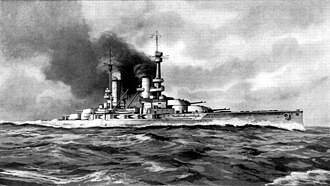
SMS Grosser Kurfürst (1913): The König-Class Battleship of Imperial Germany
The SMS Grosser Kurfürst was one of the most powerful battleships of the Imperial German Navy during the First World War and a prominent member of the four-ship König class. Launched in Hamburg on 5 May 1913 and commissioned shortly before the outbreak of the First World War, she represented the culmination of Germany’s pre-war battleship development in several important respects. Her combination of heavy armor, a powerful main battery, relatively high speed, and carefully arranged turrets made her a formidable opponent in the North Sea. Yet her career also illustrates the difficult reality of dreadnought warfare: despite being built to survive heavy gunfire, Grosser Kurfürst endured repeated damage from mines, torpedoes, collisions, and enemy shells before ultimately being scuttled by her own crew at Scapa Flow in 1919.
Origins and Construction of Grosser Kurfürst
A Battleship Born from the Naval Arms Race
The construction of Grosser Kurfürst took place during the intense Anglo-German naval competition that preceded the First World War. Germany was developing increasingly capable dreadnoughts in response to Britain’s expanding battle fleet, and the König class was intended to improve upon the preceding Kaiser-class battleships. One of the most significant features of the new design was the arrangement of its main artillery. Instead of placing a large portion of the main battery in wing turrets, the König-class ships carried all ten of their 30.5 cm guns along the centerline. This arrangement allowed a greater proportion of the main battery to fire to either broadside while making more efficient use of the ship’s limited displacement.
Grosser Kurfürst was constructed by AG Vulcan in Hamburg, with her keel laid down in October 1911. She was launched on 5 May 1913, but the rapidly changing political situation in Europe meant that her entry into service occurred at a moment of extraordinary tension. She was formally commissioned into the Imperial German Navy on 30 July 1914, only days before Britain and Germany went to war. Her name, meaning “Great Elector,” referred to Frederick William, Elector of Brandenburg and Duke of Prussia, who ruled from 1640 to 1688 and became an important figure in the development of Brandenburg-Prussia.
A Sophisticated Dreadnought Design
The König class was essentially an evolutionary design rather than a revolutionary one, but it incorporated lessons learned from earlier German battleships. Grosser Kurfürst measured 175.4 meters in length and 29.5 meters across the beam, giving her a substantial but relatively compact hull by dreadnought standards. Her normal displacement was approximately 25,796 metric tons, rising to around 28,600 tons at full load. Her substantial beam provided stability for the heavy artillery and armor while also allowing the ship to operate in the relatively confined waters of the North Sea.
The original design also contemplated the use of a diesel engine on the center shaft to improve cruising efficiency. Diesel technology, however, was not sufficiently mature for the intended application, and the König class ultimately received a conventional all-steam propulsion system. Three steam turbines drove three propeller shafts, with steam supplied by twelve coal-fired and three oil-fired water-tube boilers. The machinery generated roughly 45,570 shaft horsepower, enough to propel the battleship to approximately 21 knots. At a cruising speed of 12 knots, her theoretical range was about 8,000 nautical miles.
Armament: A Powerful Main Battery
Ten 30.5 cm Guns
The most visually distinctive feature of Grosser Kurfürst was her main battery of ten 30.5 cm (12-inch) SK L/50 guns. These were mounted in five twin turrets, with two superfiring turrets forward, two superfiring turrets aft, and a single twin turret positioned amidships between the funnels. This centerline arrangement was an important advantage because it enabled the ship to concentrate a large proportion of her heavy artillery on either broadside without relying on vulnerable wing turrets.
For a battleship of the early 1910s, the 30.5 cm gun was a formidable weapon. Its effectiveness depended not merely on caliber but also on shell weight, muzzle velocity, range, fire-control methods, and the ability of the German crew to maintain accurate fire under combat conditions. Grosser Kurfürst therefore possessed the kind of main battery necessary to fight enemy dreadnoughts on roughly equal terms.
Secondary Guns and Torpedoes
The battleship’s secondary battery consisted primarily of fourteen 15 cm SK L/45 guns, mounted individually in armored casemates. These weapons were intended to engage smaller warships, including cruisers and destroyers, while also providing additional firepower against larger targets at shorter ranges. She was additionally equipped with 8.8 cm guns, with the precise configuration changing during her service as the requirements of the war evolved. Five 50 cm underwater torpedo tubes provided another layer of offensive capability.
This mixture of weapons reflected the philosophy of pre-war battleship design. A dreadnought was expected to fight enemy capital ships with its main battery, repel torpedo craft with rapid-firing secondary weapons, and retain torpedoes for opportunities where a close-range attack might prove decisive.
Armor Protection
Built to Absorb Punishment
German battleships of the period were renowned for their heavy protection, and Grosser Kurfürst was no exception. Her main armored belt reached approximately 350 mm in its thickest central section, where it protected the machinery spaces and ammunition magazines. Toward the ends of the ship the belt became thinner, reflecting the principle that the most vital portions of the hull deserved the greatest protection. Her armored deck provided additional defense against plunging shells, while the main gun turrets and forward conning tower were also heavily armored.
The armor scheme was part of a broader German approach that emphasized survivability. Grosser Kurfürst was not designed simply to deliver a large volume of gunfire; she was expected to remain operational while under attack. The combination of thick side armor, protected magazines, armored gun turrets, and subdivision made the König class particularly well suited to the demanding conditions of North Sea combat.
Grosser Kurfürst in the First World War
Early Operations
After entering service in 1914, Grosser Kurfürst became part of the German High Seas Fleet. She participated in fleet movements and operations in the North Sea during the opening stages of the war, although the German fleet’s major challenge was not simply to destroy British battleships but to do so without exposing itself to overwhelming British numerical superiority. Consequently, many German fleet sorties were conducted with carefully defined objectives and often ended without a decisive fleet engagement.
The battleship’s career changed dramatically in 1916 when the German fleet adopted a more aggressive operational posture under Admiral Reinhard Scheer. This culminated in the Battle of Jutland, known in Germany as the Skagerrakschlacht, on 31 May and 1 June 1916.
The Battle of Jutland
Grosser Kurfürst was heavily involved in the Battle of Jutland as part of the German battle fleet’s leading formation. Her position near the front of the German line exposed her to some of the heaviest British gunfire. During the battle she was struck by eight heavy-caliber shells, suffering significant damage and losing 15 men, while another 10 were wounded. Despite this punishment, the battleship survived and ultimately returned to German waters. She later underwent repairs at AG Vulcan’s facilities in Hamburg.
Her experience at Jutland demonstrated both the strengths and weaknesses of the König-class design. Grosser Kurfürst could withstand repeated hits from large-caliber guns, but armor could not eliminate the human and mechanical costs of a major naval engagement. Damage to hull structure and internal systems could reduce speed and fighting efficiency even when a ship remained afloat. The battle also showed why German commanders valued the durability of their capital ships: survival was often essential to ensuring that the fleet could disengage from a numerically stronger opponent.
Mines, Torpedoes and Collisions
Jutland was far from the only time Grosser Kurfürst was damaged. In November 1916 she was struck by a torpedo from the British submarine HMS J1 while operating west of Heligoland. Despite suffering damage and flooding, she was able to remain with the squadron before undergoing repairs. In March 1917, she collided with her sister ship SMS Kronprinz during an exercise, damaging her bow and requiring additional repair work.
Later in the war she participated in Operation Albion, the German amphibious and naval operation against Russian positions in the Baltic in October 1917. During this operation Grosser Kurfürst struck a mine while maneuvering near Tagga Bay. The ship suffered flooding but was able to continue supporting the operation before being detached for repairs. The incident was another reminder that mines and underwater weapons represented a danger that even extremely thick armor could not completely defeat.
The Final Chapter at Scapa Flow
Internment After the Armistice
Germany’s defeat in November 1918 brought an abrupt end to the operational career of Grosser Kurfürst. As part of the terms surrounding the armistice, the principal ships of the German High Seas Fleet were interned. Grosser Kurfürst surrendered with the fleet and was transferred to Scapa Flow in the Orkney Islands, where the German ships remained under internment. Royal Museums Greenwich records that she reached the Firth of Forth as part of the surrender in November 1918 and was subsequently moved to Scapa Flow on 26 November.
The ships’ fate remained uncertain for months. German commanders feared that the interned fleet might eventually be divided among the victorious Allied powers. On 21 June 1919, Rear Admiral Ludwig von Reuter ordered the German ships at Scapa Flow to be scuttled. Grosser Kurfürst was therefore deliberately sunk by her own crew rather than handed over intact. The event became one of the most remarkable acts of naval self-destruction in history, sending much of the former German battle fleet to the bottom.
Salvage and Legacy
Grosser Kurfürst did not remain on the seabed permanently. Her wreck was raised on 29 April 1938 and subsequently sold for scrap. Unlike some of the German battleships that remain underwater at Scapa Flow today, Grosser Kurfürst was therefore largely dismantled, removing much of the physical evidence of her wartime career.
Her legacy, however, survives in naval history. Grosser Kurfürst represents the maturity of German dreadnought construction immediately before the First World War: heavily armored, heavily armed, fast enough to operate with the main fleet, and engineered around the demands of fighting in the North Sea. Her story is also a reminder that battleship history is about much more than specifications. A vessel could carry hundreds of millimeters of armor and ten enormous guns and still be threatened by a mine, a torpedo, an accidental collision, or the political consequences of a lost war.
Technical Specifications of SMS Grosser Kurfürst
The following figures summarize the principal characteristics of the ship. Sources differ slightly on details such as machinery output, crew strength, and the precise number and configuration of 8.8 cm weapons, partly because the ship’s equipment changed during the war.
| Specification | SMS Grosser Kurfürst |
|---|---|
| Ship type | König-class dreadnought battleship |
| Builder | AG Vulcan, Hamburg |
| Keel laid | October 1911 |
| Launched | 5 May 1913 |
| Commissioned | 30 July 1914 |
| Length | 175.4 m |
| Beam | 29.5 m |
| Draft | 9.19 m |
| Normal displacement | 25,796 t |
| Full-load displacement | About 28,600 t |
| Propulsion | 3 steam turbines, 3 shafts |
| Boilers | 12 coal-fired + 3 oil-fired water-tube boilers |
| Power | About 45,570 shp / 33,980 kW |
| Maximum speed | About 21 knots |
| Range | About 8,000 nautical miles at 12 knots |
| Main armament | 10 × 30.5 cm guns in 5 twin turrets |
| Secondary armament | 14 × 15 cm guns |
| Light/anti-torpedo armament | 8.8 cm guns, configuration modified during service |
| Torpedoes | 5 × 50 cm underwater torpedo tubes |
| Maximum belt armor | 350 mm |
| Turret armor | Up to 300 mm |
| Conning tower armor | Up to 300 mm |
| Crew | Approximately 1,100–1,200 personnel |
| Final fate | Scuttled at Scapa Flow, 21 June 1919 |
| Raised | 29 April 1938 |
| Final disposition | Scrapped at Rosyth |
Conclusion
SMS Grosser Kurfürst occupies an important place in the history of German naval power during the First World War. She entered service at the precise moment when Europe was sliding into conflict and spent the next several years operating with the High Seas Fleet in a war dominated by the threat of a decisive Anglo-German fleet battle. At Jutland she endured eight heavy-caliber hits and survived; elsewhere she suffered torpedo damage, a collision, and mine damage. Her survival record was therefore a powerful demonstration of the durability built into German dreadnought construction.
Yet her ultimate fate was determined not by enemy gunfire but by Germany’s defeat. Interned at Scapa Flow after the war, Grosser Kurfürst was scuttled by her own crew on 21 June 1919, ending a career that had lasted less than five years. Her subsequent salvage in 1938 brought the physical ship to an end, but her story remains a useful window into the technology, strategy, and human cost of the dreadnought era. Grosser Kurfürst was built to fight for command of the sea; instead, she became one of the many symbols of how the First World War transformed the battleship from the ultimate expression of national power into an artifact of a rapidly changing age of naval warfare.
