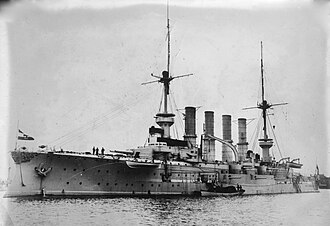
The SMS Roon was an armored cruiser of the Imperial German Navy, commissioned in 1906 during a period of extraordinary transformation in naval engineering, international diplomacy, and military strategy. Named after the Prussian field marshal Albrecht von Roon, the ship represented Germany’s determination to develop a fleet capable of operating effectively in European waters while also supporting the country’s wider maritime ambitions. Measuring approximately 127.8 meters in length and displacing more than 10,000 metric tons at full load, Roon combined heavy artillery, a protective armored belt, and a triple-screw steam propulsion system designed to give her a useful balance of firepower, endurance, and speed. Her four distinctive funnels made her recognizable among the large cruisers of her generation, while her principal battery of four 21-centimeter guns gave her substantial striking power against other cruisers. Yet Roon entered service at a moment when the future of naval warfare was already beginning to move beyond the design philosophy that had produced her. The development of the all-big-gun battleship, the emergence of fast battlecruisers, and the growing importance of submarines, mines, and aircraft would gradually alter the missions expected of surface warships. Roon nevertheless remained an important part of Germany’s fleet during the years leading up to the First World War, serving with reconnaissance formations and taking part in major fleet activities before returning to wartime service in 1914. Unlike her sister ship SMS Yorck, which was lost to German mines in November of that year, Roon survived the war’s opening period, served in Baltic operations, and was eventually withdrawn from front-line duty. Her subsequent use as a stationary accommodation vessel and the abandonment of plans to convert her into a seaplane carrier illustrate how rapidly a once-modern cruiser could move from the center of naval planning to a supporting role.
The Origins of the Roon Class
German Naval Expansion at the Beginning of the Twentieth Century
The construction of Roon formed part of Germany’s broader effort to strengthen its navy during the reign of Kaiser Wilhelm II. In the decades following German unification in 1871, the country developed into a major industrial and economic power, and its political leadership increasingly viewed a capable navy as essential to protecting trade, safeguarding overseas interests, and securing international influence. The naval expansion program associated with Grand Admiral Alfred von Tirpitz sought to create a fleet that could challenge established maritime powers, particularly Great Britain, and force potential opponents to consider the costs of a naval confrontation. Battleships were central to this strategy, but cruisers were equally important because they could carry out missions that did not always require the concentrated firepower of the battle fleet. They could scout ahead of battleships, screen larger formations, patrol sea lanes, pursue enemy cruisers, and provide a visible German presence in distant waters. The armored cruiser was especially attractive because it offered more protection than a conventional protected cruiser while retaining the speed and operational flexibility needed for reconnaissance and independent missions. In theory, this combination allowed one vessel to perform several different functions, reducing the need for a navy to maintain a separate class of ship for every possible task. In practice, however, the armored cruiser remained a compromise: adding armor and heavy guns increased displacement and cost, while the desire for speed placed pressure on the weight available for protection. Roon was the product of this balance between strategic ambition, industrial capability, and the practical limits of early twentieth-century naval architecture.
The Development of a New Armored Cruiser
The Roon class consisted of two ships, SMS Roon and SMS Yorck, and represented an incremental development of the earlier Prinz Adalbert-class armored cruisers. The new design retained the general arrangement of heavy main guns, medium-caliber secondary artillery, and belt armor, but incorporated changes intended to improve propulsion and overall performance. One of the easiest visual differences was the addition of a fourth funnel, reflecting the larger boiler installation required by the revised machinery arrangement. The designers sought to increase speed without abandoning the protective and offensive qualities expected of a major armored cruiser, although the final ships did not achieve every ambitious target originally associated with their design. Roon reached approximately 21.1 knots during trials, a respectable performance for a large coal-fired warship of the period, but not enough to keep her competitive with the fastest later battlecruisers. Her four 21-centimeter guns and ten 15-centimeter guns gave her a formidable battery for fighting ships of comparable size, while lighter guns and torpedo tubes provided additional tactical options. The armor arrangement protected the central portions of the vessel and the main gun positions, but the ship was not intended to absorb unlimited punishment from battleship-caliber artillery. As a result, Roon was best understood as a large, versatile cruiser suited to reconnaissance, patrol, and supporting combat duties rather than as a substitute for a modern battleship. Her design illustrates a recurring feature of naval development: improvements often made a ship more capable than its immediate predecessors without protecting it from the next major technological leap.
Construction and Commissioning of SMS Roon
Built at the Imperial Shipyard in Kiel
Roon was constructed at the Kaiserliche Werft, the Imperial Shipyard in Kiel, an important center of German naval construction on the Baltic coast. Her keel was laid on 1 August 1902, and she was launched on 27 June 1903. Launching marked the transition from building the hull to the extensive work required to turn it into an operational warship, including the installation of machinery, boilers, armor, gun mountings, communications equipment, internal fittings, and the many systems that supported the crew. Roon was commissioned on 5 April 1906, after a period of fitting out and trials. Building a warship of this complexity required the coordination of naval architects, engineers, armor manufacturers, weapons specialists, and hundreds of industrial workers, all contributing to a vessel whose systems had to operate together reliably under difficult conditions. The engines had to deliver power consistently, the boilers had to produce steam at the required pressure, and the gun crews had to be able to load, aim, and fire their weapons while the ship moved through the sea. Internal compartments, pumps, valves, and drainage systems also needed to function as intended, since the survival of a damaged vessel could depend on the ability to control flooding and maintain watertight integrity. Commissioning was therefore not merely a ceremonial event but the point at which the ship formally entered naval service and began the process of becoming a trained, coordinated fighting unit.
The Significance of the Name Roon
The ship was named after Albrecht von Roon, a Prussian general and statesman who played a major role in the military reforms that helped transform Prussia into the dominant power in the unification of Germany. His name was appropriate for a vessel belonging to a navy that sought to connect modern industrial technology with the traditions of Prussian military strength and national service. German warship names often drew upon monarchs, military commanders, regions, and historical figures, giving the growing fleet a symbolic identity as well as a practical one. But a warship’s history was shaped by much more than the individual whose name it carried. Roon was a complex working environment inhabited by hundreds of sailors and officers whose duties ranged from navigation and gunnery to boiler operation, ammunition handling, cooking, cleaning, maintenance, and communications. The ship’s engineering spaces could be hot, smoky, noisy, and physically demanding, particularly when the boilers were being worked hard to sustain high speed. The upper decks required constant attention to signaling equipment, rigging, guns, and lookout duties, while officers were responsible for translating orders into coordinated action under changing conditions. These routine demands rarely dominate accounts of naval strategy, but they formed the foundation of the vessel’s operational effectiveness. When Roon went to sea with the German fleet, she carried not simply a collection of weapons and machinery but an organized community expected to respond quickly and efficiently if a peaceful exercise became a real battle.
Hull Design, Dimensions, and Armor Protection
A Large and Distinctive Armored Cruiser
Roon measured approximately 127.8 meters overall, with a beam of about 20.2 meters and a deep-load draft of approximately 7.76 meters. Her normal displacement was around 9,533 metric tons, increasing to approximately 10,266 metric tons when fully loaded, depending on the source and the conditions used for the measurement. These dimensions provided the space needed for three main gun turrets or gun positions in the ship’s overall battery arrangement, a substantial secondary armament, boilers, engines, coal bunkers, ammunition magazines, accommodation spaces, and protective structure. Her long steel hull was built around a system of internal frames and watertight compartments, while a double bottom extended across a substantial portion of the vessel to provide additional structural strength and some protection against flooding. The four funnels were a prominent feature of the ship’s silhouette, rising above the machinery spaces and marking the arrangement of her boiler exhausts. Her masts and superstructure provided positions for observation and signaling, essential tasks in a fleet whose commanders relied heavily on visual information and flag or wireless communication. The ship’s overall form reflected the competing demands of early twentieth-century naval architecture: enough beam for stability and machinery, enough length for efficient movement through the water, and enough internal volume to carry the weight of guns and armor without making the vessel unacceptably slow. Roon’s dimensions made her a substantial presence in the fleet, although size alone could not determine her tactical value. Her performance depended on how efficiently her hull, propulsion, protection, weapons, and crew worked together.
The Armor Scheme and Its Limitations
Roon’s protection relied on Krupp cemented armor, a hardened steel material used on many advanced warships of the period. Her main armored belt was approximately 100 millimeters thick amidships, where the propulsion machinery and other vital spaces required protection, thinning to about 80 millimeters in parts of the central section toward the ends. The belt was backed by a layer of teak intended to support the armor and help absorb some of the effects of impact. The protective deck varied in thickness, with flat portions generally around 40 millimeters and thicker or sloped sections reaching approximately 50–60 millimeters in some locations. The main gun turrets had armor up to about 150 millimeters thick, while the forward conning tower was similarly protected by approximately 150-millimeter side armor. Secondary gun positions also received protection, with armor around 100 millimeters in important areas. This arrangement reflected the accepted logic of armored-cruiser design: protect the waterline and vital spaces against the guns likely to be encountered in cruiser combat, while limiting total weight so the ship could still attain useful speed. It was not, however, a guarantee of survival against every opponent. Armor effectiveness depended on shell caliber, impact angle, range, and the location of a hit, while damage below the waterline could threaten the ship through flooding rather than through the penetration of a gun turret or armored belt. The appearance of more powerful battleships and battlecruisers made the limits of the protection increasingly clear, because guns designed to defeat heavy armor could inflict damage beyond what the cruiser was intended to withstand. Roon was a capable armored cruiser for her era, but her protective scheme belonged to a transitional generation of warships whose advantages were gradually being overtaken by newer designs.
Propulsion, Speed, and Operational Range
Three Steam Engines and Sixteen Boilers
Roon was powered by three vertical triple-expansion steam engines, each connected to its own screw propeller. The engines received steam from sixteen coal-fired Dürr water-tube boilers, which were arranged to provide the pressure and volume required for propulsion. The triple-expansion system used successive stages to extract energy from steam, representing a well-established technology that had powered many large warships before steam turbines became more common in newer vessels. The machinery was designed to produce approximately 19,000 horsepower, and the ship reached about 21.1 knots during trials. This was a meaningful speed for a large armored cruiser, particularly when the vessel needed to scout ahead of a fleet, reposition during exercises, or pursue an enemy cruiser. Nevertheless, the ship’s performance at sea depended on more than the nominal power output of her engines. Boiler condition, hull fouling, weather, sea state, maintenance quality, and the amount of coal aboard could all affect the speed she could sustain. The machinery also required a large workforce: stokers moved coal into the furnaces, engineers monitored steam pressure and mechanical systems, and maintenance teams kept pumps, valves, bearings, and auxiliary equipment in working order. In combat, a breakdown or a loss of speed could place the vessel at a serious disadvantage, particularly if she was operating with faster battlecruisers or attempting to withdraw from a dangerous position. Roon’s propulsion system gave her the mobility expected of an armored cruiser, but it also tied her operational effectiveness to the demanding realities of coal-fired steam engineering.
Endurance and the Demands of Coal-Fired Operations
Roon could carry approximately 1,570 metric tons of coal and a supplementary quantity of oil used for fuel-related purposes, although reported figures vary by source. Her range is commonly given as approximately 4,200 nautical miles at 12 knots, providing the endurance required for patrols and extended movements between ports. Such a figure should be understood as a planning estimate rather than a fixed promise, because actual range changed with speed, weather, machinery condition, and the needs of the mission. Increasing speed sharply increased fuel consumption, while prolonged operation in rough seas or repeated maneuvering could impose additional demands on the engines and boilers. Refueling was itself a major logistical undertaking. Large quantities of coal had to be transferred from colliers or shore facilities into the ship’s bunkers, often requiring sustained manual labor and producing dust throughout the working areas. The fuel also occupied valuable internal space that might otherwise have been used for stores or other equipment. For a naval commander, endurance meant more than simply knowing how many nautical miles the ship could travel: it meant considering where friendly bases were located, whether suitable refueling facilities would be available, how long a patrol might last, and what reserve would be needed if the situation changed unexpectedly. These practical considerations helped determine whether a cruiser could remain with a formation or would need to return to port. Roon’s range made her useful for North Sea and Baltic operations, but the ship remained dependent on a larger logistical system that supplied coal, ammunition, replacement parts, food, and trained personnel.
Armament: Heavy Guns, Secondary Batteries, and Torpedoes
The Main Battery of Four 21-Centimeter Guns
Roon’s principal armament consisted of four 21-centimeter SK L/40 naval guns mounted in two twin turrets, one forward and one aft. This arrangement gave the cruiser a heavy-gun capability suitable for engagements with other armored cruisers and a range of targets that could not be handled as effectively by lighter artillery. The designation L/40 referred to the gun barrel’s length relative to its bore diameter: the barrel was forty calibers long. The guns fired heavy shells capable of damaging enemy hulls, penetrating armor under favorable conditions, and destroying important installations such as command positions, gun mountings, and exposed machinery. Their combat value depended on the quality of the ship’s rangefinding, the skill of the gun crews, the speed of ammunition handling, and the ability of observers to identify where shells landed. Before radar became available for naval fire control, crews relied on optical instruments and visual observation, making visibility, smoke, haze, and sea conditions important influences on gunnery. The gun turrets also required reliable mechanisms for training and elevation, while ammunition had to be moved from magazines through protected handling systems to the guns. In a prolonged engagement, the ability to maintain an accurate and sustainable rate of fire could matter as much as the nominal caliber of the weapon. Roon’s main battery made her a serious opponent for many cruisers of her generation, although it did not offer the overwhelming firepower that would characterize the newest dreadnought battleships.
Secondary Guns and Defense Against Smaller Vessels
The main battery was supported by ten 15-centimeter SK L/40 guns, providing a medium-caliber armament suited to engaging enemy cruisers and maintaining a faster volume of fire than the heavier weapons. These guns were distributed along the ship in individual positions, with the arrangement allowing multiple weapons to engage a target depending on its bearing. Roon also carried fourteen 8.8-centimeter guns, intended primarily to defend against smaller and more agile threats such as torpedo boats. Such craft were potentially dangerous because they could approach quickly and attempt to launch torpedoes against a larger ship before its heavy guns could respond effectively. The lighter battery therefore served an important defensive role, even though it lacked the destructive power of the main artillery. The ship additionally carried four 45-centimeter torpedo tubes, giving her the ability to attack enemy vessels with self-propelled underwater weapons. Torpedoes could be particularly dangerous at close range, where a hit near the waterline might cause severe flooding and threaten the target’s stability. Their use required careful positioning, however, and they were not a substitute for the cruiser’s guns in every engagement. The combination of heavy guns, secondary artillery, lighter defensive weapons, and torpedoes gave Roon a broad range of tactical options for the naval warfare of her time. But the very diversity of her armament also illustrates the complexity of operating a major warship: each weapon required its own ammunition, trained personnel, maintenance, and procedures, while the ship’s commander had to decide how best to use them in a rapidly changing tactical situation.
Peacetime Service and Fleet Training
Joining the German Scouting Forces
After entering service in April 1906, Roon joined the active fleet and served with the reconnaissance forces associated with the High Seas Fleet. These units were responsible for gathering information about opposing fleets, screening larger warships, and helping commanders understand the position and movements of potential enemies. Cruisers were well suited to this work because they combined useful speed with enough armament and protection to survive encounters with smaller vessels. Roon participated in fleet exercises, training cruises, and maneuvers that tested the ability of ships to operate together under simulated wartime conditions. These activities included formation keeping, signaling, navigation, gunnery practice, and the coordination of scouting groups with heavier elements of the fleet. The work could be demanding because a reconnaissance vessel often had to balance two competing requirements: moving far enough ahead to gather information while remaining close enough to friendly forces to receive support if it encountered an enemy. A cruiser that reported too little information could leave the main fleet poorly prepared, while one that advanced too aggressively might be isolated and destroyed. The effectiveness of reconnaissance also depended on the speed and clarity of communications, as information was useful only if it reached commanders in time to influence their decisions. Roon’s service in these formations helped integrate her into the larger naval system and gave her crew experience in the operational routines that would become more important when Germany entered the First World War.
Fleet Exercises and International Tensions
German fleet training took place against a background of growing international rivalry, particularly the naval competition between Germany and Great Britain. Exercises were designed to prepare the fleet for coordinated action, but they also reflected wider debates about the best way to employ battleships, cruisers, destroyers, and other vessels in a major war. Roon’s role as an armored cruiser required her to be prepared for several possible tasks, from scouting and screening to supporting combat operations against enemy cruisers. Fleet maneuvers gave commanders an opportunity to test communications procedures, practice tactical formations, and evaluate the readiness of engines, weapons, and crews. They also exposed the practical challenges of managing a large force at sea, where weather, visibility, mechanical reliability, and the behavior of individual ships could disrupt carefully prepared plans. As newer dreadnought battleships and battlecruisers entered service, the relative position of older armored cruisers became less secure. The new capital ships carried heavier guns and increasingly powerful machinery, raising questions about whether armored cruisers could safely operate near the main battle line. Roon remained useful, but her future increasingly depended on finding missions where her speed, endurance, and versatile armament could be employed without placing her at an unacceptable disadvantage against the newest enemy ships. This tension between continuing usefulness and growing obsolescence would become one of the defining features of her wartime service.
SMS Roon in the First World War
The Return to Active Service in 1914
When the First World War began in August 1914, Roon was recalled to active service after her earlier period in reserve and decommissioned status. The war changed the priorities of the Imperial German Navy almost overnight. Fleet exercises and peacetime cruises gave way to reconnaissance, coastal defense, offensive sorties, and operations intended to weaken the Royal Navy’s strategic position. Roon served alongside the more powerful German battlecruisers in the I Scouting Group, where her experience and heavy cruiser armament could contribute to operations against British naval forces. The opening months of the war were marked by uncertainty and caution, as both sides attempted to gather intelligence while avoiding engagements under unfavorable conditions. German commanders hoped to use mines, submarines, torpedo craft, and carefully planned raids to complicate British operations and reduce the numerical disadvantage facing the High Seas Fleet. In this environment, cruisers such as Roon could support larger formations, patrol threatened waters, and help search for enemy vessels. Their role was nevertheless hazardous: reconnaissance ships might encounter a superior opponent, while operations close to hostile coasts exposed them to mines, submarines, and coastal defenses. The loss of Roon’s sister ship Yorck in November 1914, when she struck German mines while returning from an operation, provided a stark example of the dangers facing even friendly warships navigating waters they believed they understood.
The Raid on the English Coast
In November 1914, Roon took part in German naval operations associated with the raid on the English coast, during which German forces attacked the British port towns of Great Yarmouth and Lowestoft’s wider coastal region was not the focus of this particular early raid; the principal targets on 3–4 November were around Great Yarmouth. The operation was intended to create uncertainty, damage coastal infrastructure, and draw British naval forces into a situation where German scouting units might be able to observe or engage them. Roon operated as part of the supporting German cruiser forces during this period, while the battlecruisers carried the main responsibility for the bombardment. The mission reflected the German navy’s attempt to offset British numerical superiority through mobility, selective engagements, and the possibility of luring an enemy force toward a prepared tactical situation. Such raids were strategically controversial because their immediate material effects could be limited, while the risks of encountering a stronger British force were substantial. They also depended on accurate intelligence and the ability to withdraw before the enemy could concentrate superior numbers. After the operation, German ships returned toward their home waters, but the return journey proved disastrous for SMS Yorck, which entered a German minefield in poor conditions and sank with heavy loss of life. Roon survived, and the episode highlighted an important distinction in naval warfare: a ship might emerge from an enemy operation unscathed yet still face grave danger from navigation, friendly minefields, or rapidly changing weather on the voyage home.
Operations in the Baltic Sea
The Strategic Importance of the Baltic
During 1915, Roon was employed in Baltic operations, where Germany sought to support its land campaign and challenge Russian naval power along the eastern coast. The Baltic was a difficult theater for large warships because its geography created narrow approaches, complicated navigation, and made mine warfare particularly effective. Islands, shoals, coastal fortifications, and confined waterways could restrict the freedom of maneuver that a large cruiser enjoyed in open water. German naval forces had to balance the need to support operations against Russian positions with the risks of entering waters where the enemy could exploit mines, submarines, and local knowledge. The Baltic also offered Germany opportunities to coordinate naval action with army advances, especially in regions where ports and coastal routes had direct military importance. Roon’s size and armament made her a useful supporting vessel, but she was not invulnerable, and the strategic value of each sortie had to be weighed against the possibility of damage or loss. The cruiser could provide heavy gunfire, patrol contested waters, and strengthen a formation, yet her coal-fired engines and substantial draft imposed practical limitations on endurance and access to shallow or restricted areas. These conditions meant that naval operations required careful planning, dependable reconnaissance, and an understanding of the coastal environment. The Baltic campaign thus placed Roon in a setting where traditional cruiser capabilities remained useful but where mines and local geography could prove just as important as artillery.
The Gulf of Riga Campaign
In July and August 1915, Roon supported German naval operations connected with the offensive toward Riga and the attempt to gain a more favorable position in the Gulf of Riga. German forces sought to disrupt Russian naval activity and assist the broader campaign along the Baltic coast, but the operation encountered determined Russian resistance and difficult navigational conditions. The gulf was a challenging environment for major warships because mines and coastal defenses could restrict movement, while Russian vessels could take advantage of their familiarity with local waters. Roon’s presence contributed to German naval strength, but the campaign demonstrated that a larger force did not automatically secure control of a confined maritime area. Russian ships remained capable of contesting German movements, and German units had to account for the risk of encountering opponents whose firepower or tactical position could be unfavorable. Historical accounts describe Roon as being involved in a clash with Russian naval forces during the Baltic campaign, including an encounter in which the Russian armored cruiser Rurik posed a significant threat. Rurik was a powerful vessel armed with heavy guns, and her appearance underscored the danger of sending older armored cruisers into engagements with well-armed opponents. Roon’s participation in these operations formed part of the larger effort to support Germany’s eastern campaign, but the difficulties encountered in the Gulf of Riga also illustrated the limits of naval power when mines, geography, and enemy resistance combined to restrict freedom of action.
The Decline of the Armored Cruiser
Dreadnoughts and Battlecruisers Change the Balance
By the middle of the First World War, the armored cruiser concept was increasingly overshadowed by newer types of warship. The launch of HMS Dreadnought in 1906 had accelerated the move toward battleships carrying a uniform battery of heavy guns, while battlecruisers combined substantial firepower with high speed and a design philosophy that emphasized striking power and operational mobility. Compared with these newer vessels, Roon’s four 21-centimeter guns were no longer sufficient to compete on equal terms with the heaviest capital ships, and her armor was not designed to withstand repeated hits from their main batteries. This did not make Roon entirely obsolete: she could still perform patrol duties, support coastal operations, and serve in situations where a modern battleship or battlecruiser was unnecessary. Nevertheless, her strategic value diminished as naval planners increasingly assigned the most demanding combat missions to newer and more powerful ships. The rapid pace of naval innovation also made the construction and maintenance of older vessels less attractive when crews, fuel, ammunition, and dockyard capacity were needed elsewhere. Roon’s later career reflected this shift. Rather than remaining a central component of the front-line scouting force indefinitely, she moved toward secondary duties as the war continued. Her history therefore illustrates the difficult position of a warship that was modern when designed but entered service just as a technological revolution was reshaping the standards by which major combatants were judged.
The Abandoned Plan to Convert Roon into a Seaplane Carrier
As Roon’s front-line usefulness declined, the German Navy considered converting her into a seaplane carrier. The proposal reflected the growing recognition that aircraft could extend naval reconnaissance beyond the range of shipboard lookouts and provide information about enemy movements, coastal defenses, and harbor approaches. A converted Roon was reportedly intended to carry four seaplanes in a hangar toward the stern, supported by a revised armament that would have included fewer heavy guns and additional weapons suited to the new role. Such a conversion would have transformed the ship from a conventional armored cruiser into a platform for naval aviation, an emerging field that was still developing its equipment, operating procedures, and tactical doctrine. Aircraft could potentially help commanders locate enemy ships and improve situational awareness, but early seaplane operations presented substantial technical difficulties. Launching, recovering, storing, and maintaining aircraft aboard a warship required suitable equipment and trained personnel, while weather and sea conditions could prevent flights at critical moments. The navy also had to decide whether an older hull was worth modifying or whether aviation resources would be better assigned to other platforms and shore facilities. In Roon’s case, the conversion never took place. The vessel was disarmed and used as an accommodation ship, leaving the proposed seaplane-carrier role as an unrealized chapter in her history. The plan is nevertheless significant because it reveals how naval authorities were exploring new uses for older warships rather than assuming that every vessel had to remain in its original combat role.
Roon’s Final Years and Disposal
From Fighting Ship to Accommodation Vessel
In 1916, Roon was withdrawn from front-line service and converted to a stationary accommodation role. Her heavy armament was removed, and the ship became a floating living and support facility rather than an active combatant. Accommodation ships provided berthing and other facilities for naval personnel when shore establishments or existing bases could not easily meet demand. Although this was a less glamorous function than scouting with the High Seas Fleet, it remained part of the logistical structure required to sustain a large navy. Warships needed trained crews, shore-based support, maintenance, supplies, and places where personnel could be housed when they were not at sea. Using an older vessel for accommodation could preserve useful facilities without committing the fuel, maintenance, and personnel required to operate it as a fully armed cruiser. Roon’s transition reflected the reality that naval usefulness did not end when a ship became unsuitable for modern combat. Her hull and internal spaces still had value, even though her original purpose had been overtaken by technological change and wartime priorities. The decision also illustrates the distinction between a vessel’s symbolic identity and its practical role: the name and structure of a once-formidable armored cruiser remained, but the ship no longer occupied the same place in the operational fleet.
Scrapping and Historical Legacy
After the war, Roon was no longer required for active naval service, and she was eventually struck from the naval list on 25 November 1920. She was broken up for scrap in 1921, bringing an end to a career that had begun amid Germany’s rapid naval expansion and continued through the first years of the First World War. Her fate was less dramatic than that of her sister ship Yorck, which sank in 1914, but it was characteristic of many older warships whose military value declined as new technologies transformed naval strategy. Roon had served as a reconnaissance cruiser, participated in fleet operations, and supported the Baltic campaign before being reassigned to a stationary role. Her story captures the evolution of naval power from a period when armored cruisers represented an attractive combination of speed, protection, and firepower to a wartime environment in which aircraft, submarines, mines, and more powerful capital ships increasingly determined the possibilities of combat. The cruiser should not be judged solely by the fact that she was surpassed by newer vessels; she was designed for the requirements and technical assumptions of her own time, and she remained useful while those assumptions held. Her career instead provides a case study in how quickly the value of a warship can change when the weapons and operational methods of naval warfare evolve.
Conclusion: The Place of SMS Roon in German Naval History
SMS Roon was a representative armored cruiser of the Imperial German Navy, combining heavy artillery, belt armor, and triple-expansion steam propulsion in a hull designed to perform reconnaissance and support missions for the fleet. Built at Kiel and commissioned in 1906, she joined the German scouting forces and participated in peacetime exercises before returning to active service during the First World War. Her wartime duties included operations connected with the raid on the English coast and the German campaign in the Baltic, including the effort to challenge Russian naval forces around the Gulf of Riga. These operations revealed both the continued usefulness and the growing limitations of the armored cruiser. Roon could still contribute to patrols and supporting actions, but newer battleships and battlecruisers increasingly dominated the most demanding naval engagements. Her eventual withdrawal from front-line service, disarmament, and use as an accommodation ship demonstrated the practical adaptation of an older vessel to a navy whose priorities had changed. The proposed conversion into a seaplane carrier, although never completed, also connects Roon to the early experimentation that helped shape the future of naval aviation. Scrapped in 1921, she left no surviving hull, but her history remains valuable for understanding the German fleet’s development and the technological transition that took place around the First World War. Roon’s legacy is ultimately that of a capable transitional warship: an impressive product of its era, useful in several roles, yet increasingly constrained by the speed at which naval technology and strategy were changing.
Technical Specifications of SMS Roon
| Specification | Details |
|---|---|
| Ship name | SMS Roon |
| Country | German Empire |
| Ship type | Armored cruiser |
| Class | Roon class |
| Namesake | Albrecht von Roon, Prussian field marshal and statesman |
| Builder | Kaiserliche Werft, Kiel, Germany |
| Keel laid | 1 August 1902 |
| Launched | 27 June 1903 |
| Commissioned | 5 April 1906 |
| Withdrawn from front-line service | 1916 |
| Struck from naval list | 25 November 1920 |
| Final fate | Scrapped in 1921 |
| Length overall | 127.8 m (419 ft) |
| Length at waterline | Approximately 127.3 m |
| Beam | 20.2 m (66.3 ft) |
| Deep-load draft | Approximately 7.76 m (25.5 ft) |
| Normal displacement | Approximately 9,533 metric tons |
| Full-load displacement | Approximately 10,266 metric tons |
| Propulsion | 3 vertical triple-expansion steam engines |
| Boilers | 16 Dürr water-tube boilers |
| Shafts and propellers | 3 |
| Power output | Approximately 19,000 indicated horsepower |
| Maximum speed | Approximately 21.1 knots |
| Range | Approximately 4,200 nautical miles at 12 knots |
| Coal capacity | Approximately 1,570 metric tons |
| Additional fuel | Approximately 207 metric tons of oil, depending on source |
| Main armament | 4 × 21 cm SK L/40 guns in two twin turrets |
| Secondary armament | 10 × 15 cm SK L/40 guns |
| Light armament | 14 × 8.8 cm guns |
| Torpedo armament | 4 × 45 cm torpedo tubes |
| Main belt armor | Approximately 80–100 mm |
| Main turret armor | Up to approximately 150 mm |
| Secondary gun protection | Approximately 100 mm in protected positions |
| Deck armor | Approximately 40–60 mm, depending on location |
| Forward conning tower armor | Approximately 150 mm sides |
| Crew complement | Approximately 633, commonly listed as 35 officers and 598 enlisted men |
| Planned conversion | Seaplane carrier; proposal not carried out |
| Final wartime role | Disarmed accommodation ship |
