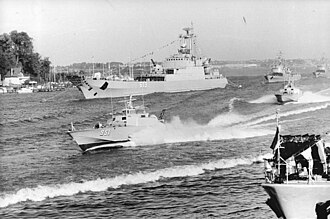
KRI Teluk Cendrawasih (533) is one of the Indonesian Navy’s amphibious landing ships, representing an important part of Indonesia’s maritime transportation and military logistics capabilities. Designed to transport troops, military vehicles, equipment, and supplies, this vessel belongs to the Frosch-class landing ship family, a group of ships originally developed and constructed in East Germany during the Cold War. Its history is particularly interesting because it connects two different naval traditions: the former East German Volksmarine and the modern Indonesian Navy (Tentara Nasional Indonesia Angkatan Laut, or TNI AL). Originally commissioned under the name Frankfurt/Oder, the ship eventually became part of Indonesia’s naval fleet following its acquisition in the 1990s. Since entering Indonesian service, it has carried the name Teluk Cendrawasih and the hull number 533, becoming one of the vessels associated with the Indonesian Navy’s amphibious warfare and fleet support capabilities.
The significance of KRI Teluk Cendrawasih goes beyond its physical dimensions or weapons systems. Indonesia is the world’s largest archipelagic country, consisting of thousands of islands spread across strategically important maritime regions. Maintaining effective transportation and military mobility between these islands requires naval vessels capable of operating across different coastal environments, including areas where conventional port infrastructure may be limited. Landing ships are particularly valuable in this context because they can transport substantial quantities of cargo and personnel while supporting amphibious operations. KRI Teluk Cendrawasih illustrates how a vessel originally built for another country’s military requirements can be incorporated into Indonesia’s maritime defense structure and continue serving a different strategic purpose.
Its background also provides an opportunity to understand the development of amphibious naval capabilities during the Cold War, the transfer of military equipment between countries after German reunification, and Indonesia’s efforts to strengthen its naval inventory during the 1990s. By examining its construction, original identity, acquisition, technical characteristics, armament, and operational role, it becomes easier to appreciate why KRI Teluk Cendrawasih remains an interesting subject for naval historians, military enthusiasts, and readers interested in the Indonesian Navy.
The Origins of KRI Teluk Cendrawasih
Construction in East Germany
Before becoming KRI Teluk Cendrawasih, the vessel was known as Frankfurt/Oder and served in the East German Volksmarine, the naval force of the former German Democratic Republic. The ship was constructed by VEB Peenewerft, a shipbuilding company located in Wolgast, East Germany, which produced various naval vessels for the country’s maritime defense requirements. Construction began with the laying of its keel on June 10, 1975, and the ship was launched on January 2, 1976. Following its completion and preparation for naval operations, Frankfurt/Oder entered service on February 2, 1977, carrying the pennant number 613.
The vessel belonged to the Project 108 family, commonly associated with the Frosch I designation in NATO naval classification. These ships were developed to provide East Germany with the ability to move military vehicles, personnel, and supplies between coastal installations and operational areas. Their design emphasized cargo transportation and amphibious landing capabilities rather than the characteristics of a conventional surface combatant. This distinction is important because landing ships have different operational priorities from frigates, destroyers, or corvettes. While major surface combatants are generally optimized for combat against enemy ships, aircraft, and submarines, amphibious vessels concentrate on delivering personnel and equipment where they are needed.
Frankfurt/Oder therefore represented a practical component of the East German naval structure. Its relatively large cargo capacity, landing-ship configuration, and ability to operate in coastal waters made it useful for military transportation and amphibious support. The ship was built during a period when naval forces throughout Europe were developing specialized capabilities to support military movements along coastlines and across the Baltic Sea. Its subsequent transfer to Indonesia would give it a second chapter of service in a very different geographical and strategic environment.
Service in the Volksmarine
During its East German service, Frankfurt/Oder operated as part of a naval organization whose responsibilities were closely connected to the country’s position on the Baltic Sea. The Volksmarine maintained a fleet consisting of patrol vessels, landing ships, mine warfare vessels, submarines, and other supporting units. Each category had a specific role within the country’s maritime defense system, and landing ships provided the logistical flexibility required to transport military resources.
The Frosch-class design was particularly suited to military transportation and amphibious operations. Rather than depending entirely on conventional port facilities, landing ships were intended to support the movement of cargo and vehicles toward coastal landing areas. This ability was relevant to the operational requirements of Warsaw Pact naval forces during the Cold War, when coastal defense and the movement of military formations were important strategic considerations.
Frankfurt/Oder remained in East German service until the political changes that transformed Europe at the end of the 1980s. German reunification in 1990 fundamentally changed the organization of the country’s armed forces, including the future of the Volksmarine. The East German navy was dissolved, and its vessels were evaluated for transfer, disposal, or other purposes. Frankfurt/Oder was removed from the naval register on October 1, 1990, and formally decommissioned on October 2 of the same year. The unified German Navy did not retain the ship as an operational vessel, leaving it available for subsequent disposal.
This transition marked the end of the ship’s original naval identity but not the end of its potential usefulness. Instead of immediately disappearing from maritime service, Frankfurt/Oder would eventually become part of a foreign naval fleet, demonstrating how military equipment can acquire a second operational life following major political changes.
Acquisition and Commissioning by Indonesia
Indonesia’s Naval Modernization in the 1990s
Indonesia’s acquisition of former East German naval vessels was part of a broader effort to strengthen its military capabilities during the early 1990s. The country faced the complex challenge of defending an extensive archipelago with maritime boundaries stretching across the Indian and Pacific Oceans. Its naval requirements included territorial surveillance, maritime transportation, amphibious support, and the ability to move military personnel and equipment between islands.
In this context, the acquisition of second-hand naval vessels offered an opportunity to expand the fleet without relying exclusively on the construction of new ships. Former East German vessels provided Indonesia with access to established ship designs that could be adapted to its operational needs. The procurement initiative was associated with the Indonesian government’s military equipment acquisition program, including Presidential Instruction No. 3 of 1992 concerning the procurement of warships for the Indonesian Armed Forces Navy.
The purchase of Frankfurt/Oder formed part of this wider procurement effort. The ship was acquired by Indonesia on August 25, 1993, and underwent preparations and refitting before entering Indonesian service. Its transfer was not simply a change of ownership; it also involved adapting a vessel originally designed for East German naval requirements to the operational environment of the Indonesian archipelago.
From Frankfurt/Oder to KRI Teluk Cendrawasih
After its acquisition, the vessel received a new identity as KRI Teluk Cendrawasih (533). The name refers to Cenderawasih Bay, a large bay located in the northern part of Papua, Indonesia. This geographical naming tradition reflects the Indonesian Navy’s practice of naming many of its vessels after important Indonesian locations, islands, bays, and geographical features.
The designation KRI stands for Kapal Republik Indonesia, meaning Ship of the Republic of Indonesia. The number 533 serves as the ship’s identifying hull or pennant number within the Indonesian naval fleet. Together, the name and number distinguish the vessel from other Indonesian warships and identify its national naval affiliation.
KRI Teluk Cendrawasih was officially commissioned into the Indonesian Navy on December 9, 1994. This date represents the beginning of its Indonesian naval service and the completion of its transition from a former East German landing ship into an Indonesian amphibious support vessel. The commissioning also reflected Indonesia’s intention to use acquired naval assets to improve the transportation and logistical capabilities of its maritime forces.
The transition was significant because the ship entered a naval environment with geographical requirements that differed considerably from those of its original operator. The Baltic Sea and the Indonesian archipelago present different climatic, geographical, and operational challenges. Consequently, the vessel’s long-term usefulness depended not only on its original construction but also on maintenance, adaptation, crew training, and integration into the Indonesian Navy’s fleet organization.
Design and Technical Characteristics
Frosch-Class Landing Ship Design
KRI Teluk Cendrawasih belongs to the Frosch-class family of amphibious landing ships, specifically the Project 108 or Frosch I design. The primary purpose of this type of vessel is to transport military cargo, vehicles, and personnel while providing the ability to support amphibious landings. Its design reflects the importance of logistical mobility in naval operations, particularly when military forces must be deployed to coastal locations without depending entirely on developed port facilities.
Unlike a conventional warship whose principal purpose is to engage hostile targets, a landing ship is fundamentally a transportation and support platform. Its operational value is measured by its ability to move useful quantities of cargo, deliver military equipment, and support the deployment of personnel. This makes it an important component of an amphibious force, even when it does not possess the sophisticated weapons and sensors found on larger combat vessels.
The Frosch I design combines a relatively long hull with a cargo-oriented arrangement and propulsion machinery suitable for sustained movement between operational areas. Its approximately 98-meter length provides the space required for its transportation mission, while its beam of approximately 11.1 meters contributes to the vessel’s overall hull proportions. The ship’s reported displacement is approximately 1,980 metric tonnes, although displacement figures should always be understood in relation to the loading condition and measurement convention used.
Dimensions and Displacement
KRI Teluk Cendrawasih has a reported overall length of approximately 98 meters, making it a substantial landing ship compared with smaller coastal transportation vessels. Its beam, or maximum width, is approximately 11.1 meters, while its reported draught is approximately 2.8 meters. These dimensions influence the vessel’s stability, cargo arrangement, maneuverability, and ability to operate in coastal waters.
The ship’s relatively shallow draught is especially relevant to its amphibious transportation role. A landing ship may need to approach coastal areas or operate in waters where the depth is more restricted than in major commercial shipping channels. Although the exact suitability of a landing area always depends on local hydrographic conditions, a relatively shallow draught can provide useful flexibility when compared with deeper-draught vessels.
Its reported displacement is approximately 1,950 long tons, equivalent to around 1,980 metric tonnes. Displacement represents the weight of the water displaced by the vessel and is commonly used to describe the size of naval ships. It is not the same measurement as cargo capacity, which refers to the weight of material the vessel can transport. Keeping these two figures separate is important when interpreting technical specifications and comparing different landing ships.
Propulsion System and Performance
The propulsion system of KRI Teluk Cendrawasih consists of two diesel engines connected to two propeller shafts. The reported installed power is approximately 5,000 horsepower, equivalent to around 3.7 megawatts. This arrangement provides the mechanical power needed to propel the ship during transportation and amphibious support missions.
Diesel propulsion is widely used in military logistics vessels because it offers a practical combination of mechanical reliability, fuel efficiency, and maintainability. The two-engine and two-shaft configuration also distributes propulsion across two systems, an arrangement that can provide operational advantages over a single-shaft installation. Nevertheless, the actual reliability and performance of an aging vessel depend heavily on the condition of its machinery, maintenance standards, spare-parts availability, and the quality of its engineering support.
The ship has a reported maximum speed of approximately 18 knots, equivalent to about 33 kilometers per hour. This speed is appropriate for a vessel whose principal mission is transporting cargo and supporting amphibious operations rather than conducting high-speed surface engagements. In military transportation, the ability to carry a useful amount of equipment and deliver it reliably is often more important than achieving the highest possible speed.
Cargo Capacity and Amphibious Transportation
Military Vehicles and Equipment
One of the most important features of KRI Teluk Cendrawasih is its capacity to transport military vehicles and heavy equipment. Published technical descriptions associate the ship with a capacity of up to 11 amphibious tanks or approximately 400 to 600 tonnes of cargo, depending on the configuration and loading conditions. These figures illustrate the vessel’s importance as a military transportation platform.
The ability to transport armored vehicles is particularly valuable for amphibious forces. Military vehicles are often too heavy or too large to be moved efficiently using smaller landing craft, especially when large quantities of equipment must be delivered within a limited period. A landing ship provides a larger transportation platform that can bring substantial military resources closer to an intended landing area.
Cargo transportation also includes equipment that may not be directly associated with combat. Engineering machinery, construction materials, vehicles, food, fuel, medical supplies, and other logistical necessities can all play important roles in sustaining military operations. The practical usefulness of a landing ship therefore extends beyond the delivery of tanks or armored vehicles.
Transportation of Marine Personnel
In addition to equipment and cargo, KRI Teluk Cendrawasih is associated with the transportation of approximately one company of marine personnel. This capability makes it suitable for supporting amphibious deployments in which troops must be moved together with the vehicles and supplies required for their mission.
The Indonesian Marine Corps, known as Korps Marinir, has responsibilities that include amphibious operations, coastal defense, and the deployment of forces in support of national defense objectives. Amphibious ships provide the transportation connection between naval forces and the land-based elements they support. Without suitable transportation platforms, even well-trained marine units may face significant difficulties moving personnel and heavy equipment between widely separated islands.
For this reason, landing ships occupy an important position within the broader amphibious force structure. They allow naval planners to coordinate the movement of personnel and equipment as part of a larger logistical operation. Their contribution is particularly relevant to an archipelagic country such as Indonesia, where maritime transportation is essential to national military mobility.
Armament and Defensive Systems
Naval Guns
Although KRI Teluk Cendrawasih is primarily an amphibious landing ship, it also has a reported collection of naval guns intended to provide a degree of onboard defensive and supporting firepower. Published descriptions of its Indonesian configuration list one single-barrel Bofors 40 mm L/60 gun, one twin-barrel V-11 37 mm L/63 gun installation, and two twin-barrel 2M-3 25 mm gun installations.
The Bofors 40 mm gun is a historically important naval weapon that has been used by many countries for decades. Its relatively large projectile provides greater destructive potential than smaller automatic cannons, although the actual effectiveness of any installation depends on its condition, fire-control equipment, ammunition, and the specific engagement circumstances.
The twin 37 mm and 25 mm installations provide additional gun armament. Weapons of these calibers have traditionally been associated with close-range defensive roles, including engagement of small surface targets and certain aerial threats. Their presence should not be interpreted as giving the vessel the same combat capability as a modern frigate or destroyer. Instead, the armament reflects the supporting and self-defensive nature of a landing ship operating within a larger naval formation.
Radar and Electronic Warfare Equipment
The ship’s reported sensor equipment includes the TSR-333 I-band navigation radar and the MR-302 Strut Curve F-band air and surface search radar. These systems are associated with the vessel’s ability to maintain navigational awareness and detect relevant activity in its surrounding maritime environment.
Navigation radar is essential for safe ship handling, particularly when operating in busy coastal waters, near islands, or in conditions where visibility is reduced. Air and surface search radar serves a different purpose by helping the crew monitor the surrounding environment for contacts that may require attention. Together, these systems contribute to the ship’s situational awareness.
Published specifications also associate the vessel with two PK-16 chaff launchers. Chaff systems are defensive countermeasure equipment designed to release clouds of radar-reflective material that can interfere with certain radar-guided threats. Their presence reflects the importance of defensive measures for naval vessels, although the effectiveness of such equipment depends on the threat environment, system condition, and the ship’s broader defensive arrangements.
It is important to distinguish between reported historical equipment and verified present-day configuration. Naval vessels can undergo modernization, equipment replacement, and changes to their armament during their operational lives. Consequently, published specifications should not automatically be treated as confirmation that every listed system remains installed and fully operational today.
Operational Role in the Indonesian Navy
Amphibious Support and Naval Logistics
KRI Teluk Cendrawasih contributes to the Indonesian Navy’s amphibious and transportation capabilities through its ability to carry personnel, military vehicles, and logistical supplies. These functions are important for a country whose geography makes maritime transportation an essential part of national defense planning.
Amphibious support is not limited to combat landings. It can also involve the movement of military personnel between naval bases, the transportation of equipment for exercises, and the delivery of supplies to locations that are difficult to reach using ordinary transportation infrastructure. A landing ship can therefore provide value during both routine naval activities and more demanding operational circumstances.
For Indonesia, this logistical function has particular importance because military units are distributed across a large number of islands. The ability to transport heavy equipment by sea helps reduce dependence on limited road networks and airport infrastructure. It also gives naval planners an additional method of moving resources when land-based transportation options are unavailable or unsuitable.
Support for Naval Exercises
Landing ships can also play important roles in amphibious exercises and joint military training. These activities allow naval personnel, marine units, and supporting organizations to practice the coordination required for moving troops and equipment from ships to shore.
Exercises are essential for maintaining operational readiness because amphibious missions require cooperation between multiple military elements. Ship crews must understand cargo handling, navigation, communications, and safety procedures, while embarked personnel must coordinate their movements with the vessel’s operational schedule. These activities demand preparation and coordination rather than simply the availability of a suitable ship.
KRI Teluk Cendrawasih has been associated with the Amphibious Ship Unit of the Indonesian Navy’s Second Fleet Command, or Koarmada II. An official Indonesian government publication reported a change of command aboard the vessel’s organizational unit in April 2024, illustrating its continued connection with the fleet’s amphibious activities at that time.
Humanitarian Assistance and Disaster Response
The capabilities of an amphibious landing ship can also be useful during humanitarian assistance and disaster relief operations. Indonesia is exposed to earthquakes, volcanic eruptions, tsunamis, floods, and other natural hazards that can disrupt transportation networks and isolate communities. When roads, bridges, airports, or conventional port facilities become unavailable, ships may provide an alternative means of transporting essential supplies.
A vessel with substantial cargo capacity can potentially support the movement of food, drinking water, medical supplies, generators, construction materials, and emergency equipment. It can also transport personnel involved in evacuation, infrastructure restoration, and disaster-response coordination, subject to the vessel’s actual condition and mission assignment.
The usefulness of landing ships in disaster response comes from their ability to move large loads by sea. Their amphibious design can offer flexibility when conventional cargo ships face limitations in accessing damaged or less-developed coastal facilities. However, the availability of the vessel, the condition of its landing arrangements, local sea conditions, and the characteristics of the affected coastline all influence whether it can be employed effectively.
The Strategic Importance of KRI Teluk Cendrawasih
Indonesia’s Archipelagic Geography
Indonesia’s geographical characteristics create demanding requirements for maritime security and military transportation. The country extends across major sea lanes and contains thousands of islands separated by extensive maritime distances. This geography means that a capable navy must do more than operate combat ships; it must also maintain the logistical infrastructure required to move personnel, equipment, and supplies throughout the archipelago.
Landing ships contribute to this requirement by providing transportation capacity that is specifically suited to military and amphibious missions. Their value is especially apparent when forces must be deployed to islands or coastal areas where commercial transportation services are limited or unavailable.
KRI Teluk Cendrawasih is one example of how an amphibious vessel can support these requirements. Although it is not a modern high-end combatant, its transportation role gives it a different kind of strategic importance. Naval effectiveness depends not only on the number of weapons a fleet possesses but also on its ability to sustain personnel and equipment across operational areas.
A Second Life for Former East German Naval Equipment
The ship’s transfer from East Germany to Indonesia also illustrates a broader aspect of international military procurement. Following the end of the Cold War, many countries reconsidered their military inventories, while other states looked for affordable opportunities to expand their defense capabilities.
The acquisition of former East German naval vessels allowed Indonesia to obtain ships with established designs and existing operational histories. Such purchases could provide useful capacity more quickly than waiting for an entirely new domestic construction program. At the same time, second-hand military equipment creates long-term responsibilities involving maintenance, spare parts, technical support, and adaptation to different operational environments.
KRI Teluk Cendrawasih therefore represents both the advantages and challenges of acquiring older naval platforms. Its continued relevance depends on the ability to maintain its machinery, preserve its structural condition, train its crew, and ensure that its capabilities remain appropriate for the Indonesian Navy’s requirements.
Operational Longevity and Maintenance Challenges
The Importance of Ship Maintenance
A naval vessel’s operational life is determined by much more than its original construction quality. Engines, electrical systems, navigation equipment, hull structures, piping, communications equipment, and weapons installations all require regular inspection and maintenance. These responsibilities become increasingly important as a vessel ages.
KRI Teluk Cendrawasih was originally commissioned in 1977 under its East German identity and entered Indonesian service in 1994. Its long history means that maintenance and modernization are central considerations when evaluating its continuing usefulness. A ship can remain valuable for transportation and support missions well beyond the period in which its original equipment was considered modern, provided that its essential systems remain safe and reliable.
For older vessels, spare-parts availability can become a significant issue. Original manufacturers may discontinue components, production facilities may close, and technical documentation may become difficult to obtain. Operators may need to develop alternative maintenance arrangements or replace outdated equipment with compatible modern systems. These processes require careful planning and technical expertise.
Balancing Operational Requirements and Modernization
Modernization is another important factor in the life of an older landing ship. Improvements to navigation, communications, safety systems, and machinery monitoring can increase operational usefulness without necessarily changing the vessel’s basic design. However, modernization must be balanced against cost, available resources, and the remaining useful life of the ship.
For an amphibious vessel, maintaining cargo-handling and transportation systems is particularly important. A landing ship that cannot reliably carry and deliver its intended cargo loses much of its primary value, regardless of the condition of its weapons. This is why a realistic assessment of the ship should consider its transportation capability, engineering condition, and support requirements together.
It is also important not to confuse the publication of historical technical specifications with confirmation of present-day readiness. Publicly available information may describe the ship’s original design or a previously reported configuration without documenting subsequent modifications. The most reliable assessment of current operational condition would require recent official information from the Indonesian Navy.
KRI Teluk Cendrawasih Within Indonesia’s Amphibious Fleet
KRI Teluk Cendrawasih is part of a wider family of former East German landing ships acquired by Indonesia. Its sister ships and related vessels were incorporated into the Indonesian Navy under different names and hull numbers, creating a group of amphibious transportation platforms that expanded the navy’s logistical capabilities.
These vessels illustrate the importance of maintaining different types of ships within a balanced naval organization. Frigates and corvettes contribute to surface warfare and maritime security, patrol vessels support surveillance and law enforcement, and submarines provide specialized underwater capabilities. Amphibious landing ships fill another requirement by transporting the personnel and equipment needed to support military activities on land.
The presence of several landing ships also offers organizational flexibility. Different vessels can be assigned to separate transportation requirements, exercises, or support activities depending on their availability and condition. However, the operational usefulness of any fleet depends on more than the total number of ships in its inventory. Maintenance, trained crews, logistical support, and coordination between units are equally important.
KRI Teluk Cendrawasih’s identity within this broader fleet therefore reflects a specialized role. It is not intended to replace the navy’s principal surface combatants, but rather to complement them by providing the transportation and amphibious support capabilities necessary for a functioning maritime force.
Conclusion
KRI Teluk Cendrawasih (533) is an interesting example of a naval vessel whose history spans different countries, political systems, and strategic environments. Originally built in East Germany as Frankfurt/Oder, the ship entered service with the Volksmarine in 1977 before being removed from service following German reunification. Indonesia acquired the vessel in 1993, and it was commissioned into the Indonesian Navy under its present name on December 9, 1994.
As a Frosch-class landing ship, its main strength lies in transportation and amphibious support. Its approximately 98-meter length, reported displacement of around 1,980 metric tonnes, twin-diesel propulsion system, and maximum speed of approximately 18 knots provide the foundation for its logistical role. Its reported ability to carry up to 11 amphibious tanks or approximately 400 to 600 tonnes of cargo illustrates its usefulness as a military transportation platform.
The ship also demonstrates the broader importance of amphibious vessels in Indonesia’s maritime defense structure. In an archipelagic country, the ability to transport military personnel, vehicles, and supplies between islands is an essential part of maintaining operational flexibility. Landing ships can contribute to military exercises, logistical deployments, and potentially humanitarian assistance activities when their condition and mission assignments permit.
Although KRI Teluk Cendrawasih is based on a design developed decades ago, its historical and operational significance remains worth examining. Its journey from Frankfurt/Oder to an Indonesian naval vessel reflects the changing nature of international military procurement and the enduring value of maritime logistics. Ultimately, the ship’s importance is not defined solely by its age or armament, but by the transportation and support capabilities it represents within the Indonesian Navy.
Technical Specifications of KRI Teluk Cendrawasih (533)
The following table summarizes the principal technical characteristics commonly reported for KRI Teluk Cendrawasih. Figures should be treated as published design or historical configuration data rather than a complete confirmation of the vessel’s present-day equipment and operational readiness.
| Specification | Details |
|---|---|
| Ship name | KRI Teluk Cendrawasih |
| Hull number | 533 |
| Original name | Frankfurt/Oder |
| Original pennant number | 613 |
| Country of origin | East Germany |
| Current operator | Indonesian Navy (TNI AL) |
| Ship type | Amphibious landing ship |
| Class | Frosch I |
| Project designation | Project 108 |
| Builder | VEB Peenewerft, Wolgast |
| Keel laid | June 10, 1975 |
| Launched | January 2, 1976 |
| Original commissioning | February 2, 1977 |
| Acquired by Indonesia | August 25, 1993 |
| Indonesian commissioning | December 9, 1994 |
| Length | 98 meters |
| Beam | 11.1 meters |
| Draught | 2.8 meters |
| Displacement | Approximately 1,980 metric tonnes |
| Propulsion | Two diesel engines |
| Propeller arrangement | Two shafts |
| Installed power | Approximately 5,000 hp (3.7 MW) |
| Maximum speed | Approximately 18 knots (33 km/h) |
| Cargo capacity | Approximately 400–600 tonnes |
| Vehicle capacity | Up to 11 amphibious tanks (reported) |
| Troop capacity | Approximately one company of marines |
| Crew complement | Approximately 46 personnel |
| Navigation radar | TSR-333 I-band |
| Air/surface radar | MR-302 Strut Curve F-band |
| Reported main gun | One Bofors 40 mm L/60 |
| Additional gun armament | One twin V-11 37 mm L/63 installation |
| Close-range gun armament | Two twin 2M-3 25 mm installations |
| Electronic countermeasures | Two PK-16 chaff launchers |
| Primary mission | Amphibious transportation and logistical support |
Frequently Asked Questions (FAQ)
What is KRI Teluk Cendrawasih (533)?
KRI Teluk Cendrawasih (533) is an amphibious landing ship operated by the Indonesian Navy. It belongs to the Frosch I class and was originally constructed in East Germany under the name Frankfurt/Oder.
When was KRI Teluk Cendrawasih commissioned?
The ship entered East German naval service on February 2, 1977, and was commissioned into the Indonesian Navy on December 9, 1994.
What is the main function of KRI Teluk Cendrawasih?
Its principal function is transporting military personnel, vehicles, equipment, and supplies. It also supports amphibious operations and other naval logistical activities.
How fast can KRI Teluk Cendrawasih travel?
Its reported maximum speed is approximately 18 knots, equivalent to around 33 kilometers per hour.
How much cargo can the ship carry?
Published specifications commonly report a cargo capacity of approximately 400 to 600 tonnes, depending on loading configuration. It is also associated with the ability to transport up to 11 amphibious tanks.
Where was KRI Teluk Cendrawasih built?
The ship was constructed by VEB Peenewerft in Wolgast, East Germany.
Why is KRI Teluk Cendrawasih important to Indonesia?
Its transportation and amphibious capabilities support Indonesia’s requirement to move military personnel and equipment across a large archipelago. These capabilities are important for naval logistics, amphibious training, and military mobility.
