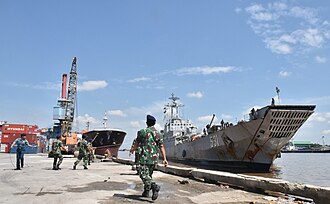
KRI Teluk Gilimanuk (531) is an amphibious landing ship operated by the Indonesian Navy (Tentara Nasional Indonesia Angkatan Laut, or TNI AL). The vessel is an important example of Indonesia’s efforts to develop its maritime transportation, amphibious warfare, and military logistical capabilities through the acquisition of former East German naval vessels. Originally built in East Germany under the name Hoyerswerda, the ship was designed as a medium landing vessel capable of transporting military vehicles, personnel, and supplies. Following the political changes that took place in Europe at the end of the Cold War, the vessel became available for international transfer and was subsequently acquired by Indonesia in the 1990s. After entering Indonesian service, it received the name Teluk Gilimanuk and the hull number 531, becoming the lead ship of the Indonesian Navy’s Teluk Gilimanuk-class landing ships.
The importance of KRI Teluk Gilimanuk extends beyond its physical dimensions, propulsion machinery, or onboard weapons. Indonesia is the world’s largest archipelagic country, with thousands of islands separated by strategically important maritime routes. Maintaining an effective naval presence across such a vast geographical area requires a balanced fleet that includes not only frigates, corvettes, submarines, and patrol vessels, but also amphibious transportation ships capable of moving personnel, vehicles, and logistical supplies between islands. Landing ships are particularly valuable because they can transport heavy military equipment and support operations in coastal areas where conventional port facilities may be limited. For the Indonesian Navy, these capabilities are essential for maintaining military mobility and supporting operations throughout the archipelago.
One of the most interesting aspects of KRI Teluk Gilimanuk is its historical background. The vessel was originally constructed during the Cold War for the East German Volksmarine, a naval force whose responsibilities were closely connected to the country’s maritime defense requirements in the Baltic Sea. Its original design, known within NATO as the Frosch I class or Project 108, emphasized amphibious transportation and logistical support. After German reunification in 1990, the East German naval force was dissolved, and many of its vessels were removed from active service. Indonesia subsequently acquired several of these ships as part of a broader naval modernization program, giving them a new operational purpose in Southeast Asia.
Since entering Indonesian service in 1994, KRI Teluk Gilimanuk has been associated with amphibious operations, marine transportation, logistical support, and maritime security patrols. Its activities have included patrols in the Natuna Sea, transportation of military resources, and support for operations outside traditional combat missions. These responsibilities illustrate the flexibility of landing ships and demonstrate why logistical vessels remain important even when a navy possesses more technologically advanced combat platforms.
This article examines the history and development of KRI Teluk Gilimanuk (531), from its original identity as Hoyerswerda to its incorporation into the Indonesian Navy. It also discusses its construction, design, technical characteristics, propulsion system, cargo capacity, armament, operational activities, and strategic importance. By understanding these aspects, readers can gain a clearer picture of the vessel’s contribution to Indonesia’s maritime defense and the wider history of amphibious naval transportation.
History and Development of KRI Teluk Gilimanuk
Construction in East Germany
Before becoming KRI Teluk Gilimanuk, the vessel was known as Hoyerswerda and served in the East German Volksmarine. It was constructed by VEB Peenewerft, a shipbuilding company located in Wolgast, East Germany, which produced various military and naval vessels during the Cold War. The ship’s keel was laid on November 25, 1974, and it was launched on July 1, 1975. Following construction and preparation, Hoyerswerda entered East German naval service on November 12, 1976, carrying the pennant number 611.
The ship belonged to Project 108, a design family classified by NATO as Frosch I. This type of vessel was developed to provide military transportation and amphibious landing capabilities, allowing naval forces to move vehicles, personnel, and logistical supplies between coastal locations. Its design reflected the importance of military mobility during the Cold War, when the ability to transport troops and equipment across maritime environments was considered an important element of national and alliance defense planning.
The Frosch I design was based on a relatively straightforward but useful concept: a naval vessel should be capable of carrying substantial cargo while retaining the ability to support amphibious landings. Rather than being optimized for high-speed surface warfare or sophisticated missile engagements, these ships concentrated on transportation, cargo handling, and the delivery of military resources. Their large internal cargo spaces and specialized landing arrangements made them suitable for operations where conventional commercial transportation facilities might not be available.
Hoyerswerda was therefore built as a specialized military transportation platform. Its construction reflected the practical requirements of the East German Navy, which needed vessels capable of supporting coastal military activities and transporting equipment in the Baltic region. Although its original environment differed considerably from Indonesia’s tropical archipelago, the basic characteristics of the ship would later prove relevant to Indonesian naval requirements.
Service in the East German Volksmarine
After entering service in November 1976, Hoyerswerda became part of the Volksmarine’s amphibious and logistical capabilities. The East German Navy operated a variety of vessel types, including missile boats, patrol ships, mine warfare vessels, submarines, landing ships, and support vessels. These ships performed different functions within the country’s maritime defense organization, and amphibious landing vessels provided the transportation capacity required to move military resources by sea.
Hoyerswerda’s principal mission was the transportation of vehicles, personnel, and equipment. In military operations, logistical transportation is essential because combat units require more than weapons and trained personnel to function effectively. They also need fuel, ammunition, food, engineering equipment, spare parts, and other supplies. A landing ship can move many of these resources together, making it an important supporting element within an amphibious force.
The Frosch I class was particularly useful for transporting military vehicles and supporting coastal landing activities. Its design provided a combination of cargo capacity and maritime mobility that allowed it to perform missions beyond those of ordinary commercial cargo vessels. Although the ship possessed defensive armament, its primary value came from its ability to transport military resources rather than engage enemy combatants independently.
Hoyerswerda continued serving the East German Navy until the political changes of 1990 transformed the country’s military organization. German reunification resulted in the dissolution of the Volksmarine and a major restructuring of the armed forces. Many former East German naval vessels were not retained by the unified German Navy, and Hoyerswerda was removed from the naval register on October 1, 1990. It was formally decommissioned on October 2, 1990, marking the end of its original military career.
Acquisition by Indonesia
Indonesia’s acquisition of former East German naval vessels was part of a broader military modernization initiative during the early 1990s. The country faced significant maritime defense requirements because of its enormous archipelago, extensive maritime boundaries, and the importance of its surrounding sea lanes. Expanding the Indonesian Navy’s capabilities required additional ships that could support combat operations, maritime surveillance, amphibious transportation, and logistical activities.
The procurement program was associated with Presidential Instruction No. 3 of 1992, concerning the acquisition of warships for the Indonesian Armed Forces Navy. The program was coordinated by a procurement team associated with then Minister of Research and Technology B. J. Habibie. Acquiring former East German vessels offered Indonesia an opportunity to expand its naval inventory using established ship designs rather than relying entirely on new construction.
Hoyerswerda was acquired by Indonesia on August 25, 1993, as part of this wider procurement effort. Before being transferred to its new operator, the vessel underwent preparation and refitting in Germany, including the removal of equipment associated with its former military configuration. This process was necessary to prepare the ship for its new role and ensure that it could be integrated into the Indonesian Navy’s fleet.
The acquisition was particularly relevant to Indonesia because the country required ships capable of transporting military personnel and heavy equipment across long maritime distances. Although Hoyerswerda had originally been developed for East German operational requirements, its transportation characteristics were suitable for the needs of an archipelagic country. Its transfer therefore represented a practical way to strengthen Indonesia’s amphibious transportation capabilities during a period of naval modernization.
Commissioning as KRI Teluk Gilimanuk (531)
Following its acquisition and preparation, Hoyerswerda entered Indonesian Navy service under the name KRI Teluk Gilimanuk (531) on July 12, 1994. The designation KRI stands for Kapal Republik Indonesia, meaning Ship of the Republic of Indonesia, while 531 is the ship’s identifying hull or pennant number.
The name Teluk Gilimanuk refers to Gilimanuk Bay, located on the western side of Bali. Gilimanuk is an important geographical location because it serves as a maritime gateway between Bali and eastern Java, particularly through the busy ferry connection linking Gilimanuk with Ketapang in Banyuwangi. The use of this geographical name reflects a common Indonesian naval naming tradition in which vessels are named after bays, islands, coastal locations, and other important geographical features.
The ship’s new identity also marked the beginning of a different operational chapter. Instead of serving the coastal defense requirements of East Germany, it became part of the Indonesian Navy’s amphibious transportation structure. Its principal duties included supporting marine deployments, transporting military vehicles and logistical supplies, and contributing to naval activities across Indonesia’s maritime territory.
KRI Teluk Gilimanuk subsequently became the lead vessel of the Teluk Gilimanuk class, a designation used for the Indonesian Navy’s Frosch I landing ships. Its name is therefore associated not only with one individual vessel but also with a wider group of amphibious transportation ships that expanded Indonesia’s naval capabilities during the 1990s.
Design and Classification
Frosch I-Class Landing Ship
KRI Teluk Gilimanuk belongs to the Frosch I class, also known as Project 108. NATO assigned the Frosch designation to a family of East German amphibious landing vessels developed to transport military vehicles, personnel, and supplies. The design was intended to provide practical logistical support for military forces operating in coastal environments.
The ship is classified as a medium landing ship and is sometimes described as a landing ship medium or landing ship tank, depending on the terminology used by different references. Its main purpose is to transport military vehicles and equipment while providing the capability to support amphibious landing operations. This makes it fundamentally different from a conventional combat vessel whose primary mission is to engage hostile ships, submarines, or aircraft.
The Frosch I design emphasizes cargo transportation and amphibious flexibility. Its relatively large hull provides the space necessary for military equipment, while its propulsion system allows it to travel between coastal destinations and naval bases. The vessel’s configuration makes it suitable for carrying vehicles and supplies that would be difficult to transport using smaller patrol ships or ordinary landing craft.
In Indonesian service, the ship became the lead vessel of the Teluk Gilimanuk class. This class name reflects the Indonesian Navy’s use of the first ship’s name to identify a group of vessels with related designs and operational characteristics. The class played an important role in expanding the navy’s amphibious transportation capacity during a period when Indonesia was acquiring several former East German warships.
Hull Design and Dimensions
KRI Teluk Gilimanuk has a reported overall length of approximately 98 meters, a beam of approximately 11.1 meters, and a draught of around 2.8 meters. Its full-load displacement is commonly reported at approximately 1,950 long tons, equivalent to roughly 1,980 metric tonnes. These dimensions place the vessel within the medium-sized landing ship category.
The ship’s hull is designed to accommodate a substantial quantity of military cargo while maintaining the stability required for maritime transportation. Its length provides room for vehicle and cargo arrangements, while its beam contributes to the vessel’s overall stability and internal capacity. These characteristics are particularly important for a landing ship because the distribution and movement of heavy equipment can influence the vessel’s balance and handling.
Its relatively shallow draught is also relevant to amphibious operations. Landing ships may be required to approach coastal areas and operate in waters where depth is more restricted than in major commercial shipping channels. A draught of approximately 2.8 meters provides some flexibility compared with deeper-draught vessels, although the actual suitability of a landing area depends on local water depth, seabed conditions, tides, and the ship’s loading condition.
Displacement should not be confused with cargo capacity. Displacement describes the total weight of the vessel and everything aboard under a particular loading condition, while cargo capacity represents the amount of material that can be transported. Published descriptions associate the Teluk Gilimanuk class with the ability to carry up to approximately 400 to 600 tonnes of cargo, demonstrating its usefulness as a military transportation platform.
The Relationship Between the Frosch I and Teluk Gilimanuk Classes
The designation Frosch I is the original East German and NATO-related classification associated with Project 108. Teluk Gilimanuk, meanwhile, is the Indonesian class designation derived from the name of the lead vessel after its transfer to the Indonesian Navy. These names refer to related aspects of the same group of ships rather than two entirely different vessel designs.
The distinction is important because the Indonesian Navy acquired several former East German landing ships and incorporated them into its fleet under Indonesian names and hull numbers. As a result, international references may describe a ship as belonging to the Frosch I class, while Indonesian sources may identify it as part of the Teluk Gilimanuk class.
The class also demonstrates how military equipment can retain its original engineering characteristics while receiving a new national identity and operational purpose. Although the ships were originally constructed for East German requirements, their transportation and amphibious capabilities were applicable to the maritime needs of Indonesia.
Propulsion System and Performance
Diesel Propulsion Machinery
KRI Teluk Gilimanuk is powered by two diesel engines connected to two propeller shafts. Its reported total installed power is approximately 5,000 horsepower, equivalent to around 3.7 megawatts. This propulsion arrangement provides the mechanical power needed to move the ship while carrying military vehicles, equipment, and other cargo.
Diesel propulsion is widely used in naval transportation vessels because it offers a practical combination of reliability, fuel efficiency, and maintainability. For a landing ship, dependable propulsion is particularly important because the vessel’s primary purpose depends on its ability to transport cargo and personnel safely over maritime distances.
The use of two engines and two propeller shafts distributes propulsion across two systems. This arrangement can provide operational advantages compared with a single-shaft installation, although actual reliability and redundancy depend on the condition of the machinery and its supporting systems. Regular maintenance, spare-parts availability, and the experience of the engineering crew are therefore essential to maintaining the ship’s performance.
As the vessel was originally commissioned in the 1970s, its propulsion machinery has also been subject to the challenges associated with operating an older naval platform. Engine inspections, replacement of worn components, maintenance of fuel systems, and monitoring of mechanical performance are all important aspects of preserving its operational capability.
Maximum Speed and Maritime Mobility
The reported maximum speed of KRI Teluk Gilimanuk is approximately 18 knots, equivalent to around 33 kilometers per hour. This speed is appropriate for a medium landing ship whose principal mission is transportation and logistical support rather than high-speed combat operations.
A landing ship’s effectiveness cannot be measured by speed alone. Its cargo capacity, endurance, mechanical reliability, and ability to deliver military resources are equally important. A vessel capable of transporting hundreds of tonnes of cargo can provide substantial logistical value even when it cannot travel as quickly as modern frigates or corvettes.
The ship’s speed allows it to perform transportation missions between naval bases, support marine deployments, and participate in maritime patrol activities when assigned. Actual operating speed depends on factors such as loading conditions, weather, sea state, machinery performance, and maintenance status.
Operational Endurance and Logistical Requirements
Operational endurance is another important consideration for a vessel operating across Indonesia’s extensive maritime territory. Ships may need to travel between widely separated islands, remain at sea for extended periods, and operate far from their primary maintenance facilities. This makes fuel management, food supplies, spare parts, and onboard logistical planning essential elements of naval operations.
KRI Teluk Gilimanuk’s transportation role requires the crew to balance the needs of the ship itself with the requirements of embarked personnel and cargo. The vessel must carry sufficient resources to complete its assigned mission while preserving the safety and operational effectiveness of its crew.
Its port visits and logistical stops are therefore a normal part of naval operations. Refueling, replenishing provisions, obtaining spare parts, and preparing for subsequent deployments allow an amphibious ship to maintain its usefulness across different operational areas.
Cargo Capacity and Amphibious Transportation Capabilities
Transportation of Military Vehicles and Tanks
One of the most important capabilities of KRI Teluk Gilimanuk is its ability to transport military vehicles and heavy equipment. Published specifications associate the Teluk Gilimanuk class with the capacity to carry up to 11 amphibious tanks or approximately 400 to 600 tonnes of cargo, depending on the configuration and loading conditions.
The transportation of armored vehicles is particularly important for amphibious forces because tanks and other military vehicles are heavy, bulky, and difficult to move using smaller landing craft. A landing ship provides a larger transportation platform that can carry multiple vehicles as part of a coordinated deployment. This capability allows military planners to move personnel and equipment together rather than relying entirely on separate transportation arrangements.
The ship’s cargo mission is not limited to tanks. It can also transport military trucks, engineering machinery, vehicles, construction materials, and logistical supplies. These resources are essential for supporting military units after they arrive at their destination, particularly when operations take place in areas with limited infrastructure.
The ability to move heavy equipment by sea is especially relevant to Indonesia because many islands have limited road connections and transportation facilities. A landing ship can provide an alternative means of moving military resources between coastal locations, helping maintain flexibility within the wider defense system.
Transportation of Marine Personnel
In addition to vehicles and supplies, KRI Teluk Gilimanuk is associated with the ability to transport approximately one company of marine personnel. This capacity makes it suitable for supporting amphibious deployments in which troops must travel together with their equipment and logistical requirements.
The Indonesian Marine Corps, known as Korps Marinir, performs responsibilities that include amphibious warfare, coastal defense, and the deployment of military forces in support of national defense objectives. Landing ships provide the maritime transportation connection that allows these units to move between islands and reach coastal areas where their presence may be required.
Transporting troops together with their equipment can simplify operational planning and improve coordination. Rather than moving personnel, vehicles, and supplies using entirely separate transportation platforms, a landing ship can carry several elements of a military force within one maritime deployment.
The exact number of personnel that can be carried safely depends on accommodation arrangements, voyage duration, ship configuration, and the requirements of the assigned mission. Therefore, the commonly reported capacity of one company should be understood as a general operational description rather than a fixed figure for every deployment.
Cargo Handling and Amphibious Landing Support
Cargo handling is an essential part of the operational usefulness of a landing ship. Transporting vehicles and supplies is only one stage of a logistical mission; the vessel must also be able to load, secure, transport, and deliver its cargo safely. This requires specialized arrangements and a trained crew familiar with the handling of heavy military equipment.
Amphibious transportation ships are designed to support the movement of cargo toward coastal destinations and landing areas. Their usefulness is especially apparent when conventional port facilities are unavailable or when military forces must operate in areas where infrastructure is limited.
KRI Teluk Gilimanuk’s landing-ship design makes it suitable for this type of support. Its principal contribution is the transportation of military resources and the provision of a maritime platform from which amphibious activities can be coordinated.
Armament and Defensive Systems
Bofors 40 mm Naval Gun
Although KRI Teluk Gilimanuk is primarily an amphibious transportation vessel, its reported armament includes a single-barrel Bofors 40 mm L/60 naval gun. This weapon is historically significant because the Bofors 40 mm family became one of the most widely used naval automatic cannon designs during and after the Second World War.
The weapon was originally developed for anti-aircraft defense and became widely adopted by naval forces because of its relatively powerful projectile and automatic firing capability. On a landing ship, a weapon of this type provides an additional defensive measure against certain aerial and surface threats.
Its presence should nevertheless be considered in the context of the ship’s overall mission. KRI Teluk Gilimanuk is not a dedicated air-defense vessel or modern surface combatant. The gun contributes to its onboard defensive capability but does not provide the same level of protection as the integrated weapon and sensor systems found on contemporary frigates and destroyers.
Twin 37 mm Naval Gun
The vessel is also associated with a twin-barrel V-11 37 mm L/63 gun installation. This weapon provides additional gun-based defensive capability and is part of the ship’s reported historical armament configuration.
The 37 mm caliber offers a larger projectile than smaller automatic cannon systems and has traditionally been used for close-range naval defense. Its twin-barrel arrangement allows the weapon to deliver a higher volume of fire than a single-barrel installation.
The practical effectiveness of such a weapon depends on its condition, ammunition, fire-control arrangements, and the characteristics of the target. Its presence should therefore be understood as part of the ship’s historical defensive configuration rather than proof of a modern integrated combat system.
Twin 25 mm Autocannons
Published descriptions also list two twin-barrel 2M-3 25 mm autocannon installations. These weapons provide additional close-range firepower and contribute to the vessel’s defensive arrangements.
The 25 mm caliber is commonly associated with naval weapons intended for engaging small surface targets and certain aerial threats at relatively short ranges. Twin-barrel installations provide a greater potential rate of fire than single-barrel weapons, although their effectiveness remains dependent on the condition of the installation and supporting equipment.
The combination of 40 mm, 37 mm, and 25 mm weapons reflects the defensive requirements of the original Frosch I design. However, armament configurations may change during a ship’s operational life, and historical technical descriptions should not automatically be treated as confirmation that every listed weapon remains installed and operational today.
Radar and Navigation Systems
The reported sensor configuration of KRI Teluk Gilimanuk includes the TSR-333 I-band navigation radar and the MR-302 Strut Curve F-band air and surface search radar. These systems contribute to the ship’s ability to monitor surrounding maritime activity and maintain navigational awareness.
Navigation radar is particularly important for a vessel operating in busy coastal waters, narrow maritime passages, and areas with significant commercial shipping. It helps the crew identify nearby vessels and geographical features, especially when visibility is reduced.
Air and surface search radar serves a broader surveillance purpose by helping detect contacts in the surrounding environment. These systems support situational awareness and contribute to the safe operation of the vessel, although their presence should not be confused with the sophisticated combat-management systems found on modern frontline warships.
Electronic Countermeasures
The ship’s reported defensive equipment also includes two PK-16 chaff launchers. Chaff is a radar-reflective material released into the surrounding environment to create misleading radar returns and interfere with certain radar-guided threats.
Such equipment forms part of the electronic defensive measures historically used by naval vessels. Its effectiveness depends on the characteristics of the incoming threat, the condition of the launchers, and the wider defensive procedures employed by the ship and its supporting formation.
As with the radar and gun systems, the current condition and exact configuration of the vessel’s electronic equipment should be confirmed through recent official information rather than inferred from historical specifications.
Operational Roles of KRI Teluk Gilimanuk
Amphibious Landing Operations
The principal role of KRI Teluk Gilimanuk is supporting amphibious operations. These operations involve moving military forces from ships to land, often in situations where conventional port infrastructure is unavailable or unsuitable. They require close coordination between naval crews, marine personnel, vehicle operators, and logistical units.
A landing ship provides the transportation capacity required to bring troops, vehicles, and supplies together. The vessel must be prepared for the assigned cargo, personnel must be embarked safely, and the ship must coordinate its movements with other participating units.
For Indonesia, this capability is particularly relevant because military deployments may involve movements between islands separated by considerable maritime distances. KRI Teluk Gilimanuk provides a specialized platform for transporting military resources by sea and supporting the deployment of marine forces.
Maritime Security Patrols in the Natuna Sea
One of the documented examples of KRI Teluk Gilimanuk’s operational activities was its participation in maritime patrols in the Natuna Sea and surrounding waters. In October 2017, ANTARA News reported that the vessel had docked at Dwikora Port in Pontianak, West Kalimantan, to replenish logistical supplies before continuing its maritime duties.
According to the report, the ship had previously conducted patrols in the Natuna Sea and surrounding areas. Its commander explained that the vessel’s mission included monitoring foreign fishing vessels and helping prevent illegal fishing activities within Indonesian waters. The ship also contributed to efforts to maintain maritime security and the safety of shipping in the region.
This activity illustrates the flexibility of amphibious landing ships. Although KRI Teluk Gilimanuk is not primarily designed as a dedicated patrol vessel, its size, transportation capacity, and ability to remain at sea allow it to participate in selected maritime security assignments.
The patrols also demonstrate the strategic importance of the Natuna region. The surrounding waters are connected with important maritime routes and fisheries, making regular surveillance an important responsibility for the Indonesian Navy. A visible naval presence can contribute to national maritime security while supporting broader efforts to protect Indonesia’s maritime interests.
Support for Military Transportation
KRI Teluk Gilimanuk also performs military transportation duties involving the movement of personnel, vehicles, equipment, and logistical supplies. These activities are essential for maintaining the mobility of Indonesian military forces across the archipelago.
Military transportation by sea offers advantages when heavy equipment must be moved over long distances. Tanks, trucks, engineering vehicles, and other large items can be difficult or expensive to transport by air, while land transportation may be impossible between islands. Landing ships provide an alternative that can carry substantial loads in a single deployment.
The vessel’s cargo capacity makes it useful for supporting military bases, training areas, and operational deployments. It can also complement other naval units by providing the logistical resources needed to sustain activities over extended periods.
Humanitarian Assistance and Disaster Relief
Indonesia frequently faces natural disasters, including earthquakes, tsunamis, volcanic eruptions, floods, and severe weather events. Such disasters can damage roads, bridges, ports, and other transportation infrastructure, making it difficult to deliver essential supplies to affected communities.
Landing ships can provide valuable transportation support during these situations. Their ability to carry substantial cargo allows them to transport food, clean water, medical supplies, generators, construction materials, and emergency equipment. They may also transport personnel involved in evacuation, medical assistance, and infrastructure recovery.
ANTARA’s October 2017 report specifically noted that KRI Teluk Gilimanuk could support non-war military operations, including assistance to disaster victims and the transportation of evacuees. This demonstrates that the ship’s usefulness extends beyond traditional military activities.
The vessel’s amphibious characteristics can also provide flexibility when damaged infrastructure prevents conventional cargo ships from reaching affected areas. However, its practical suitability for any particular relief mission depends on weather conditions, the condition of the ship, local coastal geography, and the availability of suitable landing locations.
KRI Teluk Gilimanuk and Indonesia’s Maritime Defense Strategy
The Importance of Amphibious Logistics
Indonesia’s geographical structure creates significant challenges for national defense and military transportation. The country’s islands are separated by extensive maritime distances, and military forces must be capable of moving personnel and equipment between different regions.
The Indonesian Navy therefore needs a balanced fleet that includes combat vessels and logistical support platforms. Frigates and corvettes provide surface warfare capabilities, submarines offer underwater operational capabilities, patrol vessels support maritime surveillance, and landing ships provide transportation for military personnel and heavy equipment.
KRI Teluk Gilimanuk fills an important role within this structure. Its ability to transport amphibious vehicles, marine personnel, and logistical supplies provides a capability that cannot be fully replaced by smaller patrol vessels or conventional combat ships.
Logistical mobility is particularly important during extended operations. A military force must be able to receive supplies, move equipment, and maintain its personnel over time. Without adequate transportation platforms, even a well-equipped force may experience difficulties sustaining its activities across distant islands.
The Teluk Gilimanuk Class as a Fleet Component
KRI Teluk Gilimanuk became the lead ship of the Indonesian Navy’s Teluk Gilimanuk-class landing ships. This designation reflects the incorporation of several former East German Frosch I vessels into the Indonesian naval fleet.
The class provided Indonesia with additional amphibious transportation capacity during the 1990s, a period when the country was expanding its naval inventory through the acquisition of second-hand foreign warships. These vessels were not modern new-build platforms, but their existing cargo and transportation capabilities offered practical value.
The Teluk Gilimanuk-class ships also demonstrate how a navy can incorporate different vessel types into a broader force structure. Amphibious landing ships complement combat vessels by providing the logistical means to move the personnel and equipment those forces may need.
The long-term value of the class depends on the maintenance of its ships, the availability of spare parts, crew training, and the ability to adapt equipment to changing operational requirements. These factors are especially important for vessels that were originally constructed several decades ago.
The Legacy of Former East German Naval Vessels
The acquisition of former East German warships was an important part of Indonesia’s naval development during the 1990s. It allowed the country to obtain multiple types of naval vessels, including landing ships, corvettes, patrol craft, and mine warfare ships.
These acquisitions represented a major transfer of military equipment from a former European naval organization to a Southeast Asian maritime force. The vessels had originally been designed for a different geographical environment and military doctrine, but many of their basic capabilities remained relevant to Indonesia’s requirements.
KRI Teluk Gilimanuk is a particularly clear example of this process. Its original identity as Hoyerswerda connects it with the Cold War history of the Volksmarine, while its Indonesian name and operational duties connect it with the maritime defense requirements of the Indonesian archipelago.
Operational History and Documented Activities
Patrols in the Natuna Sea in 2017
One of the best-documented examples of KRI Teluk Gilimanuk’s activities was reported by ANTARA News on October 9, 2017. The vessel docked at Dwikora Port in Pontianak, West Kalimantan, to replenish logistical supplies after conducting patrols in the Natuna Sea and surrounding maritime areas.
The report explained that the ship’s activities included monitoring foreign fishing vessels and preventing illegal fishing within Indonesian waters. Its commander also described the vessel’s responsibility for helping maintain safe and orderly shipping in the region.
The 2017 report is particularly useful because it provides a practical example of the ship’s operational role rather than simply listing its technical specifications. It demonstrates how an amphibious landing ship can be assigned maritime security responsibilities while retaining its principal transportation and logistical functions.
The report also identified KRI Teluk Gilimanuk as a Frosch I or Type 108 landing ship acquired from the former East German Navy. It confirmed the vessel’s connection with the Indonesian Navy’s amphibious unit and its role in supporting marine forces.
Visit to Pontianak and Logistical Replenishment
The vessel’s stop at Pontianak in October 2017 also illustrates the importance of logistical support for naval deployments. Ships operating over large maritime areas must periodically replenish fuel, food, spare parts, and other essential supplies.
These activities allow naval vessels to continue their missions while maintaining the safety and operational readiness of their crews. For a landing ship, replenishment is particularly important because the vessel must support not only its own personnel but potentially also embarked troops and military cargo.
The port visit also provided an opportunity for local naval authorities to coordinate with the ship’s crew and support its subsequent operations. Such activities are a normal part of maintaining a sustained maritime presence across Indonesia’s extensive waters.
Support for Operations Beyond Traditional Warfare
The 2017 ANTARA report also highlighted the ship’s ability to support non-war military operations, commonly known in Indonesia as Operasi Militer Selain Perang (OMSP). These activities can include disaster relief, evacuation support, transportation of supplies, and other missions that do not involve conventional combat.
This capability is especially relevant for the Indonesian Navy because its responsibilities extend beyond protecting maritime boundaries. Naval vessels can also provide assistance to civilian authorities and communities when emergencies occur.
KRI Teluk Gilimanuk’s transportation capacity therefore gives it a role within a wider national support system. Its contribution may involve moving military personnel, delivering equipment, or supporting humanitarian activities when required.
Maintenance, Modernization, and Operational Longevity
Challenges of Operating an Older Naval Vessel
KRI Teluk Gilimanuk entered East German service in 1976 and Indonesian service in 1994. Its long service history makes maintenance one of the most important factors in evaluating its continuing operational usefulness.
Naval vessels operate in a demanding environment where saltwater, corrosion, vibration, engine wear, and continuous mechanical stress can gradually affect their condition. These challenges become more significant as a ship ages and original components become difficult to replace.
For an amphibious landing ship, machinery reliability is directly connected to its main purpose. If propulsion systems, cargo-handling equipment, or essential navigation systems become unavailable, the vessel may be unable to carry out its transportation responsibilities effectively.
Regular maintenance therefore includes inspections of the hull, engines, electrical systems, navigation equipment, communications, safety arrangements, and cargo-handling systems. These activities help preserve the ship’s structural integrity and ensure that it remains suitable for its assigned missions.
Modernization and Equipment Replacement
Modernization can extend the usefulness of an older naval vessel by improving selected systems without replacing its basic hull and design. Potential areas of improvement include navigation equipment, communications, machinery monitoring, electrical systems, and safety installations.
Weapons and sensors may also be changed during refitting or modernization programs. However, historical descriptions of a ship’s equipment should not automatically be interpreted as confirmation of its present-day configuration. Any claims about recent upgrades or current weapon installations should be supported by official information.
For KRI Teluk Gilimanuk, maintaining its transportation capabilities is particularly important. The ship’s primary value lies in its ability to move vehicles, personnel, and supplies, meaning that the condition of its propulsion and cargo-handling systems is at least as important as the state of its armament.
Crew Training and Operational Readiness
A naval vessel’s effectiveness depends not only on its technical equipment but also on the skills and experience of its crew. Operating a landing ship requires knowledge of navigation, engineering, communications, cargo management, maritime safety, and logistical planning.
The crew must also coordinate with embarked marine personnel during transportation and amphibious activities. These operations require careful preparation because military vehicles and heavy cargo must be secured properly, personnel must be transported safely, and the ship must coordinate its movements with other participating units.
Training is therefore essential for maintaining operational readiness. It enables the crew to manage routine transportation activities, respond to mechanical problems, and support demanding maritime assignments.
The Historical and Strategic Significance of KRI Teluk Gilimanuk
KRI Teluk Gilimanuk occupies an interesting position in Indonesian naval history because its development reflects the transfer of military technology between two very different political and geographical environments. Originally constructed for the East German Volksmarine, the ship became part of Indonesia’s maritime defense system following the end of the Cold War.
Its story illustrates how military vessels can acquire a second operational life after major political changes. The dissolution of East Germany created an opportunity for Indonesia to obtain established naval platforms that could be adapted to its own requirements. This process helped expand the Indonesian Navy’s transportation and amphibious capabilities during the 1990s.
The vessel also demonstrates why naval strength should not be measured solely by the number of combat ships or the sophistication of their weapons. Transportation and logistical support are essential elements of maritime defense, especially in an archipelagic country where military resources must frequently move between islands.
KRI Teluk Gilimanuk’s role as a medium landing ship provides an example of this principle. Its ability to transport military vehicles, personnel, and supplies complements the capabilities of other naval vessels and supports the broader requirements of Indonesian maritime operations.
Its documented patrol activities in the Natuna Sea further demonstrate that landing ships can perform useful tasks beyond traditional amphibious warfare. Their transportation capacity, endurance, and onboard personnel can make them valuable supporting assets in maritime security and humanitarian missions.
Conclusion
KRI Teluk Gilimanuk (531) is a Frosch I-class amphibious landing ship operated by the Indonesian Navy. Originally built in East Germany as Hoyerswerda, the vessel entered service with the Volksmarine on November 12, 1976, before being decommissioned following German reunification in 1990. Indonesia acquired the ship on August 25, 1993, and officially commissioned it under its present name on July 12, 1994.
With a reported length of approximately 98 meters, a beam of 11.1 meters, and a full-load displacement of around 1,980 metric tonnes, the vessel was designed to transport military vehicles, personnel, and logistical supplies. Its twin-diesel propulsion system produces approximately 5,000 horsepower and provides a reported maximum speed of 18 knots. Its cargo capabilities include the transportation of up to 11 amphibious tanks or approximately 400 to 600 tonnes of cargo, depending on the loading arrangement.
The ship’s reported armament includes a Bofors 40 mm gun, a twin 37 mm gun installation, and two twin 25 mm autocannon installations, supported by historical radar and defensive countermeasure equipment. These systems provide a degree of onboard protection, although the vessel’s principal purpose remains amphibious transportation and logistical support.
During Indonesian service, KRI Teluk Gilimanuk has been associated with marine transportation, amphibious operations, maritime security patrols, and support for non-war military operations. Its documented patrol activities in the Natuna Sea in 2017 illustrate how the vessel can contribute to the protection of Indonesian maritime interests while retaining its original logistical function.
Ultimately, KRI Teluk Gilimanuk is an important example of the relationship between naval transportation, amphibious warfare, and national maritime defense. Its history connects East German naval engineering with Indonesia’s modern military development, while its operational role demonstrates the continuing importance of logistical vessels in an archipelagic country. Although based on a Cold War-era design, the ship’s contribution highlights a fundamental principle of naval operations: combat capability depends not only on weapons and sensors but also on the ability to transport and sustain the forces that operate at sea and on land.
Technical Specifications of KRI Teluk Gilimanuk (531)
The following table summarizes the principal technical characteristics commonly reported for KRI Teluk Gilimanuk. These figures describe the vessel’s historical design and published configuration; they should not be interpreted as independent confirmation of its present-day equipment or operational readiness.
| Specification | Details |
|---|---|
| Ship name | KRI Teluk Gilimanuk |
| Hull number | 531 |
| Original name | Hoyerswerda |
| Original pennant number | 611 |
| Country of origin | East Germany |
| Current operator | Indonesian Navy (TNI AL) |
| Ship type | Medium landing ship |
| Classification | Amphibious landing ship / LST |
| Class | Frosch I / Teluk Gilimanuk class |
| Project designation | Project 108 |
| Builder | VEB Peenewerft, Wolgast |
| Shipyard number | 331 |
| Keel laid | November 25, 1974 |
| Launched | July 1, 1975 |
| Original commissioning | November 12, 1976 |
| Decommissioned by East Germany | October 2, 1990 |
| Acquired by Indonesia | August 25, 1993 |
| Indonesian commissioning | July 12, 1994 |
| Length | 98 meters |
| Beam | 11.1 meters |
| Draught | 2.8 meters |
| Full-load displacement | Approximately 1,950 long tons (1,980 metric tonnes) |
| Propulsion | Two diesel engines |
| Propeller arrangement | Two shafts |
| Installed power | Approximately 5,000 hp (3.7 MW) |
| Maximum speed | Approximately 18 knots (33 km/h) |
| Cargo capacity | Approximately 400–600 tonnes |
| Vehicle capacity | Up to 11 amphibious tanks (reported) |
| Troop capacity | Approximately one company of marines |
| Crew complement | Approximately 46 personnel |
| Navigation radar | TSR-333 I-band |
| Air/surface search radar | MR-302 Strut Curve F-band |
| Main gun | One Bofors 40 mm L/60 |
| Additional gun | One twin V-11 37 mm L/63 installation |
| Close-range armament | Two twin 2M-3 25 mm installations |
| Electronic countermeasures | Two PK-16 chaff launchers |
| Primary mission | Amphibious transportation and logistical support |
| Secondary missions | Maritime security, military transportation, and humanitarian assistance |
