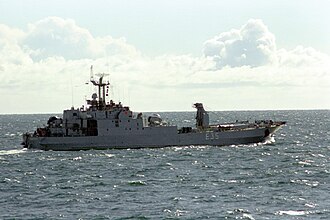
KRI Teluk Cirebon (543): History, Technical Specifications, Armament, and Operational Capabilities
KRI Teluk Cirebon (543) is an amphibious logistics and landing ship operated by the Indonesian Navy (Tentara Nasional Indonesia Angkatan Laut, or TNI AL). Belonging to the Frosch II class, the vessel represents an important component of Indonesia’s naval transportation and amphibious support capabilities. Originally constructed in East Germany under the name Nordperd, the ship was transferred to Indonesia during the 1990s as part of a major effort to expand the country’s naval fleet. After entering Indonesian service, it received the name Teluk Cirebon and the hull number 543, becoming one of the vessels responsible for supporting military transportation, amphibious deployments, and maritime security activities.
The importance of KRI Teluk Cirebon extends beyond its relatively straightforward role as a military transport vessel. Indonesia is an archipelagic nation with thousands of islands spread across strategically important maritime regions. Maintaining a capable navy in such an environment requires more than sophisticated frigates, submarines, and patrol vessels. It also requires ships that can transport military personnel, armored vehicles, logistical supplies, and equipment between islands, including locations where conventional port infrastructure may be limited. Landing ships fulfill this requirement by providing the ability to move substantial cargo loads and support the deployment of land forces through maritime routes.
One of the most interesting aspects of KRI Teluk Cirebon is its history, which connects the former East German Volksmarine with the modern Indonesian Navy. The ship was originally developed to support the military transportation and amphibious requirements of East Germany during the Cold War. Following German reunification and the dissolution of the East German naval force, the vessel became available for international transfer. Indonesia subsequently acquired it and adapted its capabilities to the operational requirements of a geographically extensive maritime country.
Since its commissioning into the Indonesian Navy in 1995, KRI Teluk Cirebon has been associated with amphibious transportation, logistical support, maritime patrol activities, and naval exercises. Its operational history also demonstrates that landing ships can perform useful missions beyond traditional amphibious warfare. They can contribute to maritime security, support the movement of military resources, and provide transportation capabilities that may become particularly valuable during humanitarian assistance and disaster response operations.
This article examines the complete background of KRI Teluk Cirebon (543), including its original identity as Nordperd, construction, acquisition by Indonesia, technical specifications, propulsion, armament, operational functions, and strategic importance. It also explores the vessel’s contribution to Indonesia’s maritime defense structure and explains why amphibious logistics ships remain important to the country’s naval capabilities.
History and Development of KRI Teluk Cirebon
Construction in East Germany
Before becoming an Indonesian naval vessel, KRI Teluk Cirebon was known as Nordperd and served in the Volksmarine, the naval force of the former German Democratic Republic, commonly known as East Germany. The ship was constructed by VEB Peenewerft, a shipbuilding company located in Wolgast, East Germany, which was responsible for producing various military and naval vessels during the Cold War. Its keel was laid on January 26, 1978, and the vessel was launched on August 30, 1978. Following completion, Nordperd was commissioned into East German naval service on October 3, 1979, initially carrying the pennant number E 35 and subsequently associated with the designation E 171.
Nordperd belonged to the Project 109 family, commonly identified by NATO as the Frosch II class. These vessels were developed as amphibious logistics ships intended to transport military vehicles, personnel, equipment, and supplies. Their design reflected the importance of military mobility in coastal environments, particularly when conventional port facilities could not be relied upon during an operation. Instead of concentrating on high-speed combat performance or sophisticated long-range weapons, the Frosch II design emphasized cargo transportation, amphibious support, and the ability to deliver military resources to coastal areas.
The development of these ships took place during a period when naval forces throughout Europe were preparing for a wide range of potential military contingencies. The Baltic Sea was strategically important to East Germany and its Warsaw Pact partners, and amphibious transportation was considered a useful capability for supporting military formations and coastal operations. A ship such as Nordperd could transport equipment and personnel while providing a larger logistical platform than smaller landing craft.
The vessel’s construction also reflected the industrial capabilities of the East German shipbuilding sector. VEB Peenewerft was involved in the production of several types of naval vessels, and its work formed part of the broader defense-industrial structure of the German Democratic Republic. Nordperd was therefore not an isolated commercial transportation ship converted into a military platform, but a purpose-built naval vessel designed around the logistical and amphibious requirements of its original operator.
Service with the East German Volksmarine
After entering service in October 1979, Nordperd became part of the East German naval inventory. The Volksmarine maintained a varied fleet that included missile-armed combat vessels, patrol ships, mine warfare vessels, landing ships, and logistical support units. Each category contributed to a particular aspect of maritime defense, and amphibious logistics vessels played an important role in transporting military resources between coastal installations and operational areas.
Nordperd’s principal function was military transportation. Its cargo-oriented arrangement allowed it to carry vehicles, heavy equipment, and other supplies required by military formations. The ship’s amphibious design provided additional flexibility compared with ordinary cargo ships, especially when supporting operations involving coastal landing areas. Although its armament provided a degree of onboard protection, the vessel was not primarily intended to operate as a frontline surface combatant.
The ship remained in East German service until the political changes of 1990 transformed the country’s military organization. German reunification resulted in the dissolution of the Volksmarine and a major restructuring of the armed forces. Many former East German vessels were not incorporated into the unified German Navy, and Nordperd was among the ships removed from the naval register.
The vessel was stricken on October 1, 1990, and formally decommissioned on October 2, 1990. Following its withdrawal from service, it was laid up rather than immediately destroyed or dismantled. Its eventual transfer to Indonesia would give the ship an opportunity to continue operating under a completely different national flag and in a very different maritime environment.
Acquisition by Indonesia
Indonesia’s acquisition of former East German naval vessels during the 1990s was part of a wider military modernization initiative. The country faced substantial maritime defense requirements because of its extensive archipelago, long maritime boundaries, and the strategic importance of its surrounding sea lanes. Expanding the Indonesian Navy’s capabilities required a combination of combat vessels, patrol ships, transportation platforms, and logistical support assets.
The procurement program was associated with Presidential Instruction No. 3 of 1992, which concerned the acquisition of warships for the Indonesian Armed Forces Navy. The program was coordinated by a government procurement team associated with then Minister of Research and Technology B. J. Habibie. Acquiring former East German vessels offered Indonesia an opportunity to expand its naval inventory using established ship designs rather than depending exclusively on new construction.
Nordperd was acquired by Indonesia on August 25, 1993. Before its departure for Indonesian service, the vessel underwent preparation and refitting in Germany, including the removal of equipment associated with its former military configuration. This process was necessary to prepare the ship for its new operator and its future role within the Indonesian Navy.
The acquisition was particularly relevant because Indonesia required vessels capable of transporting military resources across its archipelago. While the ship had originally been designed around East German naval requirements, its basic transportation and amphibious characteristics were suitable for adaptation to Indonesia’s maritime environment. The acquisition therefore represented not simply the purchase of an older ship, but the addition of a specialized capability to the Indonesian naval fleet.
Commissioning as KRI Teluk Cirebon (543)
After completing its transfer and preparation, Nordperd was commissioned into the Indonesian Navy under the name KRI Teluk Cirebon (543) on April 25, 1995. The designation KRI stands for Kapal Republik Indonesia, meaning Ship of the Republic of Indonesia, while 543 is the vessel’s identifying hull or pennant number.
The name Teluk Cirebon refers to Cirebon Bay, located on the northern coast of Java. The name also has a historical connection to Indonesian naval history. According to reporting published by Detik in 2019, the name commemorates the naval battle of January 5, 1947, in which KRI Gajah Mada, commanded by Captain Samadikun, was involved in fighting in the waters of Cirebon. Samadikun is remembered as a naval figure associated with the region and Indonesia’s struggle during the independence period.
The choice of name therefore carries historical significance beyond its geographical reference. It connects a modern Indonesian naval vessel with an earlier chapter of the country’s maritime military history. This naming tradition also reflects the Indonesian Navy’s practice of using geographical names and nationally significant historical references for its warships.
Following commissioning, the ship became part of the Indonesian Navy’s amphibious and logistical capabilities. Its former East German identity was replaced by a new national designation, and its operational responsibilities were adapted to the needs of Indonesia’s maritime defense structure.
Design and Classification
Frosch II-Class Amphibious Logistics Ship
KRI Teluk Cirebon belongs to the Frosch II class, also identified as Project 109. NATO used the Frosch designation for a family of East German landing and amphibious logistics vessels developed to provide military transportation capabilities. The Frosch II variant represents a development of the earlier Frosch I design, with differences in hull arrangement, dimensions, and equipment.
The vessel is best understood as an amphibious logistics ship rather than a conventional frontline combatant. Its principal mission is to transport military cargo, vehicles, personnel, and equipment, while providing the ability to support amphibious landing operations. This specialization is important because a navy requires transportation platforms to ensure that combat units can be supplied and deployed effectively.
Unlike a frigate or destroyer, whose primary roles may include air defense, anti-submarine warfare, and surface engagement, KRI Teluk Cirebon is designed around logistical requirements. Its cargo capacity and vehicle transportation arrangements are central to its value. The ship can support the movement of amphibious vehicles and other military equipment while providing transportation for embarked marine personnel.
The Frosch II design also offers operational flexibility. A landing ship can be used to support planned amphibious operations, routine naval deployments, military exercises, and transportation missions. Depending on its configuration and operational condition, it may also provide a useful platform for humanitarian assistance and disaster response.
Hull Design and Dimensions
KRI Teluk Cirebon has a reported overall length of approximately 90.7 meters and a beam of approximately 11.1 meters. Its draught is around 2.8 meters, while its reported displacement is approximately 1,700 long tons, or roughly 1,727 metric tonnes. These dimensions place it within the category of medium-sized amphibious logistics vessels.
The ship’s hull is designed to provide sufficient internal space for military cargo and vehicles while maintaining the structural characteristics required for maritime transportation. Its relatively broad beam contributes to stability and provides space for the vessel’s cargo arrangements, while its length supports the transportation of multiple military vehicles and substantial quantities of equipment.
Its draught is another important characteristic because amphibious vessels may be required to operate in coastal waters and approach landing areas where water depth can become a limiting factor. A draught of approximately 2.8 meters provides a degree of flexibility compared with larger vessels that require deeper water. Nevertheless, actual access to a landing area always depends on local hydrographic conditions, seabed characteristics, tides, and the ship’s loading condition.
The displacement figure should not be confused with cargo capacity. Displacement describes the weight of the vessel and everything aboard at a particular loading condition, whereas cargo capacity refers to the amount of material the ship can transport. Published descriptions associate KRI Teluk Cirebon with a cargo capacity of several hundred tonnes, making it useful for transporting substantial military resources.
Propulsion System and Performance
Diesel Propulsion
KRI Teluk Cirebon is powered by two diesel engines connected to two propeller shafts. Its reported total installed power is approximately 4,408 horsepower, equivalent to approximately 3.24 megawatts. This propulsion arrangement provides the mechanical power necessary for the ship to carry heavy loads and travel between naval bases, operational areas, and coastal destinations.
Diesel engines are widely used in naval logistics vessels because they provide a practical balance between fuel consumption, reliability, and mechanical maintainability. For a transportation-oriented vessel, dependable propulsion is especially important because the ship’s primary value depends on its ability to move cargo and personnel safely and consistently.
The two-engine and two-shaft arrangement also distributes propulsion across two systems. This configuration can provide certain operational advantages compared with a single-engine and single-shaft installation, although actual redundancy and reliability depend on the machinery arrangement and the condition of individual components. As with any aging naval vessel, regular inspections and preventive maintenance are essential to maintaining propulsion performance.
The ship’s machinery also needs to support extended operations in a maritime environment where maintenance facilities and spare parts may not always be immediately available. Engine reliability, fuel management, and the availability of technical personnel are therefore important elements of its overall operational effectiveness.
Maximum Speed and Operational Mobility
The reported maximum speed of KRI Teluk Cirebon is approximately 18 knots, equivalent to around 33 kilometers per hour. This performance is suitable for a medium-sized amphibious logistics vessel whose principal purpose is transportation rather than high-speed combat.
Speed is only one element of a landing ship’s operational effectiveness. Cargo capacity, endurance, reliability, and the ability to deliver vehicles and personnel are equally important. A ship capable of transporting several hundred tonnes of military equipment can provide substantial logistical value even if it cannot match the speed of modern frigates or corvettes.
Its speed allows it to participate in naval deployments, support transportation missions, and accompany other units during certain maritime operations. However, the vessel’s actual operating speed depends on loading conditions, machinery performance, weather, sea state, and maintenance status.
Cargo Capacity and Amphibious Capabilities
Transportation of Military Vehicles
One of the most important features of KRI Teluk Cirebon is its ability to transport military vehicles and heavy equipment. Published technical descriptions associate the vessel with the capacity to carry up to 11 amphibious tanks or approximately 400 to 600 tonnes of cargo, depending on the loading configuration and the type of equipment being transported.
There is also a difference between general published specifications and particular operational descriptions. An ANTARA News report published in October 2014 stated that KRI Teluk Cirebon could transport six amphibious tanks measuring approximately six to seven meters in length, together with landing personnel and their equipment. This lower figure is useful as an example of an operationally described loading arrangement rather than necessarily representing the ship’s maximum theoretical capacity.
The transportation of armored vehicles is particularly important for amphibious forces because military vehicles are heavy, bulky, and difficult to move using smaller landing craft. A landing ship provides a larger transportation platform that can bring multiple vehicles closer to a designated coastal area. This ability allows military planners to move equipment and personnel as part of a coordinated amphibious deployment.
The ship’s cargo mission is not limited to tanks. It can also support the movement of other vehicles, engineering equipment, logistical supplies, and military materials. These resources are essential for maintaining deployed units and supporting operations after personnel have reached their destination.
Transportation of Marine Personnel
In addition to vehicles and cargo, KRI Teluk Cirebon is associated with the ability to transport approximately one company of marine personnel. This makes the ship suitable for supporting amphibious operations in which troops must travel together with their vehicles and equipment.
The Indonesian Marine Corps, known as Korps Marinir, performs a range of military responsibilities involving amphibious warfare, coastal defense, and the deployment of land forces in support of national defense objectives. Landing ships provide an important link between naval transportation and marine operations by allowing troops and equipment to be moved across maritime distances.
Transporting personnel together with their equipment can simplify deployment arrangements and improve logistical coordination. Instead of requiring separate transportation for every category of military resource, a landing ship can carry several elements of a force as part of one maritime movement.
The actual number of personnel that can be carried safely depends on the ship’s configuration, the duration of the voyage, accommodation arrangements, and the requirements of the mission. Consequently, the published description of one company should be understood as a general operational capacity rather than a universal figure for every deployment.
Cargo Handling and Crane Equipment
Another reported feature of KRI Teluk Cirebon is its approximately five-tonne cargo crane located amidships. This equipment provides an additional method for loading and unloading cargo when suitable shore-side facilities or specialized handling equipment are unavailable.
A crane can be particularly useful during transportation missions involving supplies, smaller vehicles, engineering equipment, or other cargo that cannot be moved directly through the vessel’s landing arrangements. It also offers logistical flexibility when operating from ports with limited infrastructure.
Cargo-handling equipment is an important but sometimes overlooked aspect of amphibious logistics. A ship may have substantial internal capacity, but the ability to load, secure, transport, and unload its cargo is what makes that capacity operationally useful. The crane therefore complements the vessel’s broader transportation role.
Armament and Defensive Systems
Twin 37 mm Naval Guns
Although KRI Teluk Cirebon is primarily a logistical and amphibious vessel, it is equipped with naval guns that provide a degree of onboard defensive capability. Published descriptions of its Indonesian configuration list two twin-barrel V-11 37 mm L/63 gun installations.
These weapons are associated with close-range naval defense and can provide firepower against certain surface and aerial threats. The 37 mm caliber offers a larger projectile than the smaller automatic guns commonly installed on patrol vessels, although the practical effectiveness of the weapon depends on its condition, ammunition, fire-control arrangements, and the characteristics of the target.
The presence of twin-barrel installations increases the available rate of fire compared with a single-barrel configuration. However, the vessel’s armament should be understood within the context of its primary mission. KRI Teluk Cirebon is not designed to perform the same combat role as a modern frigate, destroyer, or dedicated air-defense vessel.
Twin 25 mm Autocannons
The ship is also associated with two twin-barrel 2M-3 25 mm autocannon installations. These weapons provide additional close-range firepower and contribute to the ship’s defensive arrangements.
The 25 mm caliber is commonly used on naval vessels for engaging small surface targets and certain close-range aerial threats. The twin-barrel design allows the installation to deliver a higher volume of fire than a single-barrel gun, although it remains a relatively short-range weapon system when compared with modern guided missiles.
Together with the 37 mm guns, the 25 mm installations provide a basic gun-based defensive capability suitable for the historical design and intended operational role of the ship. The actual configuration and serviceability of these weapons should be distinguished from historical published specifications, as naval equipment can change through modernization and maintenance programs.
Radar and Navigation Equipment
The reported sensor configuration of KRI Teluk Cirebon includes the TSR-333 I-band navigation radar and the MR-302 Strut Curve F-band air and surface search radar. These systems support the ship’s ability to monitor its surroundings and maintain navigational awareness during maritime operations.
Navigation radar is particularly important for vessels operating in busy coastal waters, narrow maritime passages, and areas with significant commercial traffic. It helps the crew maintain awareness of nearby vessels and geographical features, particularly when visibility is reduced.
Air and surface search radar serves a broader surveillance function by detecting contacts within the surrounding maritime environment. Although the presence of radar does not automatically provide the ship with advanced combat capabilities, it contributes to the situational awareness required for safe and effective naval operations.
Electronic Countermeasures
Published technical descriptions also list two PK-16 chaff launchers as part of the ship’s electronic defensive equipment. Chaff systems release clouds of radar-reflective material intended to interfere with certain radar-guided threats.
These systems are part of a wider category of naval defensive countermeasures designed to improve a ship’s ability to respond to hostile targeting. Their actual effectiveness depends on equipment condition, threat characteristics, and the overall defensive procedures employed by the vessel and its supporting naval formation.
As with the ship’s guns and radar, the listed electronic equipment should be regarded as a reported configuration rather than proof that all systems remain installed and fully operational in the present day.
Operational Roles of KRI Teluk Cirebon
Amphibious Landing Operations
The principal operational role of KRI Teluk Cirebon is supporting amphibious operations. Such operations involve the movement of military forces from ships to land, often in situations where direct access through conventional ports is unavailable or unsuitable.
An amphibious deployment requires close coordination between naval crews, marine personnel, vehicle operators, and logistical units. Troops must be transported safely, vehicles must be positioned correctly, and supplies must be delivered according to the requirements of the mission. Landing ships provide the transportation capacity needed to bring these elements together.
KRI Teluk Cirebon’s cargo capacity and vehicle transportation capabilities make it suitable for supporting this type of mission. Its role is especially relevant when military forces must be moved between islands or deployed to coastal locations as part of a wider naval operation.
Maritime Security Patrols
Although its primary classification is that of an amphibious logistics ship, KRI Teluk Cirebon has also participated in maritime security activities. An example was reported by ANTARA News in October 2014, when the vessel conducted patrol activities in the waters of West Kalimantan and surrounding Indonesian maritime areas.
The report described the ship’s contribution to maritime security efforts aimed at discouraging illegal activities, including illegal fishing by foreign fishing vessels. Its commander explained that the vessel could contribute to maritime patrol duties while retaining its principal role as a landing and logistics platform.
This illustrates the operational flexibility of amphibious ships. While they are not designed primarily as dedicated patrol vessels, their size, endurance, onboard personnel, and defensive equipment can make them useful in certain maritime security missions.
The ship’s presence in an operational area can also support naval surveillance and provide a visible military presence. This is important in maritime regions where illegal fishing, unauthorized activities, and other security concerns require regular monitoring by national authorities.
Support for Military Operations
KRI Teluk Cirebon has also been associated with wider Indonesian military operations. Reporting published by Detik in December 2019 noted that the vessel’s commander described its involvement in operations connected with Timor-Leste and Aceh, including the period of military activity involving the Free Aceh Movement (GAM).
The transportation of troops, equipment, and logistical resources is an important part of military operations conducted across maritime distances. Amphibious logistics ships can support these activities by moving personnel and material between bases and operational locations.
Such missions demonstrate that the ship’s contribution is not restricted to traditional amphibious landings. Its logistical capabilities can support a variety of military activities where transportation by sea is required. The precise responsibilities of the vessel depend on the operational assignment and the wider command structure.
Humanitarian Assistance and Disaster Relief
Indonesia is exposed to a wide range of natural hazards, including earthquakes, tsunamis, volcanic eruptions, floods, and severe weather events. These disasters can damage transportation infrastructure and isolate communities, making the movement of emergency supplies and response personnel particularly challenging.
KRI Teluk Cirebon’s cargo capacity and amphibious transportation characteristics can make it useful for humanitarian assistance and disaster relief operations when assigned and available. A vessel of this type can potentially transport food, clean water, medical equipment, generators, construction materials, and emergency response personnel.
The ability to move supplies by sea is especially important when roads and bridges have been damaged or when airports and conventional port facilities cannot accommodate normal transportation. Landing ships may offer an alternative logistical connection between unaffected areas and communities that have become difficult to reach.
The ship’s commander also referred to its readiness to support humanitarian assistance, including disaster-related operations, in the ANTARA report of October 2014. This demonstrates that the vessel’s potential usefulness extends beyond combat and maritime security activities.
KRI Teluk Cirebon and Indonesia’s Maritime Defense Strategy
Importance of Amphibious Logistics in an Archipelagic Country
Indonesia’s geographical structure creates unique challenges for national defense. Its islands are separated by large maritime distances, and military units must be able to move between different regions while maintaining reliable access to equipment and supplies.
The Indonesian Navy therefore requires a balanced fleet containing not only combat vessels but also logistical and transportation ships. Frigates and corvettes provide important combat capabilities, submarines offer specialized underwater operations, and patrol vessels contribute to maritime surveillance. Amphibious landing ships complement these assets by supporting the movement of military personnel and equipment.
KRI Teluk Cirebon is a representative example of this logistical role. Its ability to transport vehicles, supplies, and marine personnel provides a capability that cannot be fully replaced by smaller patrol vessels or conventional surface combatants.
In military planning, transportation capacity is an important part of operational readiness. A force may possess modern equipment and highly trained personnel, but without sufficient logistical support it may struggle to deploy and sustain its capabilities over long distances. Landing ships help address this requirement by providing a dedicated maritime transportation platform.
Strategic Value of the Frosch II Class
The acquisition of Frosch II-class vessels provided Indonesia with additional amphibious transportation capacity during the 1990s. These ships were not new designs when they entered Indonesian service, but their existing transportation capabilities offered practical value for a navy seeking to expand its operational resources.
The Frosch II class was originally designed for East German military requirements, but its basic characteristics were adaptable to the needs of another archipelagic country. Cargo capacity, vehicle transportation, and amphibious support were all capabilities that could be applied to Indonesia’s maritime environment.
The long-term value of such acquisitions depends on maintenance, availability of replacement parts, crew training, and the ability to preserve the ship’s essential systems. Older vessels may require considerable technical support to remain useful, and their operational value must be assessed in relation to their condition and the capabilities of newer ships entering the fleet.
Nevertheless, KRI Teluk Cirebon demonstrates how an acquired naval platform can continue to contribute to a different country’s maritime defense structure after undergoing a change of operator and national identity.
Operational History and Publicly Reported Activities
Maritime Patrol in West Kalimantan in 2014
One of the documented activities of KRI Teluk Cirebon took place in October 2014, when the ship conducted maritime patrol activities in the waters of West Kalimantan. According to ANTARA News, the vessel departed from the Indonesian Navy base in Pontianak as part of efforts to maintain security in the surrounding maritime area.
The patrol was connected with concerns about illegal fishing and other unauthorized maritime activities. Its commander explained that the ship’s presence could help discourage foreign fishing vessels from conducting illegal operations in Indonesian waters.
The report also provided useful information about the ship’s physical dimensions, armament, and transportation capabilities. It identified KRI Teluk Cirebon as a Frosch-class landing ship built at VEB Peenewerft in East Germany and described its ability to carry amphibious tanks and landing personnel.
This operational example is important because it illustrates the flexibility of the ship beyond its conventional amphibious role. The vessel could participate in maritime security activities while retaining its transportation and logistical functions.
Public Visit at Cirebon in 2019
In December 2019, KRI Teluk Cirebon was reported to have berthed at the Port of Cirebon, where members of the public were permitted to visit the naval vessel. The event provided an opportunity for local residents to learn more about the Indonesian Navy and its maritime defense responsibilities.
During the event, the ship’s commander explained its history, military functions, and connection with the city of Cirebon. The report also highlighted the ship’s ability to transport landing troops and their equipment, as well as its involvement in military operations.
The public visit was significant because it connected the vessel with the geographical location that inspired its name. Such activities can help improve public understanding of naval operations and strengthen awareness of Indonesia’s maritime heritage.
Participation in the Trisila Naval Task Force in 2024
KRI Teluk Cirebon was also reported as participating in the Indonesian Navy’s Trisila 2024 task force. According to reporting published on March 2, 2024, the task force departed from the Beaching Pier of the Military Sealift Command (Kolinlamil) on March 1, 2024, using KRI Teluk Cirebon (543).
The reported deployment provides a more recent example of the vessel’s continued association with Indonesian naval activities. It also illustrates the importance of amphibious and logistical platforms in supporting wider fleet deployments.
However, a reported deployment should not automatically be interpreted as a complete assessment of the ship’s current technical condition or permanent operational status. Naval vessels can undergo maintenance, refitting, and changes in assignment, and public reports do not always provide comprehensive information about their readiness.
Maintenance, Modernization, and Service Life
Challenges of Operating an Older Naval Vessel
KRI Teluk Cirebon entered East German naval service in 1979 and Indonesian service in 1995. Its long service history means that maintenance is an essential factor in preserving its transportation and operational capabilities.
Naval vessels operate in an environment that places significant stress on their structures and machinery. Saltwater exposure, corrosion, vibration, engine wear, and continuous mechanical operation can gradually affect the condition of a ship. These problems become particularly important as vessels grow older and original components become more difficult to replace.
For a landing ship, machinery reliability is directly connected to its primary mission. If propulsion systems, cargo-handling equipment, or vehicle transportation arrangements are unavailable, the ship may be unable to perform its intended logistical responsibilities effectively.
Regular maintenance therefore involves more than repairing visible defects. It also includes inspections of the hull, propulsion machinery, electrical systems, navigation equipment, communications, safety arrangements, and other critical components.
Modernization and Equipment Replacement
Modernization can help extend the usefulness of an older naval vessel by improving selected systems without necessarily replacing its original hull and basic design. Potential modernization areas for a logistics ship include navigation systems, communications equipment, machinery monitoring, electrical installations, and safety equipment.
Weapons and sensors may also be modified as part of a broader maintenance or modernization program. However, changes to the original equipment configuration should be confirmed through reliable official sources rather than assumed from the ship’s historical specifications.
For KRI Teluk Cirebon, preserving the cargo transportation function is particularly important. The ship’s principal value comes from its ability to move military resources, and maintaining its propulsion and cargo-handling systems is therefore essential to its operational usefulness.
The Importance of Crew Training
A naval vessel’s effectiveness depends not only on its machinery but also on the skills and experience of its crew. Operating a landing ship requires knowledge of navigation, engineering, communications, logistics, cargo management, and maritime safety.
The crew must also be capable of coordinating with embarked marine personnel and other naval units during amphibious activities. These operations involve multiple stages, including preparation, loading, maritime transportation, landing support, and the safe recovery or return of personnel and equipment.
Training helps ensure that these activities can be conducted efficiently and safely. It also allows crews to respond to changing operational conditions, equipment failures, and emergencies at sea.
The Significance of KRI Teluk Cirebon in Indonesian Naval History
KRI Teluk Cirebon occupies an interesting place in Indonesian naval history because it represents the transfer of a Cold War-era European military platform into Southeast Asian service. Its original identity as Nordperd connects it with the former East German Volksmarine, while its Indonesian name links it with a historical episode in the country’s struggle for independence.
The vessel also illustrates the evolution of Indonesia’s naval procurement strategy during the 1990s. Acquiring former East German vessels allowed the country to expand its naval transportation capabilities and incorporate established ship designs into its fleet. Although these vessels were not newly constructed, they provided useful capabilities that could be adapted to Indonesia’s geographical requirements.
Its role demonstrates why logistics ships should not be overlooked when discussing naval strength. A navy’s combat capabilities are important, but so are the transportation platforms that allow military forces to move, deploy, and receive supplies. In an archipelagic country, these functions are central to maintaining military mobility and operational flexibility.
KRI Teluk Cirebon is therefore more than a former East German landing ship operating under a different flag. It is an example of how naval equipment can acquire a second life and continue contributing to the strategic requirements of another country.
Conclusion
KRI Teluk Cirebon (543) is a Frosch II-class amphibious logistics ship operated by the Indonesian Navy. Originally constructed in East Germany as Nordperd, the vessel entered Volksmarine service on October 3, 1979, before being decommissioned following German reunification in 1990. Indonesia acquired the ship on August 25, 1993, and officially commissioned it under its present name on April 25, 1995.
With a reported length of approximately 90.7 meters, a beam of 11.1 meters, and a displacement of around 1,700 long tons, the ship was designed to transport military vehicles, personnel, and logistical supplies. Its twin-diesel propulsion system produces approximately 4,408 horsepower and supports a reported maximum speed of 18 knots. Its transportation capabilities include the carriage of amphibious vehicles and several hundred tonnes of cargo, while its reported armament consists of twin 37 mm and twin 25 mm naval gun installations.
Throughout its Indonesian service, KRI Teluk Cirebon has been associated with amphibious operations, maritime security patrols, military transportation, and naval deployments. Its reported activities in West Kalimantan in 2014, public visit to Cirebon in 2019, and participation in the Trisila 2024 task force illustrate the variety of missions in which an amphibious logistics vessel can contribute.
The ship’s importance is closely connected with Indonesia’s geographical realities. In a country made up of thousands of islands, the ability to move personnel, vehicles, and supplies across maritime distances is essential for national defense. Although KRI Teluk Cirebon is based on an older design, its historical contribution highlights the continuing importance of logistical support within a balanced naval force.
Ultimately, KRI Teluk Cirebon (543) represents a combination of East German naval engineering, Indonesian maritime history, and the practical requirements of amphibious military transportation. Its story is a valuable example of how a naval vessel can cross political and geographical boundaries while retaining an important place in the maritime history of its new operator.
Technical Specifications of KRI Teluk Cirebon (543)
The following table summarizes the principal technical characteristics commonly reported for KRI Teluk Cirebon. Some figures differ between historical references and descriptions of particular operational loading arrangements. They should therefore be regarded as published specifications rather than confirmation of every detail of the ship’s current configuration.
| Specification | Details |
|---|---|
| Ship name | KRI Teluk Cirebon |
| Hull number | 543 |
| Original name | Nordperd |
| Original pennant numbers | E 35 / E 171 |
| Country of origin | East Germany |
| Current operator | Indonesian Navy (TNI AL) |
| Ship classification | Amphibious logistics ship |
| Ship type | Landing ship |
| Class | Frosch II |
| Project designation | Project 109 |
| Builder | VEB Peenewerft, Wolgast |
| Shipyard number | 343 |
| Keel laid | January 26, 1978 |
| Launched | August 30, 1978 |
| Original commissioning | October 3, 1979 |
| Decommissioned by East Germany | October 2, 1990 |
| Acquired by Indonesia | August 25, 1993 |
| Indonesian commissioning | April 25, 1995 |
| Length | Approximately 90.7 m |
| Beam | Approximately 11.1 m |
| Draught | Approximately 2.8 m |
| Displacement | Approximately 1,700 long tons (1,727 metric tonnes) |
| Propulsion | Two diesel engines |
| Propeller arrangement | Two shafts |
| Installed power | Approximately 4,408 hp (3.24 MW) |
| Maximum speed | Approximately 18 knots (33 km/h) |
| Cargo capacity | Approximately 400–600 tonnes; other published descriptions report up to 650 long tons |
| Vehicle capacity | Up to 11 amphibious tanks in some published specifications |
| Operational vehicle load | Six amphibious tanks reported by ANTARA in 2014 |
| Troop capacity | Approximately one company of marines |
| Crew complement | Approximately 46 in published class specifications |
| Cargo-handling equipment | Approximately 5-tonne crane |
| Navigation radar | TSR-333 I-band |
| Air/surface search radar | MR-302 Strut Curve F-band |
| Main gun armament | Two twin V-11 37 mm L/63 installations |
| Additional gun armament | Two twin 2M-3 25 mm autocannon installations |
| Electronic countermeasures | Two PK-16 chaff launchers |
| Primary mission | Amphibious transportation and logistical support |
| Secondary roles | Maritime security, military transportation, and humanitarian assistance |
