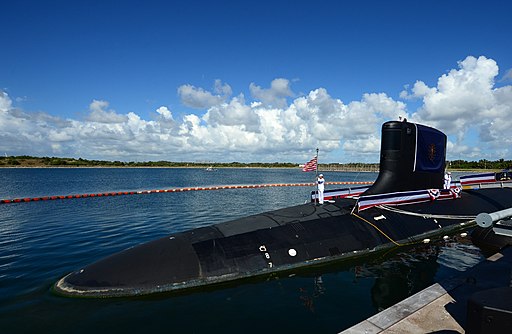
USS Indiana (SSN-789)
USS Indiana (SSN-789) – A Modern Attack Submarine of the Virginia-Class
The USS Indiana (SSN-789) is a nuclear-powered fast attack submarine in the United States Navy, and it belongs to the Virginia-class of submarines. The Virginia-class submarines are the backbone of the U.S. Navy’s attack submarine fleet, designed to perform a wide range of missions including anti-submarine warfare (ASW), anti-surface warfare (ASuW), intelligence gathering, and special operations support. The Indiana (SSN-789) represents the 13th boat in the Virginia-class series, and it continues the legacy of providing advanced capabilities for national security.
Design and Development
The Virginia-class submarines, including the USS Indiana, were developed as an answer to the growing demands for a new generation of attack submarines. The Virginia-class boats are designed to replace the Los Angeles-class submarines, which have been in service for several decades. The first submarine of the class, USS Virginia (SSN-774), was commissioned in 2004, with the Indiana being commissioned later in 2018.
The design of the Virginia-class is a significant leap forward compared to older submarine classes. The submarines are built using modular construction, which allows for easier upgrades and faster construction. The hull of the Indiana is built using a combination of steel and composites, offering a balance between strength and reduced sonar detection.
Key Specifications
- Length: 377 feet (115.8 meters)
- Beam: 34 feet (10.4 meters)
- Draught: 32 feet (9.8 meters)
- Displacement: Approximately 7,800 tons submerged
- Propulsion: S6W nuclear reactor (single reactor)
- Speed: Greater than 25 knots (46.3 km/h or 28.8 mph)
- Range: Virtually unlimited (limited only by food and crew endurance)
- Crew: Approximately 134 sailors, including officers and enlisted personnel
- Armament:
- 12 vertical launch system (VLS) tubes for Tomahawk cruise missiles
- 4 torpedo tubes for MK-48 torpedoes
- Sonar: AN/BQQ-10 sonar system, incorporating advanced bow sonar arrays for improved detection and tracking
- Combat Systems: A modern combat system with enhanced command and control capabilities, data links, and high-precision weapons targeting
Propulsion and Power
The USS Indiana is powered by a single S6W nuclear reactor, which provides nearly unlimited range and enables the submarine to operate at high speeds for extended periods. The reactor is designed to last the life of the submarine, reducing the need for costly refueling. This capability ensures the Indiana remains operational for extended deployments, often remaining submerged for months at a time without resurfacing.
The S6W reactor is designed for optimal power output with minimal risk and is complemented by a steam turbine and reduction gears, which drive the submarine’s propeller. The quiet, reliable propulsion system is one of the key factors in maintaining the submarine’s stealthy operational capabilities.
Stealth and Sensors
The Virginia-class submarines, including the USS Indiana, are renowned for their advanced stealth features. One of the most important aspects of a submarine’s stealth is its ability to avoid detection by enemy sonar systems. The Indiana features a hull made from quieter materials and special coatings that reduce its acoustic signature, making it harder to detect by enemy passive sonar systems.
The submarine is also equipped with the advanced AN/BQQ-10 sonar system, which includes a spherical sonar array in the bow, a wide aperture bow sonar, and additional sonar arrays along the hull. These systems are highly sensitive and capable of detecting and tracking both surface and submerged targets at great distances. In addition, the Indiana is fitted with a sonar array that is capable of identifying underwater threats such as other submarines, mines, and hostile vessels, ensuring situational awareness even in the most challenging environments.
Combat Systems and Armament
The USS Indiana is designed to conduct a variety of missions, and its armament and combat systems reflect this versatility. The submarine is equipped with 12 vertical launch system (VLS) tubes that can be used to launch Tomahawk cruise missiles. These missiles are primarily used for long-range strikes against land-based targets, providing the Indiana with significant standoff strike capability.
Additionally, the Indiana is equipped with four torpedo tubes that are capable of launching the MK-48 torpedo, a heavy-weight torpedo used for both anti-submarine and anti-surface warfare. The torpedo system is capable of engaging both enemy submarines and surface vessels at long ranges, with highly advanced homing and targeting capabilities.
The Indiana also boasts an integrated combat control system that allows for seamless integration with other U.S. Navy assets, such as surface ships, other submarines, and aircraft. This system enhances the submarine’s ability to operate in complex, multi-domain environments and ensures effective mission execution.
Operational Capabilities
The USS Indiana is designed to perform a wide range of missions, including:
- Anti-Submarine Warfare (ASW): The Indiana can hunt and destroy enemy submarines using advanced sonar and torpedo systems. The quiet propulsion system and advanced sonar arrays make it a formidable opponent for adversary submarines.
- Anti-Surface Warfare (ASuW): The Indiana can engage surface targets using Tomahawk cruise missiles, making it a highly effective asset in naval strike missions.
- Intelligence Gathering: The submarine can conduct surveillance and reconnaissance missions, gathering intelligence from both surface and subsurface domains. Its stealthy capabilities allow it to operate without detection in sensitive regions.
- Special Operations Support: The Indiana can support special operations forces (SOF) by carrying and deploying divers, unmanned underwater vehicles (UUVs), and other specialized equipment.
- Ballistic Missile Defense: With its Tomahawk missile capability, the Indiana can also play a role in missile defense operations, supporting the U.S. Navy’s strategic defense posture.
Construction and Commissioning
The USS Indiana was built by Huntington Ingalls Industries in Newport News, Virginia, and was launched on May 16, 2014. After several years of testing and sea trials, it was officially commissioned into service on October 26, 2018. The commissioning ceremony was attended by many dignitaries, including state and naval officials, as well as family members of those involved in the submarine’s construction.
As the 13th Virginia-class submarine, the Indiana benefits from the lessons learned from earlier boats in the class. These lessons have helped streamline construction and improve operational performance. The USS Indiana is expected to remain in service for several decades, continuing to contribute to the security and defense of the United States.
Future Role and Upgrades
The USS Indiana, along with other Virginia-class submarines, is designed with future upgrades in mind. The submarines can be modified and equipped with new technologies over the course of their service life, ensuring they remain relevant and capable of handling emerging threats.
The Virginia-class boats, including the Indiana, are expected to serve as the backbone of the U.S. Navy’s attack submarine force well into the 2030s and beyond. The Navy is already working on improvements to the class, such as the Virginia Payload Module (VPM), which will be added to future Virginia-class submarines to increase the number of vertical launch system tubes, further enhancing their strike capabilities.
Conclusion
The USS Indiana (SSN-789) is a highly advanced and versatile nuclear-powered attack submarine that exemplifies the cutting-edge technology and capabilities of the Virginia-class. With its advanced stealth, powerful propulsion system, and versatile weaponry, it is a crucial component of the U.S. Navy’s undersea warfare capabilities. As the U.S. Navy continues to adapt to changing global threats, the USS Indiana will play a central role in ensuring maritime security and national defense for decades to come.
.jpg)