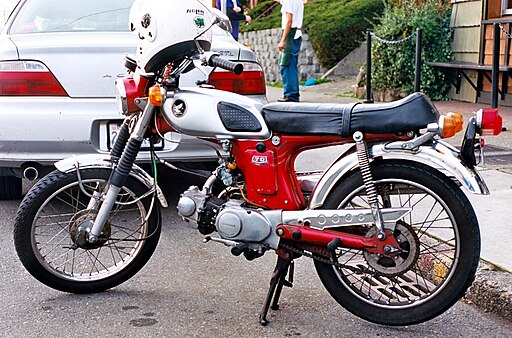
Honda CL70
Introduced at the tail end of the 1960s, the Honda CL70 emerged as a compact yet capable scrambler designed for both on-road commuting and light off-road adventures. Built between 1969 and 1973, the CL70 served as an affordable, versatile alternative to larger models and even acted as a natural evolution from its smaller brother, the CL50, by incorporating a larger engine and refined styling cues. With its minimalist design and robust mechanical simplicity, the Honda CL70 quickly earned a reputation for reliability, ease of maintenance, and a spirited riding experience that still captivates vintage motorcycle fans today.
Engine and Powertrain
Engine Design and Performance
At the heart of the Honda CL70 lies a modest yet efficient 72cc four-stroke, single-cylinder engine. This engine is air-cooled and built with an Overhead Camshaft (OHC) configuration, which ensures precise valve timing and smooth operation. The design emphasizes simplicity and durability while providing a compression ratio of approximately 9.0:1. Despite its small displacement, the engine produces around 6.5 horsepower (roughly 4.8 kW) at peak revs—typically close to 9,500 rpm—and develops a torque of about 5.2 Nm around 7,000 rpm. These power figures may seem modest by today’s standards, but they deliver a lively and responsive performance ideal for urban riding and playful ventures onto less demanding off-road terrain.
Transmission and Drivetrain
Paired with the agile engine is a four-speed manual transmission that further contributes to the motorcycle’s nimble character. The gearbox is designed to provide smooth gear changes, allowing riders to optimize the balance between low-end torque and top-end power. A centrifugal mechanism in the clutch system—often described as a semi-automatic or “polo-automatic” clutch—adds to the ease of operation, making it accessible for novice riders while still engaging for experienced enthusiasts. Power is transmitted to the rear wheel via a conventional chain drive, ensuring efficient power transfer with minimal mechanical losses.
Chassis, Suspension, and Braking
Frame and Construction
The Honda CL70 is built around a pressed steel frame—a design choice that was typical in the era. This construction method not only minimizes cost and weight but also adds a distinctive rugged charm to the motorcycle’s overall aesthetic. With a dry weight in the region of 82 kilograms (approximately 180 pounds), the CL70’s lightweight structure contributes to its maneuverability and ease of handling, particularly in twisty urban environments.
Suspension and Wheels
To cope with the demands of both paved roads and unpaved trails, the CL70 features a straightforward yet effective suspension setup. Up front, the bike is equipped with conventional telescopic forks designed to absorb minor bumps and provide stability during sharp turns. At the rear, dual shock absorbers mounted on a simple swingarm further cushion the ride, allowing for a degree of comfort while tackling uneven terrain. The motorcycle rides on drum-braked wire-spoked wheels, typically fitted with 2.75-17 tires both at the front and rear, striking a balance between performance and durability.
Braking System
Safety in braking is ensured through a classic drum brake system on both the front and rear wheels. While drum brakes may not offer the same stopping power or modulation as modern disc brakes, they were more than adequate for the modest speeds and lightweight nature of the CL70. Combined with the bike’s balanced weight distribution, the braking system provides predictable and reliable stopping performance under everyday conditions.
Design, Ergonomics, and Utility
Visual Design and Scrambler Styling
The Honda CL70 is instantly recognizable by its authentic scrambler styling. Characteristic elements include a high-mounted exhaust system with chrome trim, a broad and minimally styled fuel tank, and a distinctively angular headlight assembly. These design cues not only serve an aesthetic purpose but also reflect the machine’s dual personality—capable of both spirited on-road cruising and adventurous off-road excursions. Its retro appeal, reinforced by simple color schemes and an unpretentious build quality, endears the CL70 to collectors and enthusiasts of classic bikes.
Riding Position and Comfort
Ergonomy is a key aspect of the CL70’s design. The riding position is upright, allowing for good visibility and control in a variety of riding conditions. The seat height is set to offer a comfortable mount for a wide range of riders, while the responsive controls and accessible foot pegs ensure that the motorcycle remains user-friendly, whether navigating crowded city streets or exploring country lanes. The minimalist design of the instrument panel, featuring essential gauges like a speedometer and simple indicator lights, complements the overall utilitarian ethos of the machine.
Performance and Fuel Efficiency
Top Speed and Acceleration
While the Honda CL70 is not built for breakneck speeds, it impresses with its agility and responsive acceleration. With a top speed reaching around 90 km/h (approximately 56 mph) under ideal conditions, the CL70 is well-suited for urban commuting and short-distance rides. Its lightweight design and tuned powerband allow the motorcycle to accelerate briskly from low speeds, making it a fun choice for riders who appreciate a spirited, hands-on riding experience.
Fuel Tank Capacity and Consumption
Efficiency is another highlight of the CL70. Featuring a fuel tank with a capacity of about 5 liters, the motorcycle is designed to be economical on fuel—a critical feature during its production era when affordability and low operational costs were paramount. Its low fuel consumption, estimated at approximately 2.2 liters per 100 kilometers, makes it an economical option for daily commuting, further adding to its enduring appeal among vintage motorcycle enthusiasts.
Legacy and Impact
A Pioneer of Dual-Purpose Mobility
The Honda CL70 holds a unique place in motorcycle history as one of the early scrambler models that bridged the gap between on-road practicality and off-road capability. During the late 1960s and early 1970s, this model contributed to a growing trend of motorcycles designed to do it all—serving both as reliable transportation and as recreational vehicles for weekend adventures. Its design and functionality influenced future generations of dual-purpose bikes, setting a benchmark for versatility and simplicity.
Enduring Popularity Among Collectors
Today, the Honda CL70 remains a beloved relic among collectors and restoration enthusiasts. Its straightforward engineering, spawn of an era defined by bold design and practical performance, makes it an attractive project bike for those looking to preserve a piece of motorcycle heritage. The CL70’s legacy endures not only in technical specifications but also in the lifestyle it represents—a spirit of freedom, adventure, and functional simplicity that continues to resonate with riders all over the world.
Conclusion
The Honda CL70 is much more than just a small motorcycle; it is a symbol of a bygone era when simplicity, reliability, and versatility were at the forefront of motorcycle design. With its 72cc four-stroke, overhead cam engine, four-speed manual transmission, pressed-steel frame, and classic drum braking system, the CL70 offers a raw, unfiltered riding experience that stands in stark contrast to today’s technology-laden machines. Its scrambler styling—complete with high exhausts, minimalist instrumentation, and rugged build—epitomizes the adventurous spirit of its time. For those who appreciate vintage motorcycles or seek an economical, fun ride, the Honda CL70 remains a timeless classic that continues to inspire and excite.
