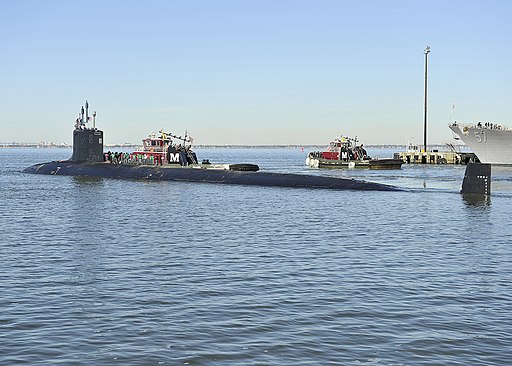
USS Minnesota (SSN-783)
Introduction to a Modern Undersea Warrior
The USS Minnesota (SSN‑783) stands as a testament to modern naval engineering. As one of the Virginia‑class submarines, she is designed to excel in intelligence gathering, precision strike capabilities, and undersea warfare. Her role in maintaining undersea dominance depends on a blend of stealth, speed, and an integrated network of advanced sensors and weaponry .
Design Philosophy and Key Features
Guided by decades of experience in submarine warfare combined with forward‑thinking innovation, USS Minnesota is built to operate quietly beneath the waves. From her advanced nuclear propulsion system to her state‑of‑the‑art weapons launch platforms, every system on board has been meticulously engineered to help her outmaneuver adversaries and operate in contested environments. Her design reflects a philosophy where mission flexibility and survivability in complex maritime theaters are paramount .
Historical Background
Construction and Commissioning
USS Minnesota was laid down on 20 May 2011 at one of the nation’s premier shipyards and was christened on 27 October 2012. Her delivery to the Navy came on 6 June 2013 — notably ahead of schedule — and she was officially commissioned on 7 September 2013. Named in honor of the North Star State, Minnesota carries forward a proud naval tradition and a legacy of service. Her relatively swift construction and commissioning highlight achievements in modern shipbuilding and project management, ensuring that she quickly became a critical asset within the Navy’s undersea fleet .
Technical Specifications
Dimensions and Displacement
USS Minnesota is built for both agility and endurance in hostile underwater environments. Her key dimensions include:
- Length: Approximately 114.9 meters (377 feet)
- Beam: Roughly 10.3 meters (34 feet)
- Draft: About 9.8 meters (32 feet) as indicated by related Virginia‑class specifications
When fully submerged, her displacement stands at roughly 7,800 long tons (7,925 metric tons). These dimensions not only optimize her hydrodynamic performance but also enhance her ability to navigate complex ocean terrains .
Propulsion and Performance
At the heart of Minnesota’s robust performance is an S9G pressurized water reactor. This advanced nuclear reactor drives one pump‑jet propulsor through highly efficient steam turbines. The combination delivers an impressive 29.84 MW (approximately 40,000 horsepower), allowing the submarine to routinely achieve speeds exceeding 25 knots. This propulsion system endows her with near‑unlimited range, limited primarily by maintenance and crew endurance rather than fuel capacity .
Operational Depth, Range, and Endurance
Engineered with an exceptional hull design, USS Minnesota can operate at test depths exceeding 800 feet (240 meters). The submarine’s design — with its quieting technologies and advanced hydrodynamics — ensures that it can remain undetected in deep waters for extended periods. This nearly unlimited range is a crucial factor in her ability to conduct extended patrols and long‑range precision strikes in strategically vital areas .
Crew Accommodations and Habitability
Designed for sustained missions, the submarine offers state‑of‑the‑art living and working conditions for its crew. Typically, her complement ranges from around 113 to 134 sailors, depending on the specific mission configuration. The internal spaces are optimized for efficiency, safety, and crew endurance, with modern amenities that help maintain high morale during long deployments in the confined environment of an undersea platform .
Armament and Offensive Capabilities
Vertical Launch System (VLS) and Missile Capability
A primary feature defining the offensive power of USS Minnesota is her Vertical Launch System (VLS). The submarine is outfitted with 12 VLS tubes that are capable of deploying a diverse array of weapons. Chief among these is the Tomahawk cruise missile, which can be used to strike high-value sea or land targets with pin-point accuracy. This system ensures that Minnesota can engage targets at long ranges while remaining submerged, a key factor in modern undersea warfare .
Torpedo Tubes and Additional Weapons
Complementing her missile capabilities, USS Minnesota is equipped with four 21‑inch torpedo tubes. These tubes launch heavyweight torpedoes (such as the Mk‑48 ADCAP) to counter enemy submarines and surface threats. Beyond these traditional armaments, the submarine’s payload can include advanced mobile mines, unmanned undersea vehicles, and specialized equipment for covert insertion of special warfare teams. This flexibility underscores the submarine’s role as a multi‑mission platform capable of executing a broad spectrum of tactical operations .
Sensors and Combat Systems
Advanced Sonar Arrays and Detection Systems
USS Minnesota is not only armed with formidable offensive systems but also equipped with an array of advanced sensors. Her sonar suite comprises both spherical active/passive arrays and lightweight wide‑aperture arrays that enable her to detect quiet, diesel‑electric submarines as well as surface vessels. High‑frequency chin and sail arrays further enhance her underwater situational awareness, ensuring that she remains acutely aware of the environment around her even in the depths of the ocean .
Electronic Warfare and Countermeasures
Modern naval combat involves more than just firepower — it requires the ability to counter incoming threats. Minnesota integrates several layers of electronic warfare capabilities. Advanced counter‑measures, including decoy launching systems and other electronic jamming technologies, allow her to defeat anti‑submarine and anti‑ship missiles. These defensive systems are critical in creating a self‑protective envelope that maximizes stealth and survivability during engagements .
Special Warfare and Additional Capabilities
Beyond conventional weapons and sensors, USS Minnesota is outfitted with systems that cater to special warfare missions. A dry deck shelter, along with provisions for advanced SEAL delivery systems, allows for the covert insertion and extraction of special operations forces. This capability expands the operational role of the submarine, making her a flexible tool in both overt and covert conflict scenarios, where intelligence gathering and precision strikes are often intertwined with special operations .
Operational History and Homeport Information
Since her commissioning, USS Minnesota has been active in numerous training exercises, deployments, and patrol missions, ensuring that the United States maintains a credible and modern undersea deterrent. Although her primary homeport has evolved along with strategic interests, her forward‑deployment has allowed the submarine to operate in key theaters around the globe. This continuous operation in dynamic environments underscores the adaptability and readiness of both her design and her crew .
Future Outlook and Upgrades
Embracing Technological Innovation
The USS Minnesota, like her Virginia‑class counterparts, is expected to undergo periodic upgrades as new technologies become available. Future improvements may include more advanced sonar suites, enhanced electronic warfare capabilities, and software updates that integrate seamlessly with integrated combat systems. These upgrades ensure that even as threats evolve, Minnesota remains on the cutting edge of military technology and continues to serve as an effective deterrent in a rapidly changing global security landscape .
Strategic Legacy and Modern Relevance
As global naval strategy increasingly focuses on multi‑domain operations, platforms like the USS Minnesota embody the evolution of undersea warfare. Her blend of offensive might, stealth, and sensor integration ensures she remains relevant for decades to come. Looking ahead, the lessons learned from her operational history and technical performance will continue to influence the design and doctrine of future generations of fast attack submarines .
Conclusion
The USS Minnesota (SSN‑783) represents both the legacy and future of undersea warfare. From the advanced S9G nuclear reactor powering her stealthy pump‑jet propulsor to her lethal combination of missile and torpedo systems, every element of her design is engineered for survival and success in hostile environments. As threats evolve beneath the waves, Minnesota’s blend of cutting‑edge technology, flexible armament, and robust sensor packages ensures she remains a cornerstone of modern naval strategy.
For those interested in further exploring the world of submarine technology, consider delving into comparative studies of the Virginia‑class, examining how advancements in sonar and stealth are reshaping undersea warfare, or investigating the challenges of integrating new technologies into legacy platforms. The journey of USS Minnesota is not just a story of advanced engineering, but also a window into the dynamic and ever‑changing nature of modern naval conflict .
_departs_Norfolk_in_January_2014.JPG)