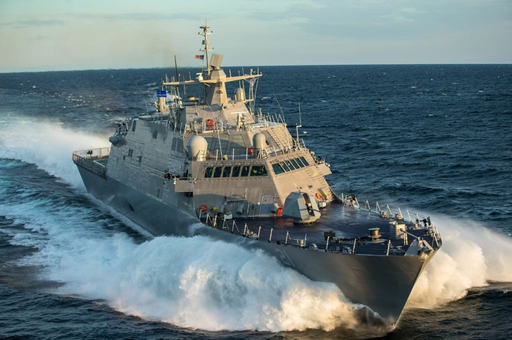
USS Minneapolis-Saint Paul (LCS-21)
The USS Minneapolis-Saint Paul (LCS-21) stands at the forefront of the U.S. Navy’s efforts to counter emerging threats in near-shore environments. As a Freedom‑class littoral combat ship, she is designed to perform a variety of missions ranging from maritime security and mine countermeasures to anti-submarine warfare and surface combat operations. Bearing the motto “Aut viam inveniam aut faciam” (I Will Find a Way or Make One), this vessel is a testament to resourcefulness and innovation in naval strategy.
Historical Background
Development and Construction
Awarded on December 29, 2010, to Marinette Marine Corp., the ship’s construction marked a significant milestone in the evolution of littoral combat vessels. With the keel laid on February 22, 2018, USS Minneapolis-Saint Paul’s construction benefited from advances in modular design and rapid-build techniques that have become hallmarks of modern shipbuilding. Launched on June 15, 2019, and later acquired on November 18, 2021, this vessel quickly proceeded to acceptance trials, despite encountering and subsequently overcoming propulsion challenges. Her official commissioning on May 21, 2022, in Duluth, Minnesota, underlines the U.S. Navy’s commitment to leveraging new technology and agile production methods to maintain maritime superiority.
Namesake and Legacy
Named in honor of Minnesota’s Twin Cities, the USS Minneapolis-Saint Paul carries a dual heritage. This naming not only pays tribute to the rich cultural and historical significance of the Minneapolis-Saint Paul region but also reinforces the tradition of naming U.S. Navy ships in recognition of communities that contribute to America’s national narrative of innovation, resilience, and determination.
Technical Specifications
A closer inspection of USS Minneapolis-Saint Paul reveals a host of advanced systems and design features that set her apart in the littoral combat fleet.
Dimensions and Displacement
Built to balance performance with operational agility, the key dimensions and displacement figures of LCS‑21 are as follows:
- Length: Approximately 387 feet (118 meters)
- Beam: 58 feet (18 meters)
- Draft: About 13 feet (4.0 meters)
At full load, her displacement reaches around 3,500 metric tons (roughly 3,900 short tons). This relatively light displacement—compared to traditional warships—provides the agility necessary for rapid maneuvers in coastal and confined maritime areas.
Propulsion and Performance
The propulsion system of USS Minneapolis-Saint Paul embodies the hybrid approach typical of modern littoral combat ships. Key aspects include:
- Powerplant: The vessel is driven by a combination of gas turbines and diesel engines. Specifically, she harnesses two Rolls‑Royce MT30 gas turbines (each delivering up to 36 MW) paired with two Colt‑Pielstick diesel engines. This integrated power system is optimized for both high-speed dash operations and fuel efficiency during extended patrols.
- Waterjet Propulsion: Four Rolls‑Royce waterjets provide the thrust necessary to achieve speeds up to 45 knots in sea state 3.
- Endurance and Range: With a range of approximately 3,500 nautical miles at 18 knots and an endurance of up to 21 days, the ship is well-suited for prolonged deployments in varied maritime settings.
Hull Design and Construction Materials
USS Minneapolis-Saint Paul embraces the sleek, monohull design characteristic of the Freedom‑class. Key features include:
- Hull Composition: Constructed from a combination of high-strength steel and aluminum, the hull and superstructure are engineered to optimize both durability and weight savings.
- Seakeeping and Maneuverability: The streamlined design minimizes hydrodynamic resistance, ensuring that the vessel can quickly respond to evolving threats in littoral zones while maintaining stealth characteristics and high maneuverability.
Armament and Mission Systems
The USS Minneapolis-Saint Paul is outfitted with a carefully curated mix of weapons and mission systems that enable flexibility across multiple operational domains.
Primary Gun System
- BAE Systems Mk 110 57mm Gun: This rapid-fire naval gun is capable of delivering precision strikes against surface targets, providing both offensive firepower and defensive capabilities during close combat situations.
Missile and Torpedo Armament
- RIM-116 Rolling Airframe Missiles (RAM): These short‑range, rapid reaction missiles are crucial for point defense against incoming threats such as anti‑ship missiles and aircraft.
- Mark 50 Torpedoes: Deployed via the vessel’s torpedo launch system, these advanced torpedoes further enhance the ship’s ability to counter both surface and subsurface adversaries.
Aircraft and Small Craft
- Helicopter and UAV Operations: USS Minneapolis-Saint Paul is designed to support aviation operations with the ability to embark two MH‑60R/S Seahawk helicopters. Additionally, unmanned aerial vehicles (such as the MQ‑8 Fire Scout) can be launched to extend surveillance and reconnaissance capabilities beyond the ship’s radar horizon.
- Boat and Landing Craft Facilities: The vessel carries high-speed RHIBs (Rigid-Hulled Inflatable Boats) which are used for boarding operations, search and rescue missions, and special warfare insertions.
Sensor Suites and Electronic Warfare
Modern naval combat demands rapid, accurate situational awareness. LCS‑21 is outfitted with an assortment of sensor and electronic warfare systems:
Radar and Communications
- Navigation and Surface Search Radars: These systems enable precise target acquisition and tracking even in congested littoral environments.
- Advanced Communication Systems: Designed to maintain connectivity within the fleet and with aerial and ground-based units, these systems form a critical component of the ship’s network-centric warfare capability.
Electronic Countermeasures
- Integrated Electronic Warfare Suite: This system includes decoy launchers and jamming technologies that help neutralize incoming missile threats and enhance the ship’s survivability during high-threat engagements.
Crew Accommodations and Habitability
Despite its relatively compact size, USS Minneapolis-Saint Paul is designed for extended mission durations with commendable crew comfort and operational efficiency:
- Crew Complement: The vessel typically operates with a core crew of 35 to 50 personnel, complemented by an additional 75 mission-focused crew members on a rotating basis.
- Living Quarters and Logistics: Modern accommodations, efficient galley services, and advanced environmental controls ensure that the crew remains mission-ready even during prolonged deployments in austere environments.
Operational Capabilities and Mission Versatility
Multi‑Domain Operations
A defining characteristic of the littoral combat ship is its modularity and flexibility. USS Minneapolis-Saint Paul exemplifies this through:
- Interchangeable Mission Modules: The ship can be reconfigured rapidly to focus on specific mission requirements—be it mine countermeasures, anti-submarine warfare, or surface combat.
- Agile Deployments: Her speed, combined with advanced sensor and weapons systems, ensures that she can swiftly adapt to unexpected threats in dynamic littoral theaters.
Strategic Impact
The integration of advanced propulsion, modular mission bays, and versatile armaments means that USS Minneapolis-Saint Paul is not merely a patrol vessel but a force multiplier in joint maritime operations. Whether operating independently or integrated into larger battle groups, her design ensures that she can both initiate offensive actions and provide robust defensive support.
Future Directions and Upgrades
Embracing Technological Innovation
The dynamic nature of maritime threats requires constant technological refreshment. Planned future upgrades for USS Minneapolis-Saint Paul and her sister ships include:
- Enhanced Sensor Integration: Upgrading radar and sonar suites to integrate with next-generation network‑centric warfare systems.
- Advanced Mission Module Integration: Incorporation of newer modules that provide enhanced anti-mine, counter‑submarine, and electronic warfare capabilities.
- Environmental and Sustainability Improvements: Efforts aimed at further improving fuel efficiency and reducing emissions, ensuring that the vessel remains both operationally effective and environmentally responsible.
Legacy and Continued Relevance
As threats in the littoral space evolve, the inherent flexibility and rapid reconfiguration potential of the Freedom‑class will continue to serve a critical role in U.S. maritime strategy. The USS Minneapolis-Saint Paul embodies not only the legacy of innovative ship design but also the future direction of naval combat—where modularity, precision, and digital integration are paramount.
Conclusion
The USS Minneapolis-Saint Paul (LCS-21) is a modern marvel built for versatility and rapid responsiveness in the complex maritime environments of today. With her combination of advanced propulsion, an array of precision weapons, state‑of‑the‑art sensor suites, and modular mission capabilities, she represents the evolving paradigm of littoral warfare. As new technologies emerge and threats evolve, this vessel stands ready to adapt—finding or creating a way to secure the seas.
