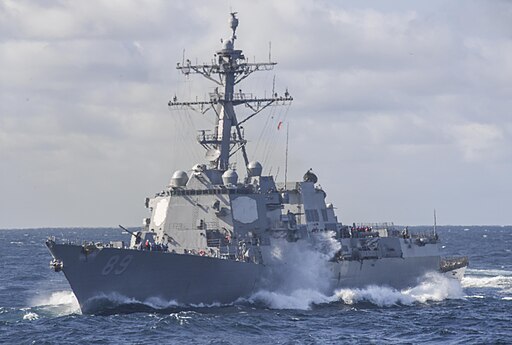
USS Mustin (DDG-89): Overview of a Modern Guided-Missile Destroyer
USS Mustin (DDG-89) is an Arleigh Burke-class, Flight IIA guided-missile destroyer commissioned on 26 July 2003. Named for the Mustin family—pioneers of U.S. naval aviation—Mustin combines Aegis combat systems, versatile weapon suites, and advanced propulsion to conduct air, surface and subsurface warfare, as well as ballistic-missile defense. Home-ported in San Diego, she supports carrier strike groups, littoral operations and maritime security missions worldwide.
Design and Development
Arleigh Burke-class Evolution
- Flight IIA Enhancements Flight IIA ships introduced a helicopter hangar, improved sonar arrays and expanded missile-cell capacity over earlier Flight I/IA designs. Mustin’s enlarged superstructure accommodates two MH-60R Seahawk helicopters, extending her anti-submarine and surface search reach.
- Aegis Combat System Central to Mustin’s design is the AN/SPY-1D(V) radar and AN/UYK-43 computing suite, linking fire control, tracking and threat evaluation in a fully integrated combat management system. This networked architecture supports simultaneous engagement of multiple targets.
Survivability and Signature Reduction
- Hull and Deckhouse Constructed from high-strength steel with angled surfaces, Mustin reduces radar cross-section. Critical compartments are armored and machinery is mounted on vibration-damping skids to lower acoustic signature.
- Battle Damage Control Automated fire-suppression systems, redundant power buses and compartmentalized piping improve Mustin’s ability to sustain casualties and continue operations under attack.
Construction and Commissioning
- Keel Laying: 15 January 2001 at Ingalls Shipbuilding, Pascagoula, Mississippi
- Launch: 12 December 2001; sponsored by Mrs. Thomas Mustin, granddaughter of Vice Admiral Henry Mustin
- Commissioning: 26 July 2003 at Naval Air Station North Island, San Diego under Cmdr. Joseph Carrillo
Sea trials validated propulsion, electronics and weapons integration before Mustin joined the Pacific Fleet.
Technical Specifications
Dimensions and Displacement
| Characteristic | Value |
|---|---|
| Length overall | 155.3 m (509 ft 6 in) |
| Beam (waterline) | 20 m (66 ft) |
| Draft | 9.4 m (31 ft) |
| Full-load displacement | ≈9,200 long tons (9,350 t) |
These proportions yield a stable weapons platform, generous aviation deck and room for 96 vertical-launch cells.
Propulsion and Performance
- Powerplant: 4 × General Electric LM2500-30 gas turbines
- Shafts: 2 (100,000 shp total)
- Propulsion: twin shafts with controllable-pitch propellers
- Speed: in excess of 30 knots
- Range: 4,400 nautical miles at 20 knots
Mustin’s all-gas turbine CODAG arrangement offers rapid acceleration for interdiction and high-speed transits.
Weapon Systems
Vertical Launching System (VLS)
- Mk 41 VLS: 96 cells (Forward and Aft modules) capable of:
- SM-2/SM-6 surface-to-air missiles
- Tomahawk land-attack cruise missiles
- RUM-139 VL-ASROC anti-submarine rockets
- ESSM (quad-packed)
Guns and Close-In Weapons
- 1 × 5-in/62 Mk 45 Mod 4 naval gun: precision surface and shore bombardment
- 2 × Mk 38 Mod 2 25 mm Bushmaster cannons: short-range surface threats
- 1 × 20 mm Phalanx CIWS: last-ditch missile defense
- 4 × .50 cal M2HB machine guns for small-boat threats
Torpedo Tubes
- 2 × Mk 32 triple torpedo tubes launching Mk 46/Mk 50/Mk 54 lightweight torpedoes
Sensors and Electronic Warfare
- AN/SPY-1D(V) Radar: 3D air/surface search and tracking
- AN/SQS-53C Hull-Mounted Sonar: medium-frequency search
- AN/SQR-19 TACTAS Towed Array: passive submarine detection
- AN/SLQ-32(V)3 Electronic Warfare Suite: radar warning and electronic countermeasure
- Decoy Launchers: Mk 36 SRBOC for chaff/flare dispensing
Aviation Facilities
- Flight Deck and Hangar: supports up to 2 MH-60R helicopters or unmanned aerial systems
- Hangar Dimensions: 20 m×7 m×6 m, with maintenance stands and aviation fuel storage
- Unmanned Vehicle support via universal launch and recovery positions
Crew and Habitability
- Standard Complement: 28 officers, 352 enlisted
- Surge Capacity: additional 20 mission-specialist billets
- Accommodations: modular staterooms, gym, medical bay, internet-capable crew spaces
Automated machinery control reduces watch-standing requirements, allowing more comfortable accommodations.
Operational History
Early Deployments
Following shakedown, Mustin deployed to the Western Pacific and Arabian Gulf, conducting maritime security patrols, anti-piracy operations and coalition exercises such as RIMPAC and Malabar.
Humanitarian Assistance
In 2013, Mustin provided relief support in the Philippines after Typhoon Haiyan, delivering supplies and serving as a communication hub for relief coordination.
Ballistic-Missile Defense
Equipped with SM-6 interceptors, Mustin participated in Aegis BMD experiments, showcasing anti-air and limited anti-ballistic capability during Integrated Air and Missile Defense exercises.
Upgrades and Modernization
- Aegis Baseline 9 Upgrade: Enhanced simultaneous air and missile defense/surface warfare
- Combat Systems Refresh: latest AN/SPY-6(V)1 radar slated for future installation
- Hull, Mechanical & Electrical (HME) Work: corrosion control, power-distribution improvements during mid-life availability
Continuous modernization ensures Mustin remains a multi-threat combatant into the 2040s.
Conclusion
USS Mustin (DDG-89) exemplifies the blend of firepower, automation and flexibility characteristic of the Arleigh Burke-class Flight IIA destroyers. With its Aegis combat suite, substantial VLS capacity, aviation facilities and robust defensive systems, Mustin continues to project power and safeguard maritime interests across the globe. Rigorous upgrades and versatile mission packages will keep Mustin at the forefront of naval warfare well into the 21st century.
.jpg)