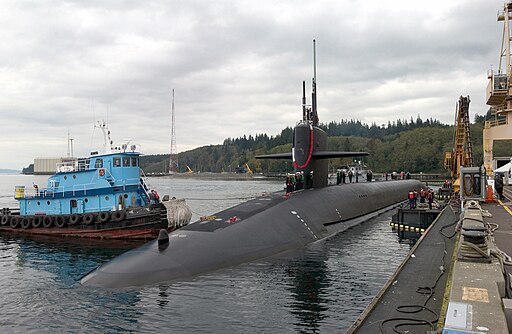
USS Nebraska (SSBN-739): Technical Profile of an Ohio-Class Ballistic Missile Submarine
USS Nebraska (SSBN-739) is the fourteenth Ohio-class nuclear-powered ballistic missile submarine of the United States Navy. Named after the Cornhusker State, she forms a critical leg of America’s strategic deterrent force. Commissioned in July 1993, Nebraska combines nearly unlimited underwater endurance with a formidable missile payload, ensuring a persistent and stealthy deterrent presence.
Design and Development
Ohio-Class Strategic Concept
The Ohio class was developed in the 1970s to replace earlier Polaris submarines and to carry the more advanced Trident II D-5 ballistic missile. Key goals included:
- Carrying a large missile complement for second-strike assurance
- Maximizing stealth through acoustic quieting technologies
- Operating for extended patrols without surfacing
“Trident” Missile Integration
Nebraska’s design centers on two vertical missile tubes—each holding eight Trident II D-5 missiles—providing a total of 16 long-range SLBMs. These missiles deliver multiple independently targetable reentry vehicles (MIRVs), reinforcing the submarine’s strategic impact.
Construction and Commissioning
- Contract Awarded: 26 May 1987, General Dynamics Electric Boat, Groton, Connecticut
- Keel Laid: 6 July 1987, marking the start of modular hull assembly
- Launched: 15 August 1992
- Commissioned: 10 July 1993, with USS Nebraska entering active service at Naval Submarine Base Kings Bay, Georgia
These milestones represent a rapid build cycle for a nearly 560-foot submarine, reflecting streamlined modular construction techniques.
Technical Specifications
Dimensions and Displacement
- Length Overall: 170 m (560 ft)
- Beam: 13 m (42 ft)
- Draft: 12 m (38 ft)
- Surfaced Displacement: 16,764 long tons (17,033 t)
- Submerged Displacement: 18,750 long tons (19,050 t)
The submarine’s teardrop hull shape reduces hydrodynamic drag, allowing efficient high-speed transit and quieter operations underwater.
Propulsion and Performance
- Reactor: Single S8G pressurized-water nuclear reactor fueled with highly enriched uranium
- Turbines: Two geared steam turbines driving one shaft with 60,000 shaft hp (45,000 kW) total
- Auxiliary Propulsion: 325 hp electric motor for low-speed maneuvering
- Speed: Exceeds 25 knots submerged
- Test Depth: Rated beyond 240 m (800 ft)
- Endurance: Limited primarily by crew consumables; reactor fuel allows years of operation without refueling
This nuclear-steam plant grants Nebraska essentially unlimited range and stealth, constrained only by food and maintenance schedules.
Armament and Payload
- Ballistic Missiles: 16 × Trident II D-5 SLBMs with MIRV capability
- Torpedo Tubes: Four 533 mm bow tubes firing Mk 48 heavyweight torpedoes
- Mines: Capability to deploy naval mines via torpedo tubes or dedicated launchers
This mixed weapon suite ensures that Nebraska can defend itself against submarines and surface threats while maintaining its strategic strike role.
Sensors, Navigation, and Countermeasures
- Sonar Suite: AN/BQQ-5 hull-mounted sonar complemented by a towed passive array for long-range detection
- Navigation: Inertial navigation system augmented by GPS when surfaced
- Electronic Warfare: ESM receivers and countermeasures dispensers to jam or decoy incoming torpedoes
Sophisticated acoustic quieting—anechoic coatings, raft-mounted machinery, and precision hull forms—keep acoustic signature to a minimum.
Crew and Habitability
- Complement: 15 officers and 140 enlisted sailors
- Berthing: Rotational bunks supporting continual operations
- Facilities: Medical bay, galley and mess halls, exercise area, and recreation lounge
- Surge Capacity: Accommodates special-operations detachments when required
Automation in engineering spaces reduces watchstanding manpower, improving habitability for long deterrent patrols.
Operational Role and Service History
Deterrent Patrols
Nebraska conducts routine strategic deterrent patrols, each lasting approximately 77 days followed by a maintenance period in port. Over her service life, she has completed dozens of patrols, ensuring continuous at-sea deterrence.
Missile Test Launches
The submarine has successfully test-fired Trident II D-5 missiles on multiple occasions, validating fire-control systems and crew proficiency.
Squadron Assignments
Originally assigned to Submarine Group 10 at Kings Bay, Georgia, Nebraska later transferred to Submarine Group 9 at Bangor, Washington, in 2004. This shift optimizes Pacific-oriented deterrent coverage.
Modernization and Life-Extension
Engineering Refueling Overhaul (ERO)
Around 2013, Nebraska entered a major overhaul to refuel her reactor and modernize combat systems, extending her service life into the 2040s.
Combat System Upgrades
- Integration of the Mk 48 ADCAP torpedo upgrade
- Enhanced fire-control processors for improved missile targeting
- Modernized communication suites for better linkage with national command authorities
These updates preserve USS Nebraska’s technological edge in strategic undersea warfare.
Conclusion
USS Nebraska (SSBN-739) remains a linchpin of U.S. strategic deterrence, combining near-silent operation, unlimited endurance, and a potent missile arsenal. Her advanced acoustic design, nuclear-steam propulsion, and modernized weapon and sensor suites ensure that she will continue to patrol the world’s oceans as a silent guardian of peace well into the mid-21st century.
_at_Naval_Base_Kitsap.jpg)