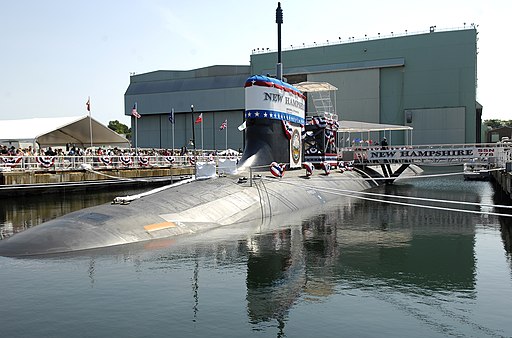
USS New Hampshire (SSN-778): A Modern Virginia-Class Attack Submarine
USS New Hampshire (SSN-778) is a nuclear-powered fast-attack submarine of the United States Navy’s Virginia class. As the first Block II boat of her class, she combines advanced stealth features, long endurance, and versatile combat systems. Commissioned in October 2008, New Hampshire serves as a multi-mission platform capable of undersea warfare, intelligence gathering, and precision land-attack operations.
Design and Development
Virginia-Class Evolution
The Virginia class was designed to replace the Los Angeles-class attack submarines with improved acoustic discretion, reduced manning requirements, and modular payload capabilities. Block II boats like New Hampshire incorporate revised bow construction that integrates standard vertical launch system (VLS) tubes—simplifying production and expanding strike capacity—alongside quieter pump-jet propulsion to reduce signature in littoral and open-ocean environments.
Stealth and Survivability Enhancements
Key stealth measures include anechoic hull coatings, raft-mounted machinery to dampen vibrations, and a contoured sail to minimize sonar reflections. The use of advanced composite materials in nonstructural elements further reduces detectability. These enhancements allow SSN-778 to operate undetected in contested waters and approach high-value targets with minimal acoustic footprint.
Construction and Commissioning
- Contract Awarded: 14 August 2003 to General Dynamics Electric Boat in Groton, Connecticut.
- Keel Laid: 30 April 2007, initiating modular hull assembly at Quonset Point.
- Launched & Christened: 21 February 2008; christening ceremony held 21 June 2008 ahead of schedule.
- Commissioned: 25 October 2008 in Kittery, Maine, home-ported at Norfolk, Virginia.
The rapid build and delivery schedule—eight months ahead of plan and $54 million under budget—reflects process improvements in Virginia-class production.
Technical Specifications Overview
Dimensions and Displacement
- Length Overall: 115 m (377 ft)
- Beam: 10 m (34 ft)
- Draft: 9.8 m (32 ft)
- Displacement: 7,800 t submerged; approximately 7,200 t surfaced
Compact dimensions and teardrop hull form optimize hydrodynamics, reducing drag and enhancing high-speed capability.
Propulsion and Performance
- Reactor: 1 × S9G pressurized-water nuclear reactor (210 MW thermal)
- Turbine Plant: 2 × steam turbines producing 40,000 shp (30 MW) total
- Propulsor: Single pump-jet with retractable secondary motor for slow-speed maneuvering
- Speed:
- Submerged: > 25 knots
- Sprint: Estimated > 30 knots in tactical dash
- Range & Endurance: Essentially unlimited (33 years reactor core life), constrained only by crew provisions
- Test Depth: Rated to exceed 244 m (800 ft)
This nuclear-steam plant coupled with pump-jet propulsion grants SSN-778 both whisper-quiet loitering and rapid transit capability.
Armament and Combat Systems
- Vertical Launch System: 12 × BGM-109 Tomahawk cruise missiles in standard VLS tubes
- Torpedo Tubes: 4 × 533 mm bow tubes firing Mk 48 heavyweight torpedoes
- Mines: Capability to deploy naval mines via torpedo tubes
- Special Operations Support: Provision for Dry Deck Shelter to launch SEAL Delivery Vehicles and combat divers
- Combat Control: AN/BYG-1 integrated combat system with fire-control for multi-target engagement
Modular payload racks in the weapons stowage area allow rapid reconfiguration for strike, anti-submarine, or mine-warfare missions.
Sensors, Navigation, and Electronic Warfare
- Sonar Suite: AN/BQQ-5 hull-mounted sonar complemented by a towed array for passive detection
- Periscope & Photonics Mast: High-resolution optical, infrared, and low-light cameras with electronic support sensors
- ESM & Countermeasures: Electronic support measures and decoy launchers for torpedo defense
- Navigation: Inertial navigation system augmented by GPS fixes at periscope depth
These systems provide long-range detection of surface and subsurface threats while maintaining situational awareness in complex littoral environments.
Crew and Habitability
- Complement: Approximately 134 personnel (14 officers, 120 enlisted)
- Accommodations: Rotational “hot bunking” for continuous operations, plus berthing for special-mission detachments
- Facilities: Medical bay, galley, torpedo and weapons stowage, exercise and recreation spaces
Automation of engineering and combat systems reduces watchstanding requirements, enabling a compact crew and extended patrol rhythms.
Operational Role and Capabilities
USS New Hampshire conducts a variety of missions, including undersea warfare, intelligence gathering, maritime security, and precision land-attack. Her ability to carry Tomahawks in a standard VLS—rather than a specialized large-diameter payload module—extends strike reach without compromising torpedo capacity. Additionally, her pump-jet drive and acoustic quieting allow operations close to denied shorelines.
Conclusion
As a Block II Virginia-class attack submarine, USS New Hampshire (SSN-778) represents a leap in undersea warfare capability. Her blend of advanced stealth features, modular payload flexibility, and nuclear endurance ensures she remains a cornerstone of U.S. naval power projection. Continuous upgrades to sonar processors, combat systems, and special-operations interfaces will sustain New Hampshire’s effectiveness well into the mid-21st century.
_sits_moored_to_the_pier_at_General_Dynamics_Electric_Boat_shipyard_moments_before_her_christening_ceremony_commenced.jpg)