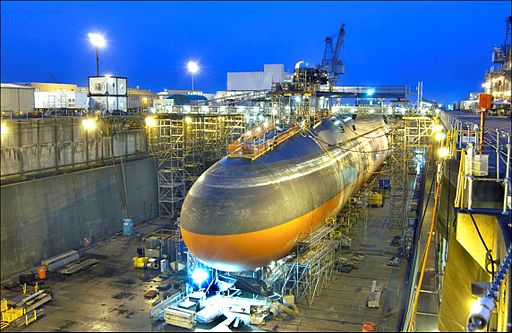
USS Ohio (SSGN-726): Technical and Operational Profile
USS Ohio (SSGN-726) is the lead boat of the Ohio class of guided-missile submarines in active service with the U.S. Navy. Originally commissioned as a ballistic-missile submarine (SSBN-726) in November 1981, she was converted into a guided-missile platform (SSGN-726) and rejoined the fleet in February 2006. Ohio combines nuclear endurance, precision strike capability and special-operations support in a single undersea vessel.
Design and Conversion
From SSBN to SSGN
Under the SSGN conversion program, Ohio’s 24 ballistic-missile tubes were reconfigured into 22 vertical launch tubes for Tomahawk cruise missiles and two lock-out chambers for special-operations forces. The 36-month refueling and overhaul began in November 2002 and concluded in January 2006, extending her service life while repurposing her for precision strike and clandestine missions.
Hull and Structure
The hull uses high-yield HY-80 steel and anechoic coatings to minimize acoustic signature. She measures 170 m overall with a beam of 13 m and a design draft of approximately 11 m. The teardrop-shaped sail houses retractable optronic masts for surveillance and communications, while vibration-isolated machinery supports stealthy operations.
Propulsion and Performance
Nuclear Reactor and Power Plant
Ohio is powered by a single S8G pressurized-water reactor using highly enriched uranium. Steam from the reactor drives two geared turbines producing 60,000 shp, all delivered through a single shaft and seven-bladed propulsor. A 325 hp auxiliary motor provides low-speed, ultra-quiet movement for special-operations scenarios.
Speed and Endurance
She achieves 12 knots on the surface and officially over 20 knots submerged, with some reports up to 25 knots. Nuclear power grants unlimited range, with endurance limited only by food supplies—approximately 60 days—while test depth exceeds 240 m.
Armament and Combat Systems
Tomahawk Vertical Launch Tubes
Twenty-two modular launch tubes each carry up to seven BGM-109 Tomahawk land-attack missiles, yielding a total strike load of 154 missiles. Launch tubes use gas ejection for submerged firing and can accommodate future munition types.
Torpedo Tubes and Special Operations Support
Four 533 mm bow torpedo tubes fire Mk 48 heavyweight torpedoes for anti-submarine and anti-surface warfare. Two converted tubes serve as lock-out chambers, enabling deployment and recovery of Navy SEALs or unmanned vehicles without surfacing.
Sensors and Electronics
Her AN/BQQ-6 bow-mounted sonar array, BQS-13 active sonar, and TB-16 towed-array sonar provide comprehensive acoustic coverage. Navigation is supported by the BQR-19 system. A combat-control suite fuses sonar, electronic-support measures and tactical data links for rapid targeting and strike coordination.
Crew and Habitability
Complement and Crewing Model
Ohio employs a dual-crew (“Blue” and “Gold”) rotation to maximize forward presence. Each crew comprises 15 officers and 140 enlisted personnel, with space to embark up to 66 special-operations forces for extended missions.
Habitability Features
Berthing areas offer increased personal storage and workstations. Modern galley and mess facilities support prolonged patrols. LED lighting mimics natural cycles, while advanced air-and-water recycling systems extend mission duration. Machinery-control automation reduces watchstanding requirements and crew fatigue.
Operational History
Strategic Deterrence Patrols
From her commissioning in 1981 through 2002, Ohio conducted deterrent patrols out of Bangor, Washington, carrying Trident II C-4 missiles. She completed her first Trident patrol in October 1982 and rotated crews to maintain continuous at-sea presence.
Conversion and SSGN Missions
Rejoining the fleet as an SSGN in February 2006, Ohio deployed on her first cruise-missile mission in October 2007. She pioneered forward-deployed crew exchanges in 2007–2008 and demonstrated rapid precision-strike and special-operations capabilities in the Western Pacific and Indian Ocean.
Notable Deployments
In June 2010, Ohio and two sister SSGNs surfaced simultaneously in three maritime regions as a strategic signal. She has supported humanitarian assistance and fleet exercises, while two crew members became the first female officer and enlisted sailor to qualify in submarines, underscoring evolving crewing practices.
Modernization and Future Outlook
Periodic upgrades to combat-system processing, sensor firmware and communications datalinks keep Ohio at peak capability. Integration of unmanned undersea vehicles and expanded payload options—such as precision hypersonic missiles—are planned. Scheduled for recycling by 2026, Ohio will conclude over four decades of combined deterrence and strike service, leaving a legacy for next-generation platforms.
