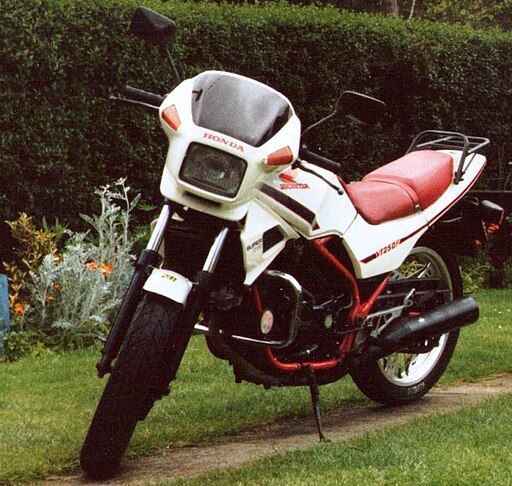
Honda VT250F
The Honda VT250F emerged in the early 1980s as a pioneering sport tourer that blended race-derived technology with everyday usability. With its lightweight V-twin engine, enclosed bodywork and advanced chassis, it set new benchmarks for handling and comfort in a 250-cc category. Riders appreciated its smooth power delivery, nimble cornering and surprising wind protection. Even decades after its launch, the VT250F remains a remarkable demonstration of Honda’s engineering foresight.
Historical Background
Market Context
In the late 1970s and early 1980s, small-displacement twins and singles dominated commuter bike sales, but few offered genuine sporting ability. Honda identified an opportunity to expand the 250-cc segment into sport tourers by introducing the VT250F, showcasing twin-cylinder refinement under fairing. Riders seeking more than basic mobility embraced the VT250F’s performance potential.
Model Evolution
The VT250F debuted in 1982 with a half-faired design and adjustable suspension. Over its production span, minor bodywork tweaks improved aerodynamics, while upgraded forks and brake components enhanced feel and stability. Its final iterations featured polished fairing panels, integrated instrumentation and subtle frame stiffening to sharpen steering response.
Design and Ergonomics
Styling
The VT250F’s fairing wrapped around the twin downdraft carburetors and V-twin engine, creating a cohesive silhouette unusual for its class. Its angular lines and squared-off headlamp housed twin gauges behind a tinted windscreen. Clean side panels concealed the battery and relay boxes, giving the impression of a single-piece body.
Rider Comfort
An 805 mm seat height strikes a balance between road clearance and rider reach for average-height adults. Clip-on handlebars are mounted above the top yoke, offering a slightly forward lean that encourages engagement without strain. Footpegs are positioned rearward enough to allow sporty corner lean angles, yet not so extreme as to hamper longer rides.
Engine and Powertrain
V-Twin Configuration
The heart of the VT250F is a 249 cc liquid-cooled V-twin engine with a 90-degree cylinder layout. Its narrow-angle design creates perfect primary balance, yielding exceptionally smooth operation for a twin of this size. Dual overhead camshafts operate four valves per cylinder, ensuring efficient breathing across the rev range.
Power Output and Delivery
Peak power is rated at 30 hp at 10,500 rpm, with maximum torque of 22 Nm at 8,500 rpm. The engine builds revs eagerly above 7,000 rpm, rewarding riders with a linear surge that keeps the tachometer needle climbing. Below that threshold, the V-twin’s low-down torque makes city riding effortless and reduces the need for constant downshifting.
Fuel System and Ignition
Fuel flows through two 26 mm Keihin carburetors with accelerator pumps for instant throttle response. An electronic ignition module times spark precisely, even at high revs, eliminating fouled plugs and uneven idle. A thermostatically controlled radiator fan ensures optimum engine temperature under all conditions.
Transmission and Final Drive
A six-speed gearbox features close-ratio gears to maximize the engine’s narrow powerband. Gear changes are slick and deliberate thanks to a modular shift drum design. Power reaches the rear wheel through a durable O-ring chain and lightweight aluminum sprockets.
Chassis and Suspension
Frame Structure
A high-tensile steel perimeter frame cradles the engine, using the V-twin as a stressed member to reduce overall weight. The design delivers a tight steering geometry with a 24.5-degree rake and 95 mm trail. This configuration yields precise turn-in and excellent stability at speed.
Front Suspension
The front suspension employs 35 mm telescopic forks with spring preload adjustability and damping tuned for sporty feedback. With 130 mm of travel, the forks absorb road irregularities while maintaining chassis control under braking.
Rear Suspension
A Pro-Link single shock with adjustable preload and rebound damping supports the rear. Mounted to a double-cradle swingarm, it offers 125 mm of travel. The rising-rate design increases resistance toward the end of the travel, preventing harsh bottom-outs during aggressive riding.
Braking and Wheels
Brake Components
At the front, a single 276 mm hydraulic disc works with a dual-piston caliper to deliver ample stopping power and modulation. The rear uses a 220 mm disc paired with a single-piston caliper, ensuring balanced braking feel. Braided brake lines resist expansion, keeping lever feedback consistent.
Wheel and Tire Setup
The VT250F rolls on 17-inch cast aluminum wheels front and rear. Stock tires are sized 100/90-17 at the front and 120/90-17 at the rear, striking a compromise between grip, rolling resistance and ride comfort. The wheel-tire combination aids quick direction changes and high-speed stability.
Electrical and Instrumentation
Charging System
A 12-V alternator produces 200 W at 5,000 rpm, enough to power the headlamp, indicators and heated accessories simultaneously. A 12 Ah battery holds reserve charge for cold starts and low-rpm operation.
Instrument Cluster
A full-size analog tachometer and speedometer flank a digital multifunction display. Gear position, dual trip meters and coolant temperature readouts live within the digital window. Indicator lamps for oil pressure, neutral, high beam and fuel warning are arranged for immediate glance recognition.
Performance and Handling
On twisty roads, the VT250F feels agile yet composed, thanks to its stiff chassis and balanced weight distribution. The 160 kg curb weight contributes to effortless changes of direction without nervousness. Highway cruising at 120 km/h places the engine at 8,500 rpm, where vibration is minimal and wind protection is surprisingly effective.
Maintenance and Service
Routine Intervals
- Oil and filter change: every 6,000 km
- Valve clearance inspection: every 12,000 km
- Air filter service: every 8,000 km or after heavy dust exposure
- Carburetor synchronization: every 12,000 km
- Brake fluid replacement: every 24 months
Long-Term Considerations
Cam chain tensioners require periodic inspection to maintain quiet operation. Coolant hoses and radiator fins benefit from occasional cleaning to prevent overheating in stop-and-go traffic. The Pro-Link shock seals should be checked annually to guard against oil leaks.
Technical Specifications
| Specification | Detail |
|---|---|
| Engine Displacement | 249 cm³ |
| Engine Type | Liquid-cooled, 90° V-twin, DOHC, 4-valve |
| Bore × Stroke | 60 mm × 44 mm |
| Compression Ratio | 11.0 : 1 |
| Carburetors | Dual Keihin CV 26 mm |
| Ignition | Electronic CDI |
| Transmission | 6-speed constant mesh |
| Final Drive | O-ring chain |
| Frame | High-tensile steel perimeter |
| Front Suspension | 35 mm telescopic fork, adjustable preload, 130 mm travel |
| Rear Suspension | Pro-Link single shock, adjustable preload/rebound, 125 mm travel |
| Front Brake | 276 mm disc, dual-piston caliper |
| Rear Brake | 220 mm disc, single-piston caliper |
| Front Tire | 100/90-17 |
| Rear Tire | 120/90-17 |
| Wheelbase | 1,350 mm |
| Seat Height | 805 mm |
| Curb Weight | 160 kg |
| Fuel Capacity | 12 L |
| Top Speed | Approximately 170 km/h |
Conclusion
The Honda VT250F remains an influential model that showcased advanced V-twin engineering within a compact sport-touring package. Its combination of lively power delivery, precise chassis dynamics and thoughtful ergonomics set a template followed by many successors. Even today, the VT250F’s blend of performance and practicality inspires enthusiasts to restore, ride and celebrate its pioneering spirit.
