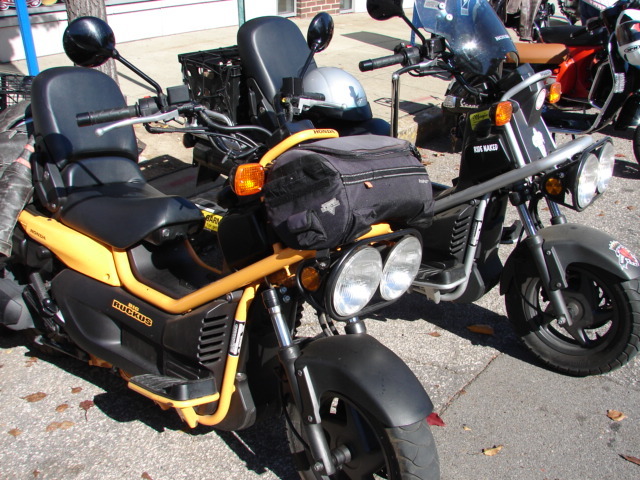
Honda Big Ruckus
The Honda Big Ruckus is a distinctive maxi-scooter that blends raw industrial styling with practical commuter functionality. Unveiled in the mid-2000s, it stood apart from conventional scooters with its exposed steel skeleton frame, dual headlights, and upright riding position. Beneath its rugged appearance lies a refined 249-cc V-twin engine, automatic transmission, and generous storage capacity—making it as comfortable on daily urban errands as it is on weekend jaunts.
Historical Background
Development and Market Launch
Honda introduced the Big Ruckus in 2004 as part of its Forza lineup in Japan, later bringing it to Europe and the United States in 2005. The goal was to offer riders a unique alternative to the standard maxi-scooter silhouette: rather than hiding mechanical elements, the Big Ruckus celebrates them. Despite its polarizing aesthetic, Honda positioned it as a premium urban runabout, leveraging proven scooter technology in an unconventional package.
Production Span and Evolution
Produced until 2007 in most markets, the Big Ruckus remained largely unchanged throughout its short run. Honda’s focus was on refining ergonomics and weed-wacking costs rather than frequent updates. Riders who embraced its bare-bones look valued its simplicity—there were no plastic side panels to crack, just a sturdy tubular frame and exposed components designed for longevity.
Design and Ergonomics
Industrial Styling
The Big Ruckus strips away bodywork in favor of visible welds, steel tubing, and mechanical parts. Dual round headlights sit low between the front forks, guarded by slender rubber boots. A minimalist rear grab bar doubles as a cargo rack, while a single-piece seat stretches from the fuel filler to the taillight housing. Black-painted frame members contrast with metallic accents, reinforcing its utilitarian persona.
Handling Character
Despite its bulkier reputation, the Big Ruckus handles with surprising agility. A wheelbase of 1,530 mm and a rake of 37° deliver stable straight-line performance, while narrow 110 mm front and 140 mm rear tires allow quick transitions at lower speeds. Tall handlebars and a short front overhang make tight U-turns in city traffic straightforward.
Rider Comfort
An upright seating position places the rider squarely over the scooter’s center of gravity, reducing fatigue in stop-and-go traffic. The wide, cushioned seat measures 760 mm above ground, accommodating a variety of rider heights. Peg-style footrests offer flexibility—riders can plant their feet forward for cruising or slide them back when weaving through congested streets.
Engine and Powertrain
V-Twin Engine Layout
Powering the Big Ruckus is a 249 cc liquid-cooled, four-stroke V-twin engine with a 52 mm bore and 58 mm stroke. Its 52° cylinder angle and 270° firing interval mimic a larger V-twin’s character, providing a smooth yet lively torque curve. A single overhead camshaft on each cylinder operates two valves apiece, balancing mechanical simplicity with sufficient breathing for urban speeds.
Power Output and Fuel Efficiency
Rated at 20 hp at 7,500 rpm and 20 Nm of torque at 6,000 rpm, the Big Ruckus delivers spirited midrange thrust while remaining docile at low revs. Throttle response is linear thanks to electronic fuel injection and a 32 mm throttle body. Average fuel consumption hovers around 3.5 L/100 km, translating to a real-world range of 250–300 km on its 7.5 L tank.
Transmission and Drivetrain
Automatic Continuously Variable Transmission
A V-belt continuously variable transmission (CVT) provides seamless acceleration without manual shifting. Honda’s two-stage centrifugal clutch system engages the rear wheel progressively, smoothing out torque delivery and eliminating belt slippage under load. Low-gear ratios help with hill starts, while the high-ratio range promotes efficient cruising.
Final Drive
Power transfers to the steel-reinforced rear wheel via a fully enclosed belt drive. Unlike traditional chains, the belt requires no lubrication and resists stretching, reducing maintenance intervals. Easy-to-adjust tensioners ensure consistent performance throughout the drive belt’s service life.
Chassis and Suspension
Steel Tube Frame
The backbone of the Big Ruckus is a high-tensile steel tube frame that doubles as both structural member and styling element. Its exposed welds and gussets reinforce stress points, while cross-bracing under the rider’s floorboard improves torsional rigidity. The open frame also simplifies inspection and repairs.
Front Suspension
Conventional telescopic forks with 110 mm of travel tackle bumps and potholes with a plush feel. Fork springs are calibrated for comfort under solo or two-up riding. A small rubber gaiter shields each fork tube from dust and debris, extending seal life.
Rear Suspension
Dual preload-adjustable shock absorbers offer 100 mm of travel, mounting the engine and swingarm assembly to the frame via progressive linkages. Riders can dial in stiffness when carrying a passenger or luggage without specialized tools.
Braking and Wheels
Front Braking System
A 256 mm hydraulic disc at the front uses a two-piston caliper to deliver strong initial bite and predictable fade resistance. A braided stainless-steel brake line connects the lever to the caliper, providing crisp feedback and minimal lever flex.
Rear Braking System
At the rear, a sealed 130 mm drum brake offers reliable stopping power and easy maintenance. Drum shoes and springs can be accessed by removing the rear hub cover, making spring replacements and adjustments simple tasks.
Tires and Rims
Cast aluminum wheels measure 13 inches front and rear, balancing agility with ride comfort. Stock tire dimensions are 110/90-13 up front and 140/70-13 at the rear. Tire profiles were chosen to minimize scrub radius and maintain crisp steering geometry under lean.
Storage and Practicality
Under-Seat Storage
Beneath the two-piece seat lies a large storage compartment capable of swallowing a full-face helmet, shopping bags, or small tool kit. A spring-loaded latch and integrated light make nighttime access convenient. The compartment’s molded plastic liner resists scratches and keeps items secure during aggressive cornering.
Cargo Rack and Accessories
The tubular rear grab bar doubles as a load-bearing rack. With optional hardware, riders can mount top cases, luggage racks, or work-mounted boxes. Tie-down points on the floorboard allow for soft duffels or grocery baskets, enhancing the Big Ruckus’s errand-running capability.
Electrical and Instrumentation
Lighting System
Dual halogen headlamps offer a broad, even beam pattern for urban and suburban roads. Indicators and brake lights use incandescent bulbs for straightforward replacement. A combined passing lamp, activated by a handlebar switch, boosts on-coming visibility without drawing on a separate circuit.
Instrument Cluster and Electronics
The dashboard blends analog and digital displays: twin round gauge housings show speedometer and tachometer, flanking a central digital screen for fuel level, trip meter, and clock. Indicator lamps for neutral, high beam, turn signals, and low-oil pressure line the bottom edge. An integrated immobilizer and key-shutter system deter unauthorized starts.
Performance and Handling
Urban Commute
In city traffic, the Big Ruckus’s upright ergonomics, torquey V-twin, and responsive CVT make weaving through lanes effortless. Its short front overhang and generous steering lock radius allow tight maneuvers in parking lots or crowded intersections. The exposed frame also aids rider awareness of wheel placement over uneven pavement.
Highway and Open Roads
Although not designed as a long-distance tourer, the Big Ruckus maintains stability at speeds up to 110 km/h. Wind windblast is moderate thanks to the rider’s upright posture, and vibrations remain subdued by the V-twin’s inherent balance. Suspension compliance softens highway joints, while robust brakes instill confidence in emergency stops.
Fuel Economy
An average of 25–30 km per liter under mixed riding conditions makes the Big Ruckus an economical choice for daily commuters. Its modest fuel tank limits maximum range, but frequent fill-ups are quick thanks to a wide filler neck and recessed cap.
Maintenance and Service
Service Intervals
Routine maintenance intervals are as follows:
- Engine oil and filter change: every 6,000 km
- CVT belt inspection: every 12,000 km
- Air filter cleaning: every 4,000 km (sooner in dusty environments)
- Brake fluid replacement: every 24 months
- Belt final drive inspection: every 12,000 km
Long-Term Upkeep
The enclosed belt drive virtually eliminates lubrication chores typical of chain-drive scooters. Drum brake maintenance requires only periodic shoe inspections. Valve clearance checks and spark plug replacements occur at extended intervals, reflecting the engine’s robust head gasket and hardened valve seats.
Technical Specifications
| Specification | Detail |
|---|---|
| Engine Displacement | 249 cc |
| Engine Type | Liquid-cooled, 4-stroke, 52° V-twin |
| Bore × Stroke | 52 mm × 58 mm |
| Compression Ratio | 10.5 : 1 |
| Fuel System | Electronic fuel injection with 32 mm throttle bodies |
| Ignition | CDI with immobilizer |
| Transmission | V-belt CVT with two-stage centrifugal clutch |
| Final Drive | Enclosed rubber-reinforced belt |
| Frame | Exposed tubular steel |
| Front Suspension | Telescopic fork, 110 mm travel |
| Rear Suspension | Dual shocks with preload adjust, 100 mm travel |
| Front Brake | 256 mm hydraulic disc, dual-piston caliper |
| Rear Brake | 130 mm leading-shoe drum |
| Front Tire | 110/90-13 |
| Rear Tire | 140/70-13 |
| Wheelbase | 1,530 mm |
| Seat Height | 760 mm |
| Fuel Capacity | 7.5 L |
| Dry Weight | 156 kg |
| Top Speed | Approximately 110 km/h |
Conclusion
The Honda Big Ruckus remains a bold statement in scooter design—its unapologetic industrial styling, practical storage solutions, and user-friendly mechanics set it apart in the maxi-scooter segment. While its production run was brief, dedicated riders continue to appreciate its low maintenance demands, agile handling, and distinctive personality. Whether carving through rush-hour traffic or tackling weekend errands, the Big Ruckus delivers an engaging ride grounded in Honda’s reputation for engineering reliability.
