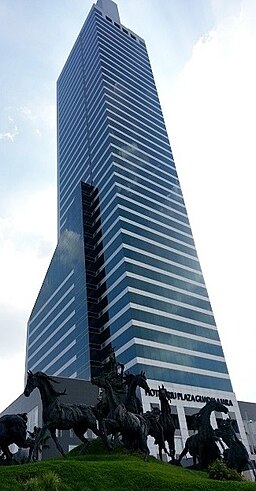
Hotel Riu Plaza Guadalajara
The Hotel Riu Plaza Guadalajara rises as a landmark in western Mexico’s urban fabric. Completed in 2011, this 204-metre tower combines refined architectural expression with rigorous engineering solutions. Serving both business and leisure guests, it integrates advanced structural systems, sustainable technologies, and high-performance building services.
Architectural and Structural Overview
Location and Urban Context
Situated on Avenida López Mateos in the Colonia Chapalita district, the tower commands direct access to Guadalajara’s commercial corridors, cultural venues, and the city’s main exhibition centre. Its position at the heart of a rapidly growing business zone influenced both its slender form and mixed-use program.
Architectural Concept
Designed by GVA & Asociados, the hotel presents a prism-like silhouette with a fully glazed façade. Clean vertical lines emphasize its height, while a rooftop penthouse and heliport cap the structure. Public amenities occupy the lowest three levels, guest rooms fill the mid-section, and executive facilities crown the top floors.
Dimensions and General Data
| Parameter | Value |
|---|---|
| Total Height (including spire) | 204.0 m |
| Roof Height | 189.2 m |
| Above-Ground Floors | 44 |
| Basement Levels | 3 |
| Habitable Floors | 42 |
| Footprint Area | 8 190 m² |
| Total Guest Rooms | 550 |
| Conference Floor Area | 4 000 m² |
| Construction Cost | USD 110 million |
| Construction Period | March 2009 – June 2011 |
| Structural Engineer | Ingeniería Básica Diseño Estructural |
| Main Contractor | Montecarlo Construcción y Mobiliario |
Foundation and Geotechnical Design
Subsoil Conditions
Subsurface exploration revealed variable volcanic and alluvial deposits typical of the Guadalajara basin. Near-surface layers comprised loose sands and silts, transitioning to stiffer clays and sands at 8–10 m depth.
Foundation System
To bypass compressible soils, designers installed 113 reinforced-concrete piles ranging from 0.6 m to 2.0 m in diameter, reaching depths of 10–15 m. A perimeter slurry wall reinforced with shotcrete contained the three-level excavation, while a raft foundation distributed gravity loads across the pile caps.
Structural System and Seismic Design
Load-Bearing Structure
The primary structure is a cast-in-place reinforced-concrete core, housing elevators, stairs, and services. Peripheral columns and post-tensioned floor slabs span between core walls and a steel-reinforced concrete perimeter frame, enabling open-plan guest rooms.
Seismic Resilience
Located in a high-seismicity zone, the building meets local design code requirements for a peak ground acceleration of 0.36 g. Structural provisions include:
- Ductile detailing in shear walls and moment frames
- Steel coupling beams in core wall openings
- Base-isolation bearings in mechanical sections
These measures limit interstory drifts and preserve structural integrity during events up to magnitude 8.0.
Façade and Building Envelope
Curtain-Wall System
A double-skin aluminum-glass curtain wall wraps the structure. The outer layer of low-emissivity tempered glass reduces solar gain, while an inner laminated pane enhances acoustic insulation.
Thermal and Acoustic Performance
- Overall U-value: 1.4 W/m²K
- Solar heat gain coefficient: 0.32
- Sound Transmission Class (STC): 45
This envelope minimizes HVAC loads and shields occupants from city noise.
Building Services and MEP Systems
HVAC
- Central absorption and electric chillers totaling 2 500 kW
- Variable Air Volume (VAV) terminal boxes per zone
- Heat-recovery wheels in AHUs achieving 60 % energy reuse
- Intelligent thermostatic controls in all guest rooms
Vertical Transportation
- Ten Otis Gen2 high-speed elevators (2.5 m/s)
- Two service lifts with 2 000 kg capacity
- Seismic sensors for automatic recall to safe floors
Electrical and Lighting
- Dual-feed utility connection with automatic transfer switch
- On-site 1 200 kVA diesel generator for emergency loads
- LED lighting throughout public and back-of-house areas
- Photovoltaic array on roof delivering up to 120 kWp
Fire Protection and Safety
- Fully zoned wet-pipe sprinkler system per EN 54 standards
- Pressurized stairwells with smoke exhaust fans
- Addressable fire-alarm panels with voice-evacuation capability
- Biometric access control and CCTV networks
Sustainability and Smart Building Features
Energy Efficiency Strategies
The hotel implements an integrated Building Management System (BMS) that:
- Optimizes chiller staging and pump pressure
- Modulates lighting via daylight sensors and occupancy detectors
- Provides real-time energy dashboards
Water Management
- Rainwater harvesting for irrigation and cooling-tower makeup
- Low-flow fixtures reducing potable water use by 40 %
- Blackwater treatment for nonpotable reuse
Digital Infrastructure
- Redundant 1 Gbps fiber-optic backbone for guest and operations networks
- In-room IP-TV and centralized IPTV streaming servers
- 5G small-cell deployment for seamless mobile coverage
Functional Layout and Amenities
Guest Rooms and Suites
Typical floors contain 12–14 rooms, sized 30–45 m². Offerings include:
- Standard Deluxe Rooms
- Executive Suites with separate living areas
- Presidential Suite on the 44th floor
All accommodations feature:
- Integrated climate, lighting, and curtain automation
- Minibar and in-room safe
- Sound-absorbing wall panels
Conference and Event Spaces
Three lower-level floors house 16 modular meeting rooms totaling 4 000 m². Equipped with:
- 4K laser projection and integrated AV systems
- Simultaneous-translation booths and digital interpretation links
- Wireless DECT microphone networks
Leisure Facilities
- Rooftop outdoor pool with panoramic city views
- Full-service spa with sauna, steam rooms, and treatment cabins
- Fitness center with cardio and free-weight zones
- Two signature restaurants and a lobby bar
Construction Timeline and Key Milestones
- Site Mobilization and Excavation: March 2009 – December 2009
- Foundation and Substructure: January 2010 – June 2010
- Superstructure Erection: July 2010 – March 2011
- Façade Installation: October 2010 – April 2011
- Interior Fit-Out and Commissioning: April 2011 – June 2011
- Grand Opening: June 2011
Conclusion
Hotel Riu Plaza Guadalajara exemplifies a synthesis of elegant design, robust engineering, and sustainable operation. Its advanced seismic detailing ensures resilience, while its smart building technologies optimize performance and guest comfort. As Guadalajara’s tallest hotel, it stands as an icon of modern urban hospitality in Latin America.
