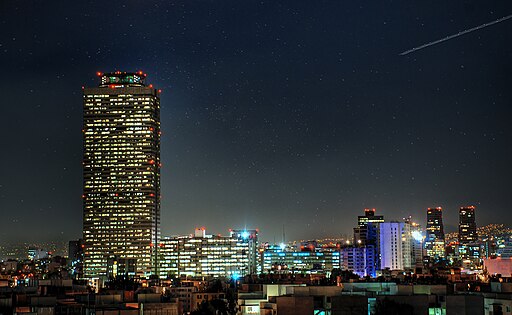
Torre Ejecutiva Pemex
The Torre Ejecutiva Pemex stands as an enduring symbol of Mexico’s oil industry and engineering prowess. Rising over the former lakebed of Mexico City, this office skyscraper combines robust seismic design with advanced building systems. Its role as the headquarters of Petróleos Mexicanos (Pemex) has driven continuous upgrades in sustainability, automation, and occupant safety.
General Data
Location and Context
The tower occupies a central site on Avenida Marina Nacional, Colonia Verónica Anzures, in Miguel Hidalgo borough. It anchors the wider Centro Administrativo Pemex complex, a cluster of administrative buildings serving Mexico’s state oil company.
Key Dimensions
Below is a concise summary of the tower’s principal metrics:
| Parameter | Value |
|---|---|
| Height | 211.3 m |
| Floors | 51 above grade + 4 below grade |
| Gross Floor Area | 165 000 m² |
| Construction Period | 1979 – 1984 |
| Architect | Pedro Moctezuma Díaz Infante |
| Foundation Piles | 164 bored piles, Ø 1.5 m × 35 m deep |
Foundation and Geotechnics
Subsoil Conditions
Built atop ancient lake sediments, the site features high-compressibility clay layers. To reach load‐bearing strata, deep foundations were essential.
Pile Foundation
A grid of 164 reinforced‐concrete piles, each 1.5 m in diameter and extending 35 m into the ground, anchors the structure. The system transfers gravity and seismic loads into firmer subsoil, bypassing the soft, compressible near‐surface deposits.
Structural System
Core and Frame
The primary vertical support comes from a two-shaft concrete core housing elevators and stairs. Surrounding this core is a steel frame composed of high-strength hollow‐section beams. Connections were bolted on-site, simplifying future retrofits and inspections.
Seismic Mitigation
To withstand Mexico City’s frequent earthquakes, ninety viscoelastic dampers are strategically placed within the X-braced bays. These devices absorb and dissipate seismic energy, limiting sway to comfort levels and protecting structural elements. The design targets resilience up to magnitude 8.5 on the Richter scale.
Façade and Envelope
Curtain Wall System
A double-skin curtain wall wraps the tower, combining anodized aluminum panels with tinted, low-reflection glass. Floor-to-ceiling glazing maximizes views while the cavity between panes enhances thermal performance.
Thermal and Acoustic Performance
The envelope achieves a U-value near 1.5 W/m²K and solar heat gain below 35 %. Acoustic insulation rated around 42 dB shields occupants from urban noise, critical in a dense metropolitan core.
Building Services
HVAC System
- Central cooling with Variable Air Volume (VAV) distribution
- 4 000 kW centrifugal chillers
- Plate‐type heat exchangers for energy recovery
- Direct Digital Control (DDC) for dynamic zone management
Vertical Transportation
- 27 high-speed elevators, up to 6 m/s
- Group dispatching logic to minimize wait times
- Seismic sensors that automatically halt cars at the nearest floor
Electrical and Lighting
- Dual‐feeder power supply from separate substations
- LED retrofit throughout common and office areas
- Emergency generators sized for critical life‐safety loads
Fire Protection
- Full‐coverage wet and dry sprinkler zones
- Fire compartments every five floors
- Three pressurized stair cores and smoke exhaust systems
Sustainability and Automation
Energy Efficiency Features
Recent retrofits have focused on reducing operating carbon:
- LED lighting with daylight harvesting
- Gray‐water reuse for nonpotable demands
- Photovoltaic panels on ancillary roofs
Building Management System
An integrated BMS orchestrates mechanical, electrical, lighting, and safety systems. Real‐time monitoring and fault detection maintain optimal performance and occupant comfort.
Functional Layout
Office and Support Spaces
Each typical floor offers roughly 1 800 m² of column-free office space. Amenities include conference suites, research labs, and executive offices configured around the central core.
Public Areas and Plaza
An expansive underground plaza links the tower to adjacent buildings. Although never fully realized, the subterranean concourse houses retail kiosks and food services for the approximately 7 000 daily occupants.
Construction Timeline and Heritage
Groundbreaking began in 1979, with structural topping-out achieved by 1982 and full completion in 1984. Since opening, the tower has withstood major quakes (1985, 1995, 2003, 2017), proving the foresight of its seismic design. An explosion in 2013 prompted further safety and fire-protection enhancements.
Conclusion
The Torre Ejecutiva Pemex exemplifies a marriage of technical rigor and operational flexibility. From its deep‐pile foundation to state‐of‐the-art building systems, every element underscores a commitment to safety, efficiency, and longevity. As one of Mexico City’s defining high-rise works, it continues to evolve with ongoing modernization initiatives, cementing its role as both a functional asset and an engineering landmark.
.jpg)