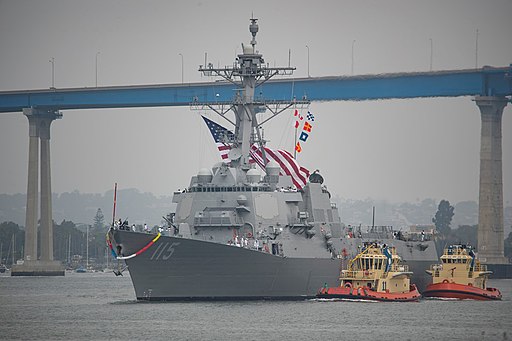
USS Rafael Peralta (DDG-115)
USS Rafael Peralta (DDG-115) is an Arleigh Burke–class Flight IIA guided-missile destroyer in the United States Navy. Named in honor of Marine Corps Sergeant Rafael Peralta, a Medal of Honor recipient, the ship embodies the multi-mission flexibility and resilience of its class. Commissioned in January 2017, Rafael Peralta operates out of San Diego, projecting power across the Pacific, supporting ballistic missile defense, and safeguarding sea lanes.
Design and Development
Flight IIA Enhancements
As a Flight IIA variant, Rafael Peralta incorporates significant upgrades over earlier Arleigh Burke destroyers. The most visible change is the enclosed hangar that supports two MH-60R Seahawk helicopters, extending the ship’s anti-submarine and surface warfare reach. Structural reinforcements accommodate added weight, while refined electronic cooling handles higher power demands of advanced radars and combat systems.
Hull and Survivability
The hull is fabricated from high-strength, low-observable steel with an angled tumblehome design to reduce radar cross-section. Internally, longitudinal framing and shock-hardened bulkheads increase resilience against underwater explosions. Automated damage control systems monitor flooding and fires, isolating compromised compartments within seconds of detection to preserve buoyancy and combat capability.
Propulsion and Powerplant
Combined Gas and Gas (COGAG)
Rafael Peralta utilizes a Combined Gas and Gas configuration. Four General Electric LM2500 gas turbines deliver a combined 100,000 shaft horsepower to two controllable-pitch propellers. This arrangement provides:
- Rapid acceleration for tactical maneuvers
- Cruise speeds exceeding 30 knots for fleet escort
- Quiet transit via single-turbine operation to reduce acoustic signature
Electrical Generation
Power for sensors, weapons, and hotel services comes from three 2,000 kW ship service gas turbine generators and two 1,500 kW emergency diesel generators. Dual main electrical buses and cross-tie switches ensure uninterrupted power flow even under battle damage or equipment failure.
Combat Systems and Armament
Vertical Launching System
Rafael Peralta’s signature firepower stems from its 96-cell Mark 41 Vertical Launching System. The flexible VLS accommodates a mix of:
- SM-2 and SM-6 Standard Missiles for air defense
- SM-3 interceptors for regional ballistic missile defense
- Tomahawk Land Attack Missiles for precision strike
- ASROC rockets to engage submarines at standoff range
Cells can be reconfigured ashore to meet specific mission requirements, supporting rapid transition between anti-air, anti-surface, and anti-submarine roles.
Naval Guns and Close-In Weapons
- One 5-inch/62-caliber Mk 45 Mod 4 naval gun delivers precision naval gunfire for shore bombardment and surface engagements.
- Two Phalanx Mk 15 Block 1B Close-In Weapon Systems provide an automated final barrier against anti-ship missiles and fast-attack craft.
- A SeaRAM launcher, replacing one Phalanx in later overhauls, integrates Rolling Airframe Missiles for extended close-in coverage.
These layered defenses ensure multiple intercept opportunities against incoming threats.
Anti-Submarine Warfare Suite
Rafael Peralta combines hull-mounted sonar (AN/SQS-53C) with a towed array (AN/SQR-19) for long-range submarine detection. The embarked MH-60R Seahawk extends ASW reach, deploying dipping sonars, sonobuoys, and Mk 54 torpedoes. Two triple Mk 32 torpedo tubes provide rapid local engagements.
Sensors and C4ISR
Aegis Combat System
At the core of Rafael Peralta’s combat prowess lies the Aegis Baseline 9 combat system. Paired with AN/SPY-1D(V) phased-array radar, it tracks hundreds of simultaneous air and surface contacts. Cooperative Engagement Capability (CEC) data links fuse sensor data with allied units, extending radar coverage and enabling networked engagements.
Electronic Warfare and Decoys
The AN/SLQ-32(V)6 electronic warfare suite offers advanced radar warning, signal analysis, and active jamming. Complementary SRBOC (Super Rapid Bloom Offboard Countermeasures) chaff and Nulka active decoy launchers deceive both radar-guided and infrared seekers, bolstering the ship’s layered defense.
Communications and Data Integration
An open-architecture Combat Information Center hosts multi-function consoles for tactical command. Tactical data links—including Link 16 and Link 22—enable real-time coordination with aircraft, submarines, and coalition vessels. Satellite communications and high-bandwidth internal networks sustain continuous situational awareness and rapid decision cycles.
Aviation Facilities
Flight Deck and Hangar
The enclosed hangar and flight deck support two MH-60R helicopters. Facilities include:
- Integrated aviation fuel tanks storing 30,000 gallons of JP-5
- Maintenance shops with spare parts, tools, and avionics consoles
- Towed sonar handling equipment and torpedo storage
These assets enhance Rafael Peralta’s ability to project ASW, anti-surface, and search-and-rescue capabilities far beyond the ship’s hull.
Unmanned Systems Integration
Wiring and deck space are reserved for future unmanned aerial and surface vehicles. Data links and control stations within the Mission Bay permit rapid fielding of vertical-takeoff ISR drones or medium-size USVs, extending the ship’s reconnaissance and targeting footprint.
Crew and Habitability
Complement and Departments
USS Rafael Peralta operates with 28 officers and 254 enlisted personnel. Departments span operations, engineering, weapons, combat systems, supply, and medical. Cross-training ensures flexible watch rotations and deep redundancy for critical functions during high-tempo operations.
Living Quarters and Amenities
Crew berthing features shock-isolated racks, privacy curtains, and climate control. Common areas include a modern galley serving 400 meals per watch, a fitness center, a well-equipped medical clinic, and a small darkened stateroom for secure communications. Automation in damage control and machinery monitoring reduces routine workload, enhancing crew endurance on extended deployments.
Dimensions and Performance
Physical Characteristics
- Length overall: 509 feet (155 m)
- Beam: 66 feet (20 m)
- Draft: 31 feet (9.4 m)
Displacement and Range
- Light displacement: 7,600 tons
- Full load displacement: 9,200 tons
- Maximum speed: over 30 knots
- Range: 4,400 nautical miles at 20 knots
Operational History
Maiden Deployments
Following commissioning, Rafael Peralta joined the U.S. Third Fleet for initial training and shakedown. Its first forward deployment to the Western Pacific included integrated air and missile defense patrols, multinational exercises with allies, and maritime security operations in the South China Sea.
Ballistic Missile Defense Patrols
Equipped with SM-3 interceptors, Rafael Peralta has rotated through rotational Aegis ballistic missile defense patrols. Operating alongside partner navies, the ship provides a sea-based layer of defense against short- and medium-range ballistic missiles, demonstrating reliability and interoperability.
Humanitarian and Security Missions
In addition to combat roles, Rafael Peralta has participated in humanitarian assistance missions, delivering aid and medical support after Pacific typhoons. Security cooperation patrols in the Indo-Pacific strengthened regional partnerships through combined exercises and port visits.
Technical Specifications
| Specification | Details |
|---|---|
| Class and Type | Arleigh Burke–class Guided-Missile Destroyer |
| Hull Material | Low-observable high-strength steel |
| Propulsion | COGAG: 4 × GE LM2500 gas turbines |
| Power Output | 100,000 shaft horsepower |
| Speed | Over 30 knots |
| Range | 4,400 nmi at 20 knots |
| Displacement (Light/Full) | 7,600 / 9,200 tons |
| Complement | 28 officers, 254 enlisted |
| Vertical Launch Cells | 96 Mk 41 |
| Main Gun | 1 × 5 in/62 cal Mk 45 Mod 4 |
| CIWS | 2 × Phalanx Mk 15 Block 1B; 1 × SeaRAM |
| ASW Systems | AN/SQS-53C hull sonar; AN/SQR-19 towed array; MH-60R |
| Radar | AN/SPY-1D(V) phased-array; SPS-67 surface search |
| Electronic Warfare | AN/SLQ-32(V)6; SRBOC; Nulka |
| Aviation Facilities | Hangar and flight deck for 2 MH-60R Seahawks |
Conclusion
USS Rafael Peralta (DDG-115) blends proven Arleigh Burke resiliency with modern enhancements in sensors, weapons, and aviation support. From ballistic missile defense to anti-submarine warfare, the ship’s integrated combat systems and flexible payloads ensure mission success across the spectrum of naval operations. As unmanned platforms and directed-energy weapons emerge, Rafael Peralta’s open-architecture design will enable seamless upgrades, securing its relevance well into the mid-21st century.
