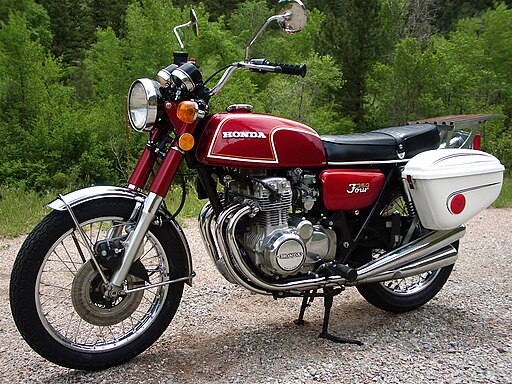
Honda CB350F
The Honda CB350F, often called the CB350 Four, stands out in the early 1970s as one of the smallest production four-cylinder motorcycles ever built. It combined the smoothness and high-revving nature of a multi-cylinder engine with the approachable handling and light weight of the CB350 twin. Designed for riders seeking character and performance in a manageable package, the CB350F remains a cult classic among collectors and custom builders.
Historical Context
When Honda introduced the CB350 twin in 1968, it set a new standard for accessible performance. By 1972, engineers pushed the envelope further with the CB350F, adding two more cylinders to a displacement only slightly larger than its predecessor. The result was a compact, high-revving 348 cc DOHC engine that delivered a thrilling powerband up to 11,000 rpm. Production ran until 1974, with roughly 25,000 units leaving the factory—enough to cement its place in Honda lore without ever becoming commonplace.
Chassis and Suspension
Frame Design and Geometry
The CB350F uses a steel double-cradle frame slightly reinforced at stress points to handle the extra vibration of four cylinders. With a wheelbase of 1,345 mm, the bike strikes a balance between straight-line stability and flickable agility in tight corners. The rake sits at 27° and trail at 92 mm, giving confident handling at both low speeds and open highway stretches.
Front Suspension
A conventional telescopic fork with 36 mm stanchions and 130 mm of travel absorbs bumps without excessive dive under braking. The preload is fixed, but spring rates were tuned for a firm yet compliant ride, matching the sporty nature of its engine.
Rear Suspension
Dual shock absorbers with adjustable preload collars provide 110 mm of rear wheel travel. Chrome-plated springs and hydraulic damping deliver a comfortable two-up ride while keeping the chassis composed under spirited cornering or back-road blasts.
Engine and Powertrain
Engine Architecture
- Configuration: 4-cylinder, DOHC, 8-valve, air-cooled
- Displacement: 348 cc
- Bore × Stroke: 40 mm × 35 mm
- Compression Ratio: 9.4 : 1
- Redline: 11,000 rpm
By splitting 350 cc across four small pistons, the CB350F’s engine revs freely, producing peak power high in the rev range while maintaining usable torque from 5,000 rpm onward.
Carburation and Induction
Each cylinder features its own 20 mm Keihin constant-velocity carburetor. Individual slide-type throttles ensure crisp throttle response, and removable foam intake socks help filter dust in light off-road use. A small balance tube between exhaust headers smooths out firing impulses at low rpm.
Performance Figures
- Maximum Power: 36 hp at 10,500 rpm
- Peak Torque: 3.0 kg·m at 8,000 rpm
- Top Speed: Approximately 155 km/h
- 0–100 km/h: Roughly 8.2 seconds
These numbers position the CB350F between the CB350 twin and larger CB450 iron-head models, giving riders a distinctive four-cylinder rush in a compact package.
Transmission and Final Drive
Gearbox Details
A five-speed constant-mesh transmission handles the engine’s broad powerband. The close-ratio gearing keeps the engine in its sweet spot, while a ratchet-type shift drum provides precise, positive shifts. The wet multi-plate clutch features a hydraulically damped basket to tame chatter from the high-revving mill.
Final Drive
Power travels to the rear wheel via a #520 O-ring chain. The standard sprocket configuration—17 teeth up front and 42 teeth at the rear—provides a comfortable balance between brisk acceleration and relaxed highway cruising. A protective chain guard is integrated into the swingarm to keep debris from whipping into the sprocket.
Brakes, Wheels and Tires
Braking System
- Front: Single 266 mm hydraulic disc with a two-piston caliper
- Rear: 130 mm leading-trailing drum brake
The CB350F was one of the first mid-sized Hondas to combine a front disc brake with its twin’s chassis, delivering strong stopping power that matches its sporty engine.
Wheels and Tires
Both wheels are spoked steel rims—18 × 1.60 in at the front, 18 × 2.15 in at the rear. Tires mount at a recommended size of 3.25-18 front and 3.50-18 rear, bias-ply construction. Modern riders often fit tubeless-conversion rims and 10-spoke cast wheels to improve reliability and lighten unsprung mass.
Electrical System and Instrumentation
Ignition and Charging
Running on a 12 V system, the CB350F uses a point-type ignition with electronic advance for consistent spark timing. A 90 W alternator keeps the battery charged and powers lighting, while a 12 V, 6 Ah maintenance-free battery sits beneath the seat.
Lighting and Gauges
- Headlight: 12 V, 60 W/55 W halogen unit for improved nighttime illumination
- Taillight and Turn Signals: 12 V incandescent bulbs housed in chrome-plated covers
- Instruments:
- Speedometer (180 km/h max)
- Tachometer (12,000 rpm max)
- Neutral, high-beam and turn-signal indicator lights
The cockpit balances classic analog charm with the clear readability required at high revs.
Ergonomics and Rider Interface
Controls and Layout
Raised, accordion-booted handlebars promote an upright riding position that reduces fatigue on long rides. Controls are laid out intuitively, with a twist-grip throttle, front-brake lever, and clutch lever all featuring adjustable reach. Footpegs are mid-mounted to offer an engaging, sporty stance without over-cramping the rider.
Seat and Comfort
A stepped two-person seat measuring 760 mm in height provides firm support. Thick vinyl covering and a slight rise for the passenger help keep both occupants secure under acceleration. Despite its sporty orientation, the CB350F remains friendly for riders of average height.
Dimensions, Weight and Capacities
Key Measurements
| Specification | Measurement |
|---|---|
| Overall Length | 2,055 mm |
| Overall Width | 800 mm |
| Overall Height | 1,070 mm |
| Wheelbase | 1,345 mm |
| Seat Height | 760 mm |
| Ground Clearance | 170 mm |
Weight and Payload
- Dry Weight: 158 kg
- Wet Weight (full fluids): 165 kg
- Maximum Payload: 180 kg including rider, passenger and luggage
Fuel Capacity and Range
With a 12 L fuel tank and a 2 L reserve, the CB350F offers a theoretical range of up to 240 km under mixed-riding conditions, balancing weight and convenience.
Customization and Legacy
Though production ceased in 1974, the CB350F’s unique character has sparked a vibrant aftermarket scene. Popular modifications include:
- Electronic CDI ignition upgrades for reliability
- Upswept or megaphone-style exhausts for classic four-into-four aesthetics
- Front disc brake conversions on earlier twin models to match CB350F stopping power
- Café-style clip-on handlebars and rear-set footpeg kits for a sportier ride
- LED lighting that retains the period look while improving visibility
Enthusiasts prize the CB350F for its pioneering split-four architecture in a lightweight chassis. Its brief production run and relative rarity only amplify its appeal on the vintage motorcycle market.
Conclusion
The Honda CB350F occupies a singular place in motorcycle history: a miniaturized inline-four that delivered real performance without the heft of larger machines. Its blend of high-revving power, agile chassis, and classic styling continues to captivate riders and builders. Whether restored to factory specs or transformed into a custom creation, the CB350F remains a testament to Honda’s engineering ambition in the early 1970s.
