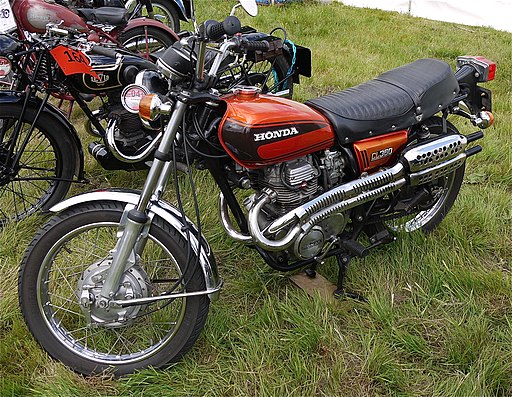
Honda CL360
The Honda CL360 emerged in 1974 as a rugged, street-legal scrambler built on the CB360 platform. Aimed at riders craving nimble off-road capability without sacrificing road manners, the CL360 blended a torquey parallel-twin with high-mounted exhausts, a reinforced frame, and dual-purpose rubber. Though produced for only two years, it cemented its place among mid-size classics for its versatile performance and timeless styling.
Historical Context
Honda’s scrambler lineage dates back to the CL350 of the late 1960s, but growing competition and riders’ evolving tastes led to the CL360. Launched alongside its road-biased CB counterpart, the CL360 capitalized on lessons learned from earlier models by improving engine smoothness, chassis strength, and suspension travel. Production ran from 1974 to 1975, after which the line gave way to larger twins as Honda shifted toward road sport bikes.
Chassis and Suspension
Frame Design and Geometry
The CL360 frame is a double-cradle steel backbone, reinforced at the headstock and swingarm pivot to withstand light trail use. A slightly longer wheelbase of 1,365 mm enhances stability when traversing loose terrain. Steering geometry is set at a 27.5° rake with 95 mm of trail, offering a predictable steering feel both on pavement and unpaved roads.
Front Suspension
A 37 mm conventional telescopic fork delivers 140 mm of wheel travel, an increase over the CB360 model to absorb bumps and ruts encountered off-road. Fork internals were damped to balance firm control under braking with compliance on washboard sections.
Rear Suspension
Dual chrome-plated shocks with adjustable preload provide 120 mm of travel. Hydraulic damping combined with progressive-rate springs maintains traction when cornering on gravel while still yielding a comfortable ride on asphalt.
Engine and Powertrain
Engine Architecture
- Configuration: 2-cylinder, SOHC, 4-valve, air-cooled
- Displacement: 356 cc
- Bore × Stroke: 67 mm × 50.6 mm
- Compression Ratio: 9.3 : 1
- Crankshaft: 180° firing order
A wider 180° crank firing interval smooths out power pulses for tractable low-end torque, ideal for trail starts and quick bursts.
Carburation and Induction
Two 28 mm Keihin constant-velocity carburetors feed the engine, each equipped with vacuum-operated slides for precise throttle response. Foam pre-filter socks shield against dust ingress when riding off-road, and a balance tube between the exhaust headers reduces low-rpm unevenness.
Performance Figures
- Maximum Power: 34 horsepower at 9,500 rpm
- Peak Torque: 2.8 kg·m at 8,000 rpm
- Top Speed: Approximately 150 km/h
- 0–100 km/h: Around 7.5 seconds
The CL360’s power delivery emphasizes midrange punch rather than high-revving excitement, matching its more utilitarian focus.
Transmission and Final Drive
Gearbox Details
A five-speed constant-mesh transmission with a ratchet-type shift drum offers crisp engagement. Gearing is spaced to keep the engine in its prime torque band, aiding both acceleration on loose surfaces and relaxed cruising on highways.
Final Drive
Power is conveyed via a #530 O-ring chain protected by a robust swingarm guard. Standard sprocket sizes—18 teeth up front and 42 teeth at the rear—strike a compromise between low-speed tractability and highway gearing, while aftermarket kits allow riders to fine-tune acceleration or top-end speed.
Brakes, Wheels and Tires
Braking System
The CL360 sports a single 276 mm hydraulic disc brake at the front, providing consistent stopping power in varied conditions. The rear relies on a 130 mm leading-trailing drum, chosen for its low weight and simplicity when cleaning mud or grit after off-road excursions.
Wheels and Tires
Spoked steel rims—19 × 1.60 in front, 18 × 2.50 in rear—accept dual-purpose tires sized 3.00-19 and 4.10-18 respectively. The larger front wheel aids roll-over capability on obstacles, while the wider rear tire maximizes traction on loose surfaces.
Electrical System and Instrumentation
Running on a 12 V electrical system, the CL360 features a 100 W alternator that powers lighting and ignition. A maintenance-free 12 V, 6 Ah battery resides under the seat.
Instrument gauges include:
- Analog speedometer (180 km/h max)
- Tachometer (10,000 rpm max)
- Indicator lamps for neutral, high beam, and turn signals
Switchgear is sealed to resist water and dust, ensuring reliable operation in off-road conditions.
Ergonomics and Rider Interface
A flat, ribbed seat measuring 780 mm in height encourages an upright posture, giving riders easy control when navigating trails. Wide, high-rise handlebars with cross-brace lend leverage in tight turns, while mid-mounted footpegs offer a compromise between comfort and ground clearance. Controls are placed for minimal effort when shifting weight or standing on the pegs.
Dimensions, Weight and Capacities
Key Measurements
| Specification | Measurement |
|---|---|
| Overall Length | 2,120 mm |
| Overall Width | 840 mm |
| Overall Height | 1,130 mm |
| Wheelbase | 1,365 mm |
| Seat Height | 780 mm |
| Ground Clearance | 190 mm |
Weight and Payload
- Dry Weight: 165 kg
- Wet Weight (full fluids): 173 kg
- Maximum Payload: 175 kg including rider, passenger, and light gear
Fuel Capacity and Range
With a 13.5 L tank and a 2.5 L reserve, the CL360 can cover up to 260 km on mixed terrain, balancing range and low-weight handling.
Customization and Legacy
Despite its short production run, the CL360 spawned a loyal following among scrambler enthusiasts. Common customizations include:
- Upswept twin exhausts in a “high-pipe” style for classic off-road looks
- Front fork gaiters and skid plates for added protection
- Modern dual-purpose tires with improved compound and tread
- Electronic ignition conversions for maintenance-free spark
- Café-scrambler builds featuring clip-ons and rear-set pegs
The CL360’s blend of agility, style, and approachable power continues to inspire restorations and retro builds worldwide.
Conclusion
The Honda CL360 stands as a testament to mid-1970s innovation, merging street-bike sophistication with the adventurous spirit of a true scrambler. Its robust twin-cylinder engine, reinforced chassis, and purposeful styling deliver a riding experience that remains fresh decades later. Whether restored to original glory or reimagined as a custom machine, the CL360 carries forward Honda’s legacy of versatility and fun.
