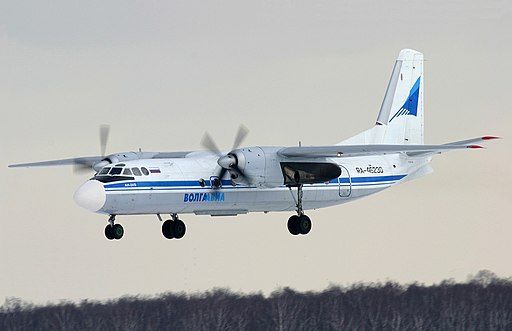
Antonov An-24
The Antonov An-24 emerged in the early 1960s as a twin-turboprop regional airliner designed to operate from short, unprepared airstrips. Its combination of reliability, rugged construction, and simple systems made it a workhorse for civil and military operators across the Soviet Union and beyond. Over 1,000 An-24s and its derivatives were built, serving in passenger, cargo, medevac, and maritime patrol roles.
Development and Design
Origins and Requirements
Soviet airlines and regional authorities needed an aircraft to replace obsolete piston twins on feeder routes. Key design goals included:
- Carrying 40–50 passengers over 800 kilometers
- Operating from grass, gravel, or ice runways under harsh conditions
- Simplified maintenance with modular systems and field-replaceable components
- Redundancy for safety in low-visibility and mountainous regions
Antonov’s design bureau leveraged experience from the An-10 and military transports to meet these requirements.
Prototype and Production
The first An-24 prototype took flight on October 20, 1959. Flight trials validated its low-speed handling, short takeoff and landing performance, and engine reliability. Production began in 1962 at Kyiv and Voronezh. Later lines opened in China under license, extending the airframe’s global footprint.
Airframe Structure
Fuselage
The semi-monocoque fuselage uses aluminum alloy skins riveted to frames. The pressurized cabin allowed flights up to 8,000 meters and maintained comfortable conditions for passengers and crew. Large, round-corner windows provided good visibility while reinforcing structural integrity.
Wings and Control Surfaces
High-mounted wings span 29.20 meters and feature:
- Integral fuel tanks in the wing roots
- Double-slotted trailing-edge flaps for low-speed lift
- Frise-type ailerons for crisp roll response
Wing center sections attach directly to the fuselage, simplifying assembly and inspection.
Landing Gear
The retractable tricycle gear uses single-wheel legs with oleo-pneumatic shock absorbers. Main gear retracts into pods on the wing undersides, leaving fairings to protect tires from debris. Nose gear folds forward into the fuselage, enabling tight turn radii for remote-field taxiing.
Powerplant and Performance
Engines and Propulsion
Each An-24 is powered by two Ivchenko AI-24 turboprops producing 2,820 shaft horsepower. Paired with five-blade constant-speed propellers, the powerplant offers:
- Quick acceleration for short-field departures
- Reliable starts in subzero temperatures
- Ease of overhaul using modular engine units
Fuel is stored in wing tanks with a total capacity of 5,640 liters, supporting four hours of endurance at economy cruise.
Performance and Flight Characteristics
The An-24 achieves:
- Maximum cruise speed of 520 kilometers per hour
- Stall speed (flaps down) near 165 kilometers per hour
- Service ceiling of 8,500 meters
- Takeoff distance over a 15-meter obstacle of 1,200 meters
- Landing roll from 15-meter height in under 900 meters
Its high wing and robust control surfaces deliver predictable handling in gusty and turbulent conditions.
Flight Deck and Avionics
The cockpit accommodates two pilots seated side by side, with an optional navigator station in some variants. Standard avionics include:
- Airspeed indicator, altimeter, vertical speed, and attitude gyros
- Engine gauges for torque, turbine temperature, and fuel flow
- VHF communication radios and automatic direction finders
- Doppler or inertial navigation systems on later production models
Manual flight controls connect via push-pull rods and cables, offering direct feedback without hydraulic assistance.
Payload and Cabin
Passenger and Cargo Configurations
The standard An-24 interior seats 44 passengers on reclining seats with overhead storage racks. Cargo doors on the starboard side permit loading of up to 3,500 kilograms of freight. Configurations include:
- Medevac: up to 12 stretchers plus attendant seating
- Combi: mixed passenger and cargo layout for remote routes
- Freighter: reinforced floor and large cargo ramp for pallets
Tie-down fittings secure irregular freight, while the pressurized cabin protects sensitive equipment.
Operational History
Civilian Service
Aeroflot deployed the An-24 across the Soviet republics, serving remote mining, forestry, and Arctic communities. Its ruggedness and short-field prowess kept isolated settlements connected year-round. Many Western bloc airlines and Chinese carriers also adopted licensed versions, extending the type’s influence.
Military and Special Roles
Military operators used the An-24 for troop transport, VIP travel, and maritime patrol. Sensors, radomes, and observation windows converted some airframes into electronic intelligence platforms. Its adaptability ensured decades of frontline service.
Variants
- An-24A: Baseline passenger model with 44 seats
- An-24B: Extended-range version with additional fuel tanks and strengthened wing roots
- An-24T: Dedicated freighter with reinforced floor and large cargo door
- An-24RV: High-pressure compressor variant for improved hot-and-high performance
- Chinese Y-7: Licensed production by Xi’an Aircraft Industry Corporation with localized engines
Each variant preserved the core airframe while tailoring systems to mission requirements.
Technical Specifications
| Parameter | Value |
|---|---|
| Crew | 2 pilots, optional navigator |
| Passenger Capacity | 44 |
| Length | 23.53 m |
| Wingspan | 29.20 m |
| Height | 8.31 m |
| Wing Area | 71.40 m² |
| Empty Weight | 12,500 kg |
| Maximum Takeoff Weight | 21,000 kg |
| Powerplant | 2 × Ivchenko AI-24 turboprops, 2,820 shp each |
| Maximum Cruise Speed | 520 km/h |
| Stall Speed (flaps extended) | 165 km/h |
| Range (max payload) | 1,600 km |
| Service Ceiling | 8,500 m |
| Takeoff Distance (15 m obstacle) | 1,200 m |
| Landing Distance (15 m obstacle) | 900 m |
| Fuel Capacity | 5,640 L |
The Antonov An-24’s blend of simplicity, durability, and short-field performance cemented its reputation as one of the most reliable regional transports ever built. Its legacy endures in the many airframes still flying in rugged corners of the globe.
