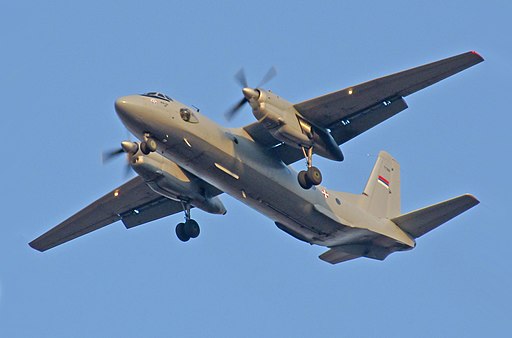
Antonov An-26
The Antonov An-26 is a twin-engined turboprop transport aircraft introduced in the late 1960s to fulfill light cargo, troop carrier, medevac, and parachute drop roles. Developed as an evolution of the An-24 regional airliner, the An-26’s design emphasizes ruggedness, flexibility, and short-field performance. Over 1,400 airframes have been built, serving civilian airlines, military forces, and humanitarian organizations across more than 50 countries.
Development and Design
Origins and Mission Requirements
The Soviet Air Force issued a requirement in 1965 for a military version of the An-24 capable of:
- Rapidly loading and unloading up to 5,500 kg of cargo
- Operating from unpaved runways under austere conditions
- Delivering paratroopers and freight in airdrop missions
- Performing aeromedical evacuation with onboard stretchers
Antonov’s bureau adopted the proven An-24 airframe but added a rear loading ramp, reinforced floor, and uprated engines.
Prototype Testing and Production
The first An-26 prototype flew on June 21, 1969. Flight tests validated its gross weight performance, short takeoff and landing distances, and structural integrity under cargo loading. Initial production began in Kyiv in 1970. By 1973, license production started in China as the Y-14. Total production exceeded 1,400 units by the late 1980s.
Airframe and Structure
Fuselage and Cargo Ramp
The pressurized fuselage retains the An-24’s semi-monocoque construction with riveted aluminum panels. Key modifications include:
- Hydraulically operated rear ramp and clamshell doors for roll-on/roll-off cargo handling
- Reinforced cabin floor capable of supporting military vehicles and palletized freight
- Tie-down rails and net anchor points spaced every 500 mm along the cabin floor
Loading and unloading a light truck can be accomplished in under five minutes without ground support equipment.
Wings and Control Surfaces
The high-mounted straight wing spans 29.20 m and carries integral fuel tanks holding up to 5,640 L. Lift devices and control surfaces include:
- Double-slotted trailing-edge flaps for enhanced low-speed lift
- Balanced ailerons with differential deflection to minimize adverse yaw
- Leading-edge slats on the inner wing panels for improved stall characteristics
Wingtip tanks add 680 L per side and reduce wing bending moment, aiding structural longevity.
Landing Gear
Designed for rough-field operations, the retractable tricycle gear features:
- Single-wheel main legs with oleo-pneumatic struts
- High-flotation tires to distribute weight on soft terrain
- Nose gear that retracts forward into a sealed bay, ensuring minimal drag
Shock absorbers are adjustable for varying runway conditions, allowing operations from gravel, grass, and ice strips.
Powerplant and Propulsion
Turboprop Engines
Each An-26 is powered by two Ivchenko AI-24VT turboprops delivering 2,820 shp at takeoff. Engine highlights:
- Automatic cold-start system for reliable operation down to –50 °C
- Modular compressor and turbine sections for rapid field maintenance
- Full authority digital engine control (FADEC) retrofit available on later models
Fuel consumption at maximum continuous power is 580 kg per hour per engine.
Propellers
Five-blade constant-speed propellers measure 4.4 m in diameter and feature:
- Feathering capability to minimize drag in engine-out emergencies
- De-icing boots and hot-air anti-icing for blade leading edges
- Automatic synchronization system reducing cabin noise and vibration
Cruise propeller pitch is adjustable in flight, optimizing performance across speed regimes.
Flight Deck and Avionics
Cockpit Layout
The two-crew cockpit centers around conventional analog flight instruments. Primary elements include:
- Airspeed indicator, altimeter, vertical speed indicator, and attitude gyro
- Engine gauges for torque, interstage turbine temperature, and fuel flow
- Standby magnetic compass and independent altimeter
Ergonomic throttle quadrants and flap controls allow intuitive management of power and lift devices.
Navigation and Communication
Standard avionics suite comprises:
- Dual VHF transceivers and HF radios for long-range communication
- Automatic direction finder (ADF) and VOR/ILS receivers for instrument approaches
- Doppler navigation system providing ground speed and drift data
- Optional GPS/FMS upgrade kits enabling RNAV procedures
Redundant electrical and vacuum systems ensure continued instrument functionality if a primary bus fails.
Cargo Handling and Payload
Loading Configurations
The An-26 cabin measures 17.5 m in length, 2.5 m in width, and 1.8 m in height. Versatile loading setups include:
- Standard pallets (2.44 m × 3.05 m) aboard six rail-mounted tracks
- Bulk cargo loose-loaded with net restraints
- Up to 38 paratroopers seated on side-facing benches
- Aeromedical configuration with four stretchers and attendant seating
Onboard cranes or external forklifts can interface directly with the rear ramp.
Maximum Payload and Weight Limits
Empty weight of the An-26 is 11,600 kg. Weight figures are:
- Maximum payload: 5,500 kg
- Maximum takeoff weight (MTOW): 24,000 kg
- Maximum landing weight: 23,000 kg
- Maximum payload in airdrop role: 4,000 kg
Payload distribution is managed via modular ballast and fuel transfer systems to maintain center-of-gravity limits.
Operational History
Military Service
The An-26 has been a backbone transport for more than 40 air forces. Notable deployments include:
- Soviet Air Force: troop rotations to Afghanistan with rapid forward base setups
- East German Air Force: Cold War logistics across Warsaw Pact airfields
- Many African nations: humanitarian airlifts during drought and refugee crises
Its unprepared-field capability and ease of maintenance solidified its utility in remote conflict zones.
Civil and Humanitarian Roles
Civil operators employ the An-26 for freight, charter passenger flights, and aerial survey missions. Key civil uses:
- Mineral exploration: carrying drilling crews and seismic gear into tundra regions
- Medical evacuation: converting the cargo bay into a flying intensive care unit
- Firefighting: fitting modular tanks and pumps for water or retardant drops
Several An-26s remain active in Arctic and Antarctic logistics, shuttling supplies to isolated research stations.
Variants
An-26B
Baseline troop and cargo transport with standard AI-24VT engines and analog avionics.
An-26PK
Passenger-configured model seating up to 40 civilians with upgraded cabin pressurization.
An-26PS
Search and rescue version equipped with ELINT sensors, rescue winch, life raft racks, and medical facilities.
Y-14
Chinese license-built version produced by Xi’an Aircraft Company, featuring local adaptations to engine cowling and avionics.
An-26-100
Modernized upgrade with digital glass cockpit, GPS navigation, modern autopilot, and improved environmental controls.
Technical Specifications
| Parameter | Value |
|---|---|
| Crew | 2 (pilot, co-pilot) |
| Capacity | 5,500 kg payload or 38 paratroopers |
| Length | 23.80 m |
| Wingspan | 29.20 m |
| Height | 8.10 m |
| Wing Area | 71.4 m² |
| Empty Weight | 11,600 kg |
| Maximum Takeoff Weight (MTOW) | 24,000 kg |
| Powerplant | 2 × Ivchenko AI-24VT turboprops, 2,820 shp each |
| Maximum Cruise Speed | 540 km/h |
| Stall Speed (flaps extended) | 165 km/h |
| Range (with max payload) | 1,100 km |
| Ferry Range | 2,500 km |
| Service Ceiling | 7,500 m |
| Takeoff Distance (MTOW, 15 m obstacle) | 1,300 m |
| Landing Distance (MLW, 15 m obstacle) | 900 m |
| Fuel Capacity | 5,640 L |
Conclusion
The Antonov An-26 remains one of the most versatile and durable turboprop transports ever produced. Its ability to adapt to myriad roles—from frontline military logistics to remote scientific resupply—demonstrates the strength of its design philosophy. Decades after its introduction, the An-26 continues to serve in demanding environments where reliability, simplicity, and short-field performance are paramount.
