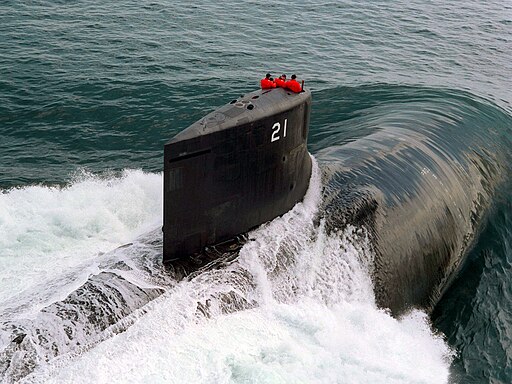
USS Seawolf (SSN-21)
USS Seawolf (SSN-21) represents a quantum leap in submarine design, combining unmatched stealth, firepower, and agility. Laid down in 1989 and commissioned in 1997, she serves as the lead ship of her class, epitomizing Cold War–era urgency fused with cutting-edge technology. Her mission set spans deep-water surveillance, anti-submarine and anti-surface warfare, strike operations, and covert special-operations support. Throughout her career, Seawolf has demonstrated the adaptability and resilience expected of a nuclear-powered attack submarine built for the 21st century.
Development History
Origins of the Seawolf Program
In the mid-1970s, escalating Soviet submarine capabilities spurred the U.S. Navy to envision a successor to the Los Angeles–class SSNs. This new platform aimed for superior acoustic stealth, deeper operating depth, and a higher sustained speed. Formal design studies began in 1973 under Project Nobska, leading to the Seawolf program’s approval in 1985. Budgets shifted with the end of the Cold War, truncating planned orders from 29 to just three hulls.
Construction and Commissioning
Seawolf’s keel was laid at Electric Boat’s Groton shipyard on February 25, 1989. Innovative modular construction techniques reduced assembly time while preserving exacting tolerances for hull alignment. Sea trials started in mid-1996, validating performance parameters against design benchmarks. On July 19, 1997, USS Seawolf officially entered service, becoming the Navy’s quietest and most heavily armed attack submarine.
Design Features
Hull and Structural Advances
Seawolf’s hull employs high-strength HY-100 steel, allowing safe operations at depths exceeding 800 feet. The teardrop shape minimizes hydrodynamic drag and wake signature, while anechoic tiles covering the outer hull dampen incoming sonar pings. Internal design emphasizes shock resistance, using rack-mounted equipment and resilient mountings to survive near-miss explosions.
Acoustic Stealth and Coatings
To achieve unprecedented silence, Seawolf integrates raft-mounted machinery, advanced silencing technologies on auxiliary pumps and motors, and variable-pitch propulsor blades. Anechoic coatings attenuate both outgoing noise and incoming sonar energy, significantly reducing the vessel’s acoustic cross-section. These measures make Seawolf virtually undetectable to passive sonar arrays at typical engagement ranges.
Propulsion and Power Systems
Powered by an S6W pressurized water reactor, Seawolf can generate over 40 MW of thermal energy. A direct-drive steam turbine system converts this heat to mechanical power, driving a single skew-backed propulsor for ultra-quiet thrust. Nuclear stamina allows for effectively unlimited range and endurance, constrained only by onboard food stores and crew endurance.
Sensor and Combat Systems
Sonar Suite
Seawolf’s sensor suite centers on the BQQ-10 integrated sonar system, which fuses:
- Spherical bow array for passive detection
- Flank arrays for broadside acoustic coverage
- High-frequency intercept sonar for incoming pogo-projectiles
- Towed array for long-range tracking of quiet contacts
This multi-axis coverage grants unparalleled situational awareness in cluttered littoral and deep-water environments.
Fire Control Systems
The Mk 11726 combat control system orchestrates target classification, tracking, and engagement. Its open-architecture design allows rapid software updates and integration of new weapon types. Digital signal processors sift sensor data to generate fire-control solutions under a fraction of a second, supporting simultaneous engagements against multiple threats.
Armament and Mission Profile
Torpedo and Missile Loadout
Seawolf carries up to 50 weapons internally, distributed across eight 660 mm torpedo tubes. Typical loadouts include:
- Mk 48 ADCAP torpedoes for anti-submarine and anti-surface warfare
- Tomahawk Land Attack Missiles for precision strikes ashore
- Submarine-launched Harpoon missiles for over-the-horizon surface engagements
The combination of torpedoes and cruise missiles enables flexible responses to strategic and tactical missions.
Special Operations Support
Three lock-in/lock-out chambers allow for deployment of SEALs and unmanned undersea vehicles (UUVs) while submerged. The submarine’s internal staging areas enable covert swimmer delivery and mission planning without surfacing. These capabilities make Seawolf an ideal platform for intelligence gathering, sabotage, and reconnaissance.
Crew Accommodations and Habitability
Designed for a complement of 140 officers and enlisted personnel, Seawolf provides enhanced living conditions compared to earlier SSNs. Staterooms feature two-person berths, improved ventilation, and noise isolation. A dedicated galley and recreation deck foster morale on extended patrols lasting up to 90 days.
Technical Specifications
| Specification | Value |
|---|---|
| Displacement (surfaced/submerged) | 8,100 t / 9,138 t |
| Length | 353 ft (107.6 m) |
| Beam | 40 ft (12.2 m) |
| Draft | 32 ft (9.8 m) |
| Test Depth | >800 ft (244 m) |
| Maximum Speed | >35 kn (65 km/h) |
| Propulsion | 1 × S6W nuclear reactor; steam turbine to propulsor |
| Complement | 14 officers, 126 enlisted |
| Armament | 8 × 660 mm torpedo tubes; 50 × weapons total |
| Sensors | BQQ-10 sonar suite; PK-2 radar; ESM/ELINT arrays |
Operational History
Since commissioning, USS Seawolf has conducted multiple deterrent patrols, exercises with NATO allies, and surveillance missions in contested waters. Her quiet signature and advanced sensors enable tracking of high-value targets with minimal risk of detection. Deployments to the North Atlantic, Arctic under-ice operations, and Pacific exercises demonstrate her global reach and versatility.
Upgrades and Modernization
Continuous modernization programs keep Seawolf at the forefront of undersea warfare. Recent upgrades include next-generation electronic warfare suites, enhanced communications through broadband data links, and integration of advanced UUVs. Software-defined sensors and open-architecture combat systems ensure rapid fielding of emerging technologies.
Strategic Role and Future Prospects
As one of only three Seawolf-class submarines, SSN-21 embodies a bridge between Cold War imperatives and future force multipliers. Her stealth and strike capabilities complement Virginia-class boats, forming a layered undersea fleet. Ongoing developments in artificial intelligence and unmanned systems may further extend her mission envelope well into the 2040s.
Conclusion
USS Seawolf (SSN-21) remains a testament to naval engineering excellence. She balances raw power with surgical precision, making her one of the most formidable attack submarines ever built. As technologies evolve, Seawolf’s adaptable design ensures she will continue to shape undersea warfare for decades to come.
_(20679202313).jpg)