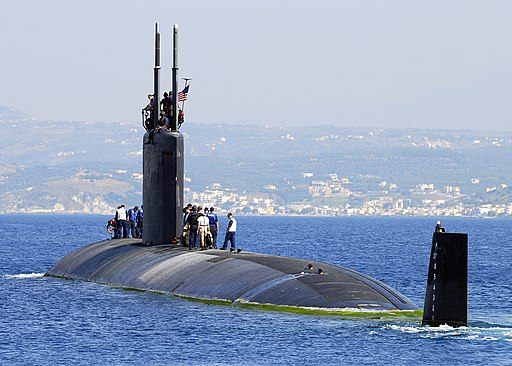
USS Scranton (SSN-756)
The USS Scranton (SSN-756) is a Los Angeles–class nuclear-powered attack submarine commissioned in November 2001. Built by Newport News Shipbuilding, she belongs to the Improved 688i subclass, featuring vertical launch capability and enhanced acoustic quieting. Her mission set spans anti-submarine warfare, intelligence gathering, covert insertion, and Tomahawk strike missions in both littoral and open-ocean environments.
Design and Construction
Hull Form and Materials
The hull of Scranton employs high-strength HY-80 steel with internal structural framing optimized for deep diving. A teardrop-shaped bow reduces flow noise and hydrodynamic drag, while anechoic coatings on the outer hull attenuate sonar detection. Behind the sail, the hull tapers gradually to the propulsor shroud, minimizing flow separation and broadband noise.
Improved 688i Features
- Twelve vertical launch system (VLS) tubes for Tomahawk cruise missiles
- Retractable towed-array sonar housed aft of the sail
- Hydrodynamically optimized propulsor replacing conventional screw
- Upgraded combat and fire-control systems for simultaneous multi-target engagement
Propulsion and Power
Nuclear Reactor Plant
At the heart of Scranton lies a single S6G pressurized-water reactor driving two steam turbines. Its power output exceeds 30,000 shaft horsepower, enabling sustained high-speed transits. Reactor endurance effectively provides limitless range, constrained only by food and spare parts.
Propulsor and Maneuvering
The submarine’s shrouded propulsor, often called a pump-jet, decreases cavitation across the 0–25 knot envelope. Bow and stern planes, along with retractable fairwater planes, grant exceptional depth control and rapid course adjustments in littoral waters.
Performance Characteristics
Speed and Endurance
- Maximum submerged speed: 30+ knots
- Silent-patrol speed: 2–4 knots for ultra-quiet sonar operations
- Mission endurance: 90 days without replenishment
- Test depth: 800 feet (classified deeper operating depth)
Acoustic Signature
Through layered anechoic tiles, active noise-cancellation machinery mounts, and isolation of auxiliary systems, Scranton achieves one of the lowest acoustic signatures in the U.S. attack submarine fleet.
Sensors and Combat Systems
Sonar Suite
- BQQ-5 passive/active hull-mounted sonar array
- TB-23 towed-array sonar for low-frequency detection
- BQS-15 fathometer for precise bottom profiling
Combat Management
The AN/BYG-1 fire-control system integrates sonar data, periscope imagery, and intelligence feeds. Link-11 and satellite communications enable real-time targeting and mission updates while submerged at periscope depth.
Armament
Torpedo and Missile Weapons
- Four 21-inch torpedo tubes launching Mk-48 ADCAP heavyweight torpedoes
- Twelve VLS tubes for Tomahawk land-attack cruise missiles
- Capacity for up to 26 weapons total (mix of torpedoes, missiles, SEAL delivery tubes)
Special Operations Support
Two lock-in/lock-out trunks below the sail allow covert insertion and retrieval of up to 16 special-operations personnel. Floodable chambers and diver propulsion vehicle stowage facilitate clandestine beaching.
Crew and Habitability
Complement
- Officers: 12
- Enlisted: 98
- Special-carrier spaces for up to 12 additional mission personnel
Living and Workspaces
Crew quarters consist of double-occupancy rack rooms with private storage. Common areas include a combined mess/recreation lounge, gym alcove, and a compact medical bay. Environmental control systems maintain air and water quality during extended patrols.
Technical Specifications Summary
| Attribute | Specification |
|---|---|
| Class and Type | Los Angeles–class (Improved 688i) Attack Submarine |
| Displacement (surfaced) | 6,200 tons |
| Displacement (submerged) | 6,900 tons |
| Length overall | 110.3 m (362 ft) |
| Beam | 10.1 m (33 ft) |
| Draft | 9.7 m (32 ft) |
| Propulsion | S6G nuclear reactor; steam turbines; pump-jet |
| Speed | 30+ knots submerged |
| Test Depth | 800+ feet |
| Endurance | 90 days without replenishment |
| Complement | 12 officers, 98 enlisted, 12 mission personnel |
| Main Armament | 4× 21-inch torpedo tubes, 12× VLS Tomahawk tubes |
| Sonar and Sensors | BQQ-5 hull array, TB-23 towed array, BQS-15 |
| Combat System | AN/BYG-1 Fire Control System |
Operational Highlights
Since her commissioning, USS Scranton has completed multiple Western Pacific and Persian Gulf deployments. Highlights include ballistic-missile defense trials, deep-water surveillance missions, and combined exercises with allied submarines. Her blend of stealth, firepower, and special-operations capability continues to make her a versatile asset in undersea warfare.
_departs_Souda_harbor_following_a_routine_port_visit_to_Greece%27s_largest_island.jpg)