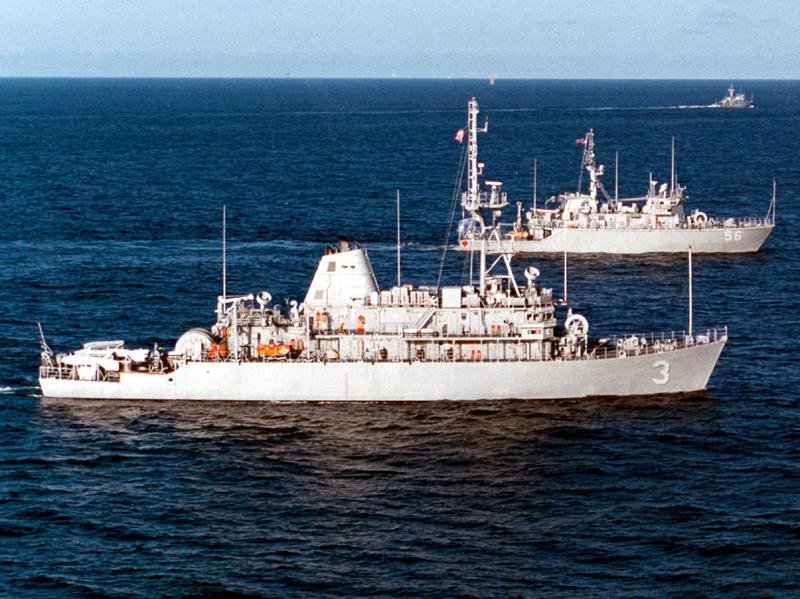
USS Sentry (MCM-3)
USS Sentry (MCM-3) is the United States Navy’s third Avenger-class mine countermeasures ship, commissioned in June 1989. Designed to locate, classify, and neutralize moored and bottom mines, Sentry combines advanced sonar, unmanned vehicles, and a non-magnetic hull to operate safely in mine-infested waters. Her primary roles span from coastal minehunting to support of amphibious operations and fleet maneuvers in littoral zones. Over three decades of service have demonstrated her reliability, flexibility, and critical contribution to naval mine warfare.
Design and Construction
Hull Composition and Magnetic Signature
Sentry’s hull is constructed from wooden laminates sheathed in glass-reinforced plastic, yielding exceptionally low acoustic and magnetic signatures. This composite design minimizes the risk of detonating magnetic or acoustic mines while ensuring structural integrity in harsh maritime environments. The ship’s superstructure and major fittings also use non-ferrous materials to maintain signature reduction. Shock-absorbing mountings and compartmentalized bulkheads enhance survivability against underwater blasts and collisions.
Modular Structural Layout
Built at Intermarine USA’s Louisiana shipyard, Sentry utilized a modular construction approach that allowed parallel fabrication of forward, mid, and aft hull sections. Precision alignment of these modules reduced assembly time while maintaining tight tolerances critical for the wooden-composite interface. The internal layout follows a “mission bay” concept, with flexible stowage and handling spaces for sonar trailers, ROV equipment, and explosive ordnance disposal (EOD) gear. This modularity also simplifies upgrades and maintenance periods.
Propulsion and Power Generation
Diesel Engines and Controllable Thrusters
Sentry is propelled by four Paxman 12RP200DM diesel engines, each delivering 1,000 hp to two variable-pitch, controllable-reversible propellers via reduction gearboxes. The arrangement provides a top speed of 14 knots and precise low-speed handling required for minehunting lanes. Twin 300 hp bow thrusters further enhance station-keeping and maneuvering in confined waters. Fuel capacity supports over 3,000 nautical miles of range at 12 knots, enabling extended deployments without underway replenishment.
Electrical Distribution and Auxiliary Systems
A pair of 500 kW diesel generators supply ship-wide electrical power, feeding essential systems including sonar processors, navigation radars, and habitability loads. A dedicated emergency generator ensures critical services—fire pumps, lighting, and control circuits—remain operational under casualty conditions. Sophisticated power management systems automatically shed or restore non-essential loads to prioritize mine countermeasure equipment during peak demand.
Mine Countermeasure Suite
Sonar Detection Systems
The AN/SQQ-32 minehunting sonar suite forms the heart of Sentry’s detection capability. It comprises a high-frequency search-and-classification sonar in the bow for shallow water sweeps and a lower-frequency towed variable-depth sonar for detecting bottom mines in deeper waters. Real-time signal processing distinguishes mine shapes and densities, while digital logging archives contacts for post-mission analysis. Operators monitor multiple sonar beams from an ergonomically designed console.
Mine Neutralization Vehicles
Once a mine is located, the remotely operated AN/SLQ-48 vehicle is deployed through a specialized three-man lock-out chamber. The ROV carries an explosive disposal charge which a technician places alongside the mine, then retreats before detonation. Sentry can also tow mechanical sweep gear and magnetic/acoustic influence sweeps to trigger or cut mines’ anchors. Integration of these systems allows layered approaches—identify, mark, and neutralize—in a single evolution.
Defensive and Support Systems
Self-Defense Armament
While optimized for mine warfare, Sentry carries light self-defense weapons to deter small boat attacks. Her primary guns include two Mk 38 Mod 2 25 mm chain guns on the forecastle and stern. Four .50 caliber machine guns mounted on the bridge wings provide rapid response against fast inshore craft. Non-lethal systems, such as long-range acoustic devices and warning signals, support escalation-of-force protocols during peacetime patrols.
Communications and Navigation
A fully integrated Combat Information Center features secure multi-band radios (HF/UHF/VHF), satellite communications, and data-link terminals for networked operations. Navigation relies on differential GPS augmented by inertial navigation and SINS (Shipboard Inertial Navigation System) for accurate positioning in GPS-denied environments. A compact surface search radar (AN/SPS-67) and ECDIS (Electronic Chart Display and Information System) ensure precise track planning and obstacle avoidance.
Crew and Habitability
Sentry carries a complement of 7 officers and 76 enlisted personnel, including explosive ordnance disposal specialists. Living quarters feature two-person staterooms and sound-isolated berths to mitigate fatigue during long sweeps. The ship’s galley, mess decks, and fitness area support morale on deployments up to 45 days without port calls. Climate-controlled HVAC and fresh water generation systems maintain a comfortable environment in tropical and arctic theaters alike.
Operational History
Following her commissioning in 1989, USS Sentry conducted maiden mine countermeasure exercises off the U.S. East Coast before deploying to the Persian Gulf for Operations Desert Shield and Desert Storm. In the post-9/11 era, she participated in coalition mine-clearing missions in the Arabian Sea and Gulf of Oman. Humanitarian assistance patrols in Southeast Asia and multinational exercises with NATO allies have showcased her interoperability. Periodic overhauls at Norfolk Naval Shipyard introduce incremental upgrades, sustaining her mission readiness.
Technical Specifications
| Specification | Value |
|---|---|
| Displacement (full load) | 1,300 long tons (1,321 t) |
| Length | 224 ft (68.3 m) |
| Beam | 39 ft (11.9 m) |
| Draft | 13 ft (4.0 m) |
| Speed | 14 knots (26 km/h) |
| Range | 3,200 nmi at 12 knots |
| Propulsion | 4 × Paxman 12RP200DM diesels; 2 × CPP |
| Thrusters | 2 × 300 hp bow thrusters |
| Sonar Suite | AN/SQQ-32 hull-mounted & towed array |
| Mine Neutralization | AN/SLQ-48 ROV; mechanical & influence sweeps |
| Armament | 2 × Mk 38 25 mm; 4 × .50 cal machine guns |
| Crew Complement | 7 officers; 76 enlisted |
| Hull Material | Wood laminate with fiberglass sheathing |
| Generators | 2 × 500 kW diesel generators; 1 × emergency |
Conclusion
USS Sentry (MCM-3) embodies the specialized blend of stealth, precision, and flexibility required for modern mine warfare. Her unique hull, advanced sonar, and neutralization vehicles enable safe clearance of complex minefields. Through continuous upgrades and rigorous training, Sentry remains at the forefront of undersea threat mitigation. As naval operations increasingly focus on littoral challenges, her role as guardian of maritime access lanes grows ever more vital.
;11120302.jpg)