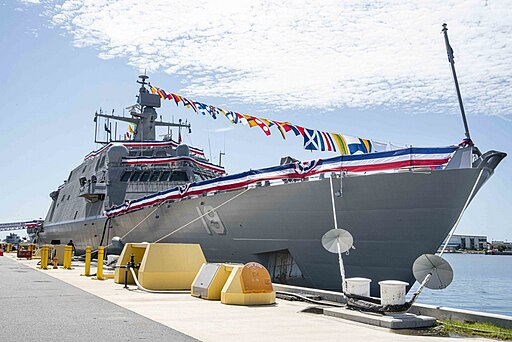
USS St. Louis (LCS-19)
USS St. Louis (LCS-19) is a Freedom-class littoral combat ship of the United States Navy, built to conduct high-speed operations in coastal and shallow-water environments. She is the seventh naval vessel named after St. Louis, Missouri, and the tenth ship in her class. St. Louis entered service on 8 August 2020, bringing network-centric modularity and agile maneuvering to littoral missions.
Design and Construction
Hull and Structural Design
St. Louis features a monohull constructed from high-strength A 131 steel, optimized for rigidity and hydrodynamic efficiency. The slender hull form reduces drag at speeds up to 45 knots, while four Rolls-Royce waterjets deliver precise thrust vectoring and low acoustic signature for stealthy approaches. Modular mounting points fore and aft accommodate containerized mission packages without permanent hull alterations.
Propulsion and Power Generation
The ship employs a combined diesel and gas (CODAG) configuration: two Rolls-Royce MT30 gas turbines (36 MW each) for sprint speeds, paired with two Colt-Pielstick diesel engines for economical cruising. Four Isotta Fraschini V1708 diesels, each driving an 800 kW Hitzinger generator, supply electrical power to mission systems and hotel loads. This hybrid arrangement allows a maximum speed of 45 knots and a 3,500 nautical-mile range at 18 knots.
Modular Mission Package
USS St. Louis was designed around three interchangeable mission modules—Surface Warfare (SUW), Anti-Submarine Warfare (ASW), and Mine Countermeasures (MCM). Standardized slots in the bow and stern accept container-style equipment units that can be swapped in a matter of hours. This modularity enables St. Louis to transition swiftly from missile engagements to torpedo counter-threats or mine clearance tasks without major dry-dock periods.
Technical Specifications
Dimensions and Displacement
- Length overall: 378.3 ft (115.3 m)
- Beam: 57.4 ft (17.5 m)
- Draft: 13.0 ft (4.0 m)
- Full-load displacement: 3,500 metric tons
Propulsion and Performance
- 2 × Rolls-Royce MT30 gas turbines (36 MW each)
- 2 × Colt-Pielstick diesel engines
- 4 × Rolls-Royce waterjets
- Maximum speed: 45 knots (sea state 3)
- Range: 3,500 nmi at 18 knots
Endurance and Manning
- Endurance: 21 days at sea
- Core crew: 15–50 personnel
- Mission crews: up to 75 (Blue/Gold rotational crews)
- RHIBs: one 11 m and multiple 40 ft high-speed boats
Weapons and Sensors
Surface Warfare Armament
St. Louis mounts a BAE Systems Mk 110 57 mm naval gun on her forecastle for rapid engagements against surface and low-flying air targets. The SUW module can host up to eight Tomahawk cruise missiles, while the vertical-launched Rolling Airframe Missile (RAM) system provides short-range air defense.
Anti-Submarine Warfare Systems
Dual Mk 32 triple torpedo tubes enable the launch of lightweight Mk 46/50 or advanced Mk 54 torpedoes under ASW configuration. Hull-mounted sonar arrays and towed-array systems integrate with modular ASW equipment to detect and prosecute submarine threats efficiently.
Electronic and Radar Suite
A multifunction active-electronically scanned array radar conducts simultaneous air, surface, and littoral surveillance. Supporting electronic support measures (ESM) and electronic countermeasures (ECM) packages offer passive detection and jamming capabilities, enhancing situational awareness and self-defense.
Aviation Facilities
The hangar and aft flight deck accommodate up to two MH-60R/S Seahawk helicopters or an MQ-8 Fire Scout unmanned helicopter. Fueling, maintenance support, and weapons loading are fully integrated, allowing continuous airborne mission support without dependency on shore facilities.
Construction and Career
Construction began when Marinette Marine in Wisconsin laid the keel on 17 May 2017. The hull was christened and launched on 15 December 2018, followed by acceptance trials in Lake Michigan and the Atlantic. Commissioned on 8 August 2020, USS St. Louis is homeported at Naval Station Mayport, Florida, and has since operated in both the Mediterranean and Indo-Pacific theaters.
Conclusion
USS St. Louis (LCS-19) embodies the US Navy’s shift toward agile, networked near-shore warfare, combining speed, modularity, and versatile systems integration. Her Freedom-class pedigree ensures high transit speeds, while mission-package flexibility allows rapid role changes—from surface engagements to mine countermeasures—making her a critical asset in modern littoral operations.
_on_her_commissioning_ceremony.jpg)