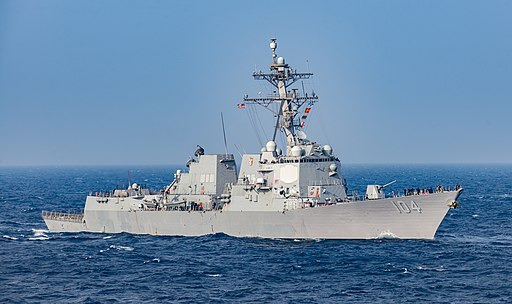
USS Sterett (DDG-104)
USS Sterett (DDG-104) is an Arleigh Burke–class guided-missile destroyer commissioned into U.S. Navy service in August 2008. Designed for multi-mission operations, Sterett combines the Aegis Combat System, advanced propulsion plants, integrated electronic warfare suites, and robust aviation support to project power across the world’s littorals and open oceans. As the fourth U.S. Navy vessel bearing the Sterett name, she honors naval officer Andrew Sterett and upholds a legacy of adaptability, resilience, and combat readiness.
Hull Design and Structural Characteristics
Hull Form and Materials
USS Sterett features the Flight IIA variant hull form, distinguished by a flared bow, reinforced sheer, and extended beam to improve seakeeping and stability when launching helicopters. The steel hull and superstructure utilize HSLA-80 naval plate steel, offering high tensile strength and fatigue resistance. Hull welding techniques emphasize precision seams to minimize radar cross-section while preserving structural integrity under high-sea states.
Dimensions and Displacement
- Overall length: 509 ft 6 in (155.3 m)
- Waterline length: 471 ft (143.6 m)
- Beam: 59 ft (18 m) at waterline; 66 ft (20.1 m) maximum
- Draft: 31 ft (9.4 m) maximum; 22 ft (6.7 m) at operational load
- Standard displacement: approximately 6,600 long tons
- Full-load displacement: approximately 9,200 long tons
These dimensions strike a balance between a slender, hydrodynamic form for high speeds and a broader flight-deck footprint to host two Seahawks or unmanned aerial vehicles.
Propulsion and Performance
Powerplant Configuration
Sterett employs a four-gas-turbine arrangement, each General Electric LM2500-30 delivering 25,000 shaft horsepower, driving two controllable-pitch propellers on dual shafts. This combined output of 100,000 shp enables rapid speed changes, precise maneuvering, and sustained high-speed transits.
Speed, Endurance, and Range
- Maximum speed: designed for over 30 knots in calm seas
- Cruising speed: 20 knots for fuel-efficient transits
- Range: 4,400 nautical miles at 20 knots
- Endurance: capable of 45 days at sea without replenishment
Efficient turbine management and automated fuel scheduling allow Sterett to cover theater-wide distances while maintaining readiness for combat stations.
Combat Systems Architecture
Aegis Combat System
At the heart of Sterett’s combat suite lies the Aegis Baseline 7 Phase 1 configuration, integrating the AN/SPY-1D(V) phased-array radar with the Command and Decision (C&D) processor. This system can track over 100 air and surface contacts simultaneously, automatically assigning threat priorities and coordinating weapon engagements.
Vertical Launching System
Sterett carries a total of 96 Mk 41 Vertical Launch System (VLS) cells in two primary modules:
- Forward VLS: 32 cells
- Amidships VLS: 64 cells
Load-out options include:
- RIM-66M Standard Missile 2 Medium Range for air defense
- RIM-156 Standard Missile 2 Extended Range
- RIM-174 Standard ERAM (SM-6) for extended air and ballistic missile defense
- RIM-161 Standard Missile 3 for exo-atmospheric intercepts
- BGM-109 Tomahawk cruise missiles for land-attack missions
- RUM-139 VL-ASROC for submarine engagements
- MK 54 lightweight torpedoes in quad-packs
Gun and Close-In Weapon Systems
- One Mk 45 Mod 4 5-inch/62 caliber naval gun forward, capable of high-rate precision naval gunfire support.
- Two Mk 15 Phalanx Block 1B Close-In Weapon Systems (CIWS) provide autonomous defense against supersonic anti-ship missiles and small surface craft.
- Two Mk 38 Mod 2 25 mm machine gun systems for short-range surface threats.
Anti-Submarine Warfare Fit
Sterett’s Flight IIA design incorporates:
- Dual Mk 32 triple torpedo tubes for Mk 46/Mk 50/Mk 54 torpedoes
- Hull-mounted sonar (AN/SQS-53C) for active/passive submarine detection
- Towed sonar array (AN/SQR-19 Tactical Towed Array Sonar) for passive long-range acoustic surveillance
Integration between VLS-launched ASROC rockets and towed/hull arrays enables layered submarine defense.
Electronic Warfare and Countermeasures
- AN/SLQ-32(V)3 electronic support measures detect and classify incoming radar emissions.
- Mk 36 SRBOC chaff/flare launchers deploy infrared and radar decoys.
- AN/SLQ-25 Nixie torpedo decoy provides acoustic countermeasures against incoming torpedoes.
Advanced digital receivers and threat libraries allow automatic threat analysis and countermeasure deployment.
Sensor Suites and Communications
Radar and Fire Control
- AN/SPY-1D(V) multi-function radar conducts 360° coverage with high refresh rates.
- SPG-62 fire-control radars illuminate semi-active targets for Standard Missiles.
- AN/SPQ-9B high-resolution surface-search radar optimizes hostile small craft detection.
Sonar and Underwater Systems
- AN/SQS-53C hull sonar array provides medium-range detection and classification.
- AN/SQR-19 towed passive array offers long-range acoustic coverage against quiet submarines.
- AN/SLQ-61 Lightweight Tow (LWT) C3 sonar decoy can lure incoming torpedoes away from the ship’s hull.
Communications, Navigation, and C4I
- Multi-band satellite communications (INMARSAT, WSC-6) support global command links.
- Link 16 tactical data link for real-time networked air and surface track sharing.
- GPS and LPI (low-probability-of-intercept) navigation systems ensure precise position accuracy.
- Cooperative Engagement Capability (CEC) enables shared radar tracks across Aegis ships and aircraft.
Aviation Facilities
Flight Deck and Hangar
The aft flight deck and enclosed hangar accommodate two MH-60R/S Seahawk helicopters or an MQ-8 Fire Scout unmanned aerial vehicle. Full-motion hangar doors and integrated maintenance shops allow for routine repairs, arms loading, and fueling without reliance on shore support.
Aviation Support Equipment
- H-60 maintenance stands, hydraulics test benches, and engine-run pads for intermediate repairs
- Weapons-loading rails compatible with Hellfire, torpedoes, and Air-to-Surface missiles
- Aviation fuel storage and replenishment rigs deliver JP-5 to rotary-wing aircraft
These facilities enable extended ASW, surveillance, and surface strike flights.
Crew Composition and Habitability
Manning Structure
- Total personnel: approximately 380
- Officers: ~32
- Enlisted: ~348
- Commanding Officer, Executive Officer, department heads, division officers, and enlisted watchstanders
- Cross-training in damage control, firefighting, weapons handling, and engineering watch stations
Living Spaces and Amenities
- Staterooms for officers and chief petty officers with private heads
- Modular berthing racks for junior enlisted with integrated personal lockers
- Mess decks, galley, and lounge areas designed for high-throughput meal service
- Fitness center, library/computer room, and small-arms firing range simulator
Habitability upgrades over earlier Arleigh Burke flights include improved noise attenuation and HVAC zoning for comfort in varying climates.
Construction and Service History
Building and Commissioning
- Contract award date: 13 September 2002 to Bath Iron Works, Bath, Maine
- Keel laid: 17 November 2005
- Launch date: 20 May 2007
- Commissioning ceremony: 9 August 2008 in Baltimore, Maryland
Sponsored by a descendant of Andrew Sterett, the ship was delivered within budget and on schedule.
Operational Deployments
Since entering service, Sterett has undertaken multiple Western Pacific, Middle East, and joint-alliance missions. Highlights include:
- Maiden deployment with Carrier Strike Group 7 to the Fifth and Seventh Fleet areas
- Participating in theater ballistic missile defense exercises in the Pacific
- Anti-piracy patrols off the Horn of Africa, conducting visit-board-search-and-seizure operations
- Regular UNITAS and RIMPAC multinational exercises focusing on integrated air, surface, and undersea warfare
Her deployments underscore flexibility across diplomacy, deterrence, and combat operations.
Awards and Recognitions
Over her service life, USS Sterett has earned several unit commendations and award honors:
- Navy Unit Commendation for exceptional performance during high-risk missions
- Battle “E” Efficiency awards for combat readiness in multiple years
- Spokane Trophy for superior performance in surface warfare excellence
These accolades reflect crew proficiency, operational excellence, and sustained combat power projection.
Conclusion
USS Sterett (DDG-104) exemplifies the Arleigh Burke–class ethos of multi-mission adaptability, advanced C4I, and robust kinetic capabilities. From her steel monohull shaped for speed and stability to her Aegis-driven engagement network, Sterett operates at the forefront of naval warfare. With a capable crew, modular systems, and continuous upgrades, she remains a cornerstone of forward naval presence, security cooperation, and crisis response across the globe’s littorals and beyond.
_in_Malabar_2020.jpg)