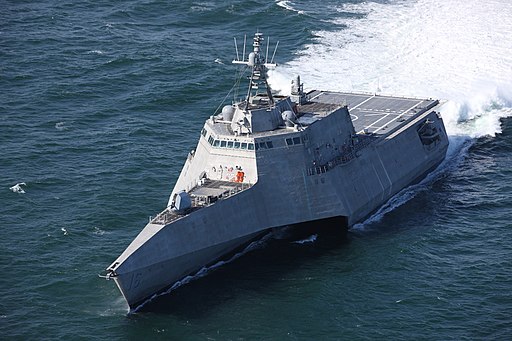
USS Tulsa (LCS-16)
USS Tulsa (LCS-16) is an Independence-class littoral combat ship in the United States Navy. She is the third vessel to bear the name of Tulsa, Oklahoma, and was commissioned on 16 February 2019, establishing her homeport in San Diego, California.
Development and Construction
Littoral Combat Ship Program
In the early 2000s, the U.S. Navy sought a new class of fast, agile, and modular vessels tailored for operations close to shore. The resulting Littoral Combat Ship (LCS) concept prioritized a low draft, high speed, and interchangeable mission packages to counter evolving threats in littoral environments. Independence-class vessels, including USS Tulsa, feature a distinctive trimaran hull design optimized for stability and deck space.
Keel Laying and Launch
Austal USA in Mobile, Alabama, received the contract to build USS Tulsa on 29 December 2010. Her keel was laid on 11 January 2016, and she was launched on 16 March 2017. Former Tulsa mayor Kathy Taylor sponsored the ship during the christening ceremony on 11 February 2017. After outfitting and trials, Tulsa officially entered service on 16 February 2019.
Design
Hull Form and Hydrodynamics
The trimaran hull of the Independence class consists of a central hull flanked by two smaller outriggers. This configuration offers exceptional transverse stability at high speeds and a wider flight deck compared to conventional monohulls. The shallow draft of approximately 4.27 meters allows operations close to shore and in shallow waters where larger frigates and destroyers cannot venture.
Propulsion System
Tulsa employs a combined diesel and gas (CODAG) propulsion arrangement. Two GE LM2500 gas turbines and two MTU diesel engines drive four waterjets, supplemented by a retractable azimuth thruster. This hybrid setup delivers a combined output of around 44,000 shaft horsepower, enabling rapid acceleration and efficient cruising under varying conditions.
Performance and Maneuverability
Designed for speeds exceeding 40 knots in sustained operations and capable of sprints over 47 knots, Tulsa can quickly reposition in littoral theaters. Her range extends to 4,300 nautical miles at a cruising speed of 20 knots. Precision maneuvering is achieved through the quartet of waterjets and the azimuth thruster, allowing tight turns, station keeping against strong currents, and navigation in confined channels.
Armament and Defensive Systems
- Main gun: one BAE Systems Mk 110 57 mm naval cannon for surface and air targets
- Missile defense: one Evolved SeaRAM launcher with 11 RIM-162 ESSM cells
- Close-in weapons: four .50 caliber (12.7 mm) machine guns in four stations
- Decoys and countermeasures: four SRBOC chaff/flares launchers and integrated ESM/ECM suite for electronic warfare and threat warning
Sensors and Electronics
- Surveillance radar: Sea Giraffe 3D for simultaneous air and surface search
- Navigation radar: Bridgemaster-E for collision avoidance and course keeping
- Electro-optical/infrared sensor: AN/KAX-2 for night tracking and fire control
- Electronic support measures: EDO ES-3601 for signal interception and analysis
Mission Modules and Aviation
Tulsa’s large mission bay and modular design allow rapid reconfiguration between surface warfare, mine countermeasures, and anti-submarine packages. The flight deck and 340 m² hangar can accommodate two MH-60 Seahawk helicopters or two MQ-8 Fire Scout unmanned aerial vehicles, enabling extended surveillance and targeting missions.
Crew and Accommodation
The ship carries a core complement of 40 sailors (eight officers and 32 enlisted) with capacity for up to 35 additional mission crew members. Displacement measures roughly 2,307 metric tons light and 3,104 metric tons at full load, balancing a compact profile with ample onboard space for crew operations and mission equipment.
Operational Role
USS Tulsa’s speed, shallow draft, and modular payload make her ideal for patrols, maritime security, and expeditionary missions in coastal regions. By delivering flexible mission capabilities, she enhances the Navy’s ability to conduct presence operations, sea control, and partner engagement in littoral zones.
Conclusion
USS Tulsa (LCS-16) represents a leap in littoral warfare design, merging innovative hull architecture, hybrid propulsion, and modular mission systems. Her capabilities underscore the U.S. Navy’s commitment to flexibility and responsiveness in near-shore environments, ensuring readiness for diverse maritime challenges.
_in_acceptance_trials.jpg)