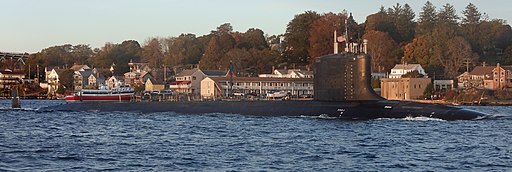
USS Vermont (SSN-792)
Namesake and Class Position
The USS Vermont is a nuclear-powered attack submarine of the United States Navy, designated SSN-792. She is the nineteenth vessel in the Virginia-class series and the third naval vessel to honor the state of Vermont. Vermont represents the Block IV variant, featuring incremental enhancements over earlier blocks in acoustic stealth, maintenance cycles, and payload flexibility .
Commissioning and Homeport
Vermont was formally commissioned into active service on 18 April 2020 at Naval Submarine Base New London before transiting to her assigned homeport at Pearl Harbor, Hawaii. Since arrival in the Pacific fleet she has operated under Submarine Squadron One, projecting undersea power and conducting multinational exercises in the Asia-Pacific region .
Development and Construction
Contract Award and Naming Ceremony
The construction contract for Vermont was awarded on 28 April 2014 as part of a US $17.6 billion agreement to build ten Block IV Virginia-class submarines. Then-Secretary of the Navy Ray Mabus announced the selection of “Vermont” on 18 September 2014, perpetuating the tradition of naming attack submarines after U.S. states .
Keel Laying, Christening, Launching and Commissioning
The keel was authenticated in February 2017 at General Dynamics Electric Boat in Groton, Connecticut. A ceremonial christening followed on 20 October 2018, when a bottle of Vermont sparkling apple wine shattered against her bow. Vermont was launched on 29 March 2019, delivered to the Navy on 17 April 2020, and officially entered service the next day .
Design and Construction Features
Hull Architecture and Materials
Vermont features the Virginia-class double-hull arrangement with an internal pressure hull constructed from HY-100 steel and an outer low-observable hydrodynamic casing covered in anechoic tiles. This layered design minimizes acoustic signature and sonar returns while preserving structural integrity at depth .
Stealth and Modular Interiors
Combat and technical spaces are organized into modular zones, enabling rapid replacement or upgrade of sensors, combat systems, and mission-specific equipment without extensive dry-dock periods. Hull and sensor modules can undergo “selected restricted availability” upgrades, streamlining modernization across her service life .
Propulsion and Performance
Nuclear Reactor and Steam Turbines
Power is provided by a single S9G pressurized-water nuclear reactor fueled with 93 percent highly enriched uranium. The reactor generates steam for two turbines rated at a combined 210 MW (280,000 shp), supplying sustained energy without refueling for the vessel’s expected 33-year core life .
Pump-Jet Propulsion and Maneuvering
Thrust is delivered through a single pump-jet propulsor, supplemented by a secondary electric motor for ultra-quiet operations. This arrangement reduces cavitation noise relative to traditional propellers and enhances acoustic stealth during covert transits .
Speed, Range and Endurance
Underwater speeds exceed 25 knots, allowing rapid response and transit. Endurance is effectively unlimited from a fuel standpoint, constrained only by food and maintenance; Vermont can operate submerged for extended patrols, with stores to support roughly 90 days of sustained deployment .
Sensors and Combat Systems
Sonar and Acoustic Sensors
Vermont carries a comprehensive sonar suite blending hull-mounted arrays, flank arrays, and towed passive arrays to detect and classify contacts across a wide frequency spectrum. These systems enable long-range threat detection and support both stationary and high-speed tracking .
Combat Management and Electronic Warfare
An integrated combat system fuses sonar, fire control, navigation, and electronic support measures into a single tactical display. Built-in electronic warfare capabilities allow interception and analysis of adversary emissions, enhancing situational awareness in both littoral and open-ocean environments .
Armament
Vertical Launch System
A twelve-cell 21-inch vertical launch system accommodates a variety of missiles, including BGM-109 Tomahawk cruise missiles for long-range strikes, RUM-139 VL-ASROC anti-submarine rockets, and Standard SM-6 surface and anti-air interceptors .
Torpedo Tubes and Additional Weapons
Four 533 mm torpedo tubes fire Mk 48 heavyweight torpedoes for anti-submarine and anti-surface warfare. The combination of torpedoes and missiles grants Vermont a versatile strike package capable of engaging threats across multiple domains .
Crew and Habitability
Complement and Mission Teams
The submarine is staffed by 15 officers and 120 enlisted sailors who handle navigation, engineering, weapons, and support functions. Space is allocated for additional mission specialists when operating in intelligence, surveillance, reconnaissance, or special-operations roles .
Living Spaces and Amenities
Berthing arrangements accommodate rotating watch sections, while common areas include mess facilities, a gym, and secure communication centers. Life-support systems maintain air quality, water production, and waste processing to sustain long deployments .
Operational Role and Recent Deployments
Multi-Mission Capabilities
Designed for anti-submarine warfare, anti-surface warfare, strike operations, and special-operations support, Vermont exemplifies the Virginia-class ethos of modular adaptability. She can insert unmanned undersea vehicles, deploy naval command centers, or engage high-value targets with precision munitions .
Key Exercises and Port Visits
In December 2020, Vermont sailed to Brazil to attend the launch of the Brazilian Navy submarine Humaitá and conducted bilateral exercises with the Brazilian submarine Tupi, showcasing interoperability and reinforcing regional security ties .
Technical Specifications
Below is a summary of Vermont’s principal characteristics:
| Parameter | Value |
|---|---|
| Class & Block | Virginia-class, Block IV |
| Displacement | 7,800 t submerged; 7,000 t surfaced |
| Length | 115 m |
| Beam | 10.4 m |
| Draft | 9.8 m |
| Test Depth | >244 m |
| Propulsion | 1× S9G PWR reactor; 2× steam turbines; 1× pump-jet; 1× motor |
| Power Output | 210 MW (280,000 shp) |
| Speed | >25 knots |
| Endurance | Unlimited (nuclear fuel); ~90 days supplies |
| Complement | 15 officers; 120 enlisted |
| VLS Tubes | 12 |
| Torpedo Tubes | 4× 533 mm |
| Primary Armament | Tomahawk; SM-6; VL-ASROC; Mk 48 torpedoes |
| Hull Material & Stealth Features | HY-100 steel; anechoic tiles |
_underway_on_the_Thames_River_at_Groton,_Connecticut_(USA),_on_15_October_2020_(201015-N-AY957-202).JPG)