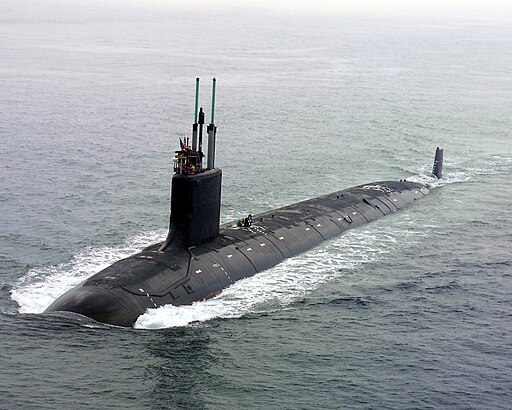
USS Virginia (SSN-774)
Genesis of the Virginia Class
Work on the Virginia class began in 1991 under the code name Centurion to create a cost-effective alternative to the Seawolf class, emphasizing stealth, modularity, and multi-mission flexibility.
The Navy awarded the contract for SSN-774 on 30 September 1998, laid her keel on 2 September 1999 at General Dynamics Electric Boat in Groton, Connecticut, and launched her on 16 August 2003. She was commissioned on 23 October 2004, becoming the first submarine designed entirely with computer-aided tools.
Modular Construction Approach
Virginia’s hull is built in large prefabricated modules that allow rapid technological upgrades and ease of maintenance. Each module can be swapped or refitted without extensive dry-dock periods, extending the class’s service life and adaptability to emerging threats.
Hull Architecture and Stealth
Materials and Anechoic Coating
The internal pressure hull is made of HY-100 steel, chosen for its high yield strength under deep-sea pressure. An outer low-observable casing is covered in anechoic tiles that absorb incoming sonar pings and reduce the submarine’s acoustic signature.
Photonics Mast and Control Room
Instead of a traditional optical periscope, USS Virginia uses a photonics mast with high-resolution cameras and infrared sensors. This system feeds imagery directly to the control room, which is positioned lower in the hull to improve survivability and ergonomics.
Propulsion and Performance
Nuclear Propulsion System
Power comes from a single S9G pressurized-water reactor fueled with 93% highly enriched uranium. The reactor produces steam for two turbines rated at a combined 280 000 shaft horsepower, driving a single pump-jet propulsor.
Pump-Jet Propulsor and Secondary Motor
Thrust is delivered primarily by the pump-jet propulsor, reducing cavitation noise. A secondary electric motor enables ultra-quiet maneuvering during covert operations, further enhancing Virginia’s stealth profile.
Speed, Test Depth, Range, and Endurance
Virginia can exceed 25 knots submerged and dive below 800 feet (244 meters). Her nuclear core gives effectively unlimited range, with endurance limited only by onboard stores and crew resilience, allowing patrols lasting up to three months.
Sensors and Combat Systems
Integrated Sonar and Electronic Warfare
An advanced sonar suite combines a bow-mounted spherical array, flank arrays, and a towed passive array to detect and classify contacts across frequencies. Electronic support measures intercept and analyze adversary emissions, feeding data into an integrated combat system for rapid decision-making.
Fire Control and Command
The combat management system merges navigation, sonar, and weapons control into a single tactical display. Operators can track multiple targets and assign weapons with minimal latency, enabling simultaneous anti-submarine, anti-surface, and strike missions.
Armament
Vertical Launch System and Torpedo Tubes
Virginia carries twelve 21-inch vertical launch tubes for Tomahawk cruise missiles, RUM-139 VL-ASROC anti-submarine rockets, and potential hypersonic or anti-air missiles. Four 21-inch torpedo tubes deploy Mk 48 heavyweight torpedoes and can also lay mines from the tube mouths.
Crew and Habitability
Complement and Mission Teams
USS Virginia is staffed by 14 officers and 120 enlisted sailors, with space for additional mission specialists during surveillance or special-operations support. Modular berthing areas and dedicated workspaces enable rapid reconfiguration for diverse mission profiles.
Life-Support and Amenities
Life-support systems regenerate air and water, manage waste, and maintain temperature. Common areas include a mess hall, gym, and secure communications center, all optimized for long deployments in confined quarters.
Operational Role and History
Multi-Mission Flexibility
As the lead ship of her class, Virginia set the standard for anti-submarine warfare, strike operations, special-operations support, and intelligence gathering. Her design allows rapid switching between mission modules for littoral or open-ocean tasks.
Milestones and Deployments
After commissioning in 2004, Virginia has participated in numerous Atlantic and Pacific exercises, demonstrating interoperability with allied navies and validating her advanced systems in real-world scenarios. She maintains homeport in Groton, Connecticut, under Submarine Group 2.
Technical Specifications
| Parameter | Value |
|---|---|
| Class & Block | Virginia-class, lead ship |
| Displacement | 7 000 t surfaced; 7 800 t submerged |
| Length | 115 m |
| Beam | 10.4 m |
| Draft | 9.8 m |
| Test Depth | >244 m |
| Propulsion | 1 × S9G PWR reactor; 2 × steam turbines; 1 × pump-jet; 1 × electric motor |
| Power Output | 280 000 shp (210 MW) |
| Speed | >25 knots |
| Endurance | Unlimited nuclear fuel; ~90 days supplies |
| Complement | 14 officers; 120 enlisted |
| VLS Tubes | 12 |
| Torpedo Tubes | 4 × 21 in |
| Armament | Tomahawk; VL-ASROC; Mk 48 torpedoes |
| Hull Material & Stealth Features | HY-100 steel; anechoic tiles |
Conclusion
USS Virginia (SSN-774) established a new benchmark for submarine design by integrating stealth, modular construction, and advanced combat systems. As the prototype for her class, she continues to validate the future-proof architecture that enables the U.S. Navy to project power undersea with unmatched flexibility and survivability.
_returns_to_the_General_Dynamics_Electric_Boat_shipyard.jpg)