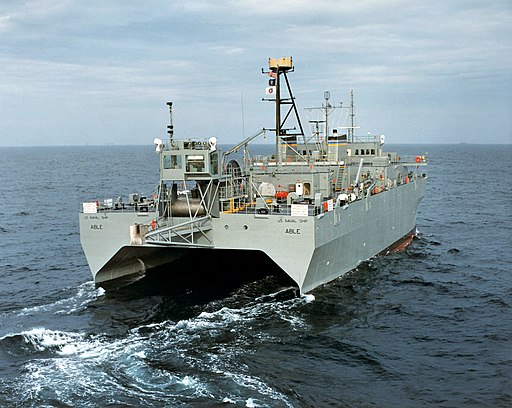
USNS Able (T-AGOS-20): Technical Overview and Operational Role
The USNS Able (T-AGOS-20) is a United States Navy ocean surveillance ship, part of the Stalwart-class (later designated as the Victorious-class after modifications and reassignments). Operated by the Military Sealift Command (MSC), Able is a critical component of the Navy’s undersea surveillance network, serving in intelligence, surveillance, and reconnaissance (ISR) roles. Her primary mission focuses on tracking and monitoring submarines and other undersea threats using advanced sonar systems integrated into the global ocean surveillance architecture.
Development and Background
The T-AGOS program emerged during the Cold War to provide continuous and wide-area acoustic surveillance of the world’s oceans. The Surveillance Towed Array Sensor System (SURTASS) ships were designed to complement fixed undersea surveillance systems such as the Sound Surveillance System (SOSUS). Their mobility allowed flexible monitoring of specific ocean regions, particularly those associated with Soviet submarine activity.
USNS Able was laid down at Tacoma Boatbuilding Company in Tacoma, Washington, as the second of four units in her subclass. She was launched in the late 1980s and delivered to the Navy in 1989. Following her commissioning, Able operated under the Military Sealift Command with a civilian crew and Navy detachment responsible for operational systems.
General Characteristics
-
Type: Ocean Surveillance Ship
-
Class and Type: Victorious-class (originally Stalwart-class)
-
Builder: Tacoma Boatbuilding Company, Tacoma, Washington
-
Operator: Military Sealift Command (MSC)
-
Displacement: Approximately 3,200 tons (full load)
-
Length: 224 feet (68 meters)
-
Beam: 43 feet (13 meters)
-
Draft: 15 feet (4.6 meters)
-
Propulsion: Diesel-electric drive consisting of four Caterpillar D-398 diesel engines powering two General Electric electric motors, driving a single shaft
-
Power Output: Approximately 3,200 shaft horsepower
-
Speed: 11 knots (cruising), maximum about 16 knots
-
Range: 3,000 nautical miles at economical speed
-
Endurance: 30 to 60 days, depending on mission profile
-
Crew: 24 civilian mariners (MSC) and 5–10 Navy specialists
Design and Construction Features
USNS Able was designed for acoustic quietness, endurance, and stability rather than speed. Her SWATH-like (Small Waterplane Area Twin Hull) hull form minimizes roll and pitch motions, critical for maintaining towed sonar array stability. The hull’s aluminum superstructure and steel lower sections ensure both durability and reduced magnetic signature.
The ship’s propulsion system uses diesel-electric configuration, which isolates vibration and noise from the hull. This reduction in self-noise is essential for sonar performance, as it prevents interference with the sensitive acoustic systems deployed from the vessel.
Sensor and Surveillance Systems
The defining feature of USNS Able is her SURTASS suite—an advanced towed array sonar system capable of detecting and tracking submarines over long ranges. The towed array consists of a cable several thousand meters long, equipped with hydrophones that collect acoustic data across the low-frequency spectrum. Data from SURTASS are transmitted via satellite communication links to shore-based processing facilities for analysis and integration with other surveillance assets.
Later in her service life, Able received upgrades to accommodate SURTASS Low Frequency Active (LFA) systems, expanding her detection capabilities against quieter and deeper-diving submarines. The LFA array allows for active sonar operations, emitting low-frequency signals that can detect objects beyond the passive range of standard arrays.
Communications and Data Handling
USNS Able’s mission requires secure, real-time data transmission. The ship is equipped with advanced satellite communications suites, including Defense Satellite Communications System (DSCS) terminals and Secure Voice and Data Links for transmitting acoustic and positional data to Navy processing centers. Onboard data storage and pre-processing capabilities support immediate tactical analysis.
Navigation and Control
The vessel uses an integrated bridge navigation system featuring automated radar plotting aids, electronic chart displays, and GPS navigation. Dynamic positioning capability allows precise station-keeping during sonar operations, ensuring optimal array deployment and minimal disturbance from sea conditions.
Operational History
Following her delivery, USNS Able joined the Pacific-based fleet of ocean surveillance vessels. During the final years of the Cold War, she conducted patrols in the Pacific and Indian Oceans, contributing to the global antisubmarine warfare (ASW) network. Post-Cold War, Able’s mission evolved toward supporting undersea surveillance in peacetime operations, including monitoring maritime activity in regions of strategic interest and contributing to environmental acoustic research.
In the early 2000s, Able underwent a series of upgrades to extend her service life and enhance her sensor and communications capabilities. These upgrades included digital sonar processing systems, improved power management, and enhanced habitability for long-duration missions.
Role within the Modern Navy
Although originally conceived for Cold War submarine tracking, USNS Able continues to serve an important role in the modern U.S. Navy’s surveillance strategy. She operates as part of the Integrated Undersea Surveillance System (IUSS), which combines fixed arrays, mobile SURTASS units, and autonomous platforms to maintain maritime domain awareness.
Her versatility allows deployment in a range of missions beyond traditional ASW, such as environmental monitoring, acoustic research, and multinational cooperative operations involving undersea data collection.
Current Status
As of the mid-2020s, USNS Able remains in active service under Military Sealift Command, based primarily in the Pacific. Regular maintenance and modernization ensure operational readiness for continued surveillance missions. Her longevity reflects the Navy’s ongoing reliance on towed-array platforms for persistent undersea detection in the era of increasingly quiet and advanced submarines.
Summary
USNS Able (T-AGOS-20) stands as a testament to the enduring relevance of acoustic surveillance in naval strategy. With her specialized sensors, quiet propulsion system, and robust communication capabilities, she continues to fulfill a critical role in maritime security and intelligence gathering. Though her origins lie in Cold War deterrence, Able’s design and technology have proven adaptable to modern undersea challenges, ensuring that she remains a vital node in the United States Navy’s global surveillance network.
_aft_SURTASS_equipment.jpg)