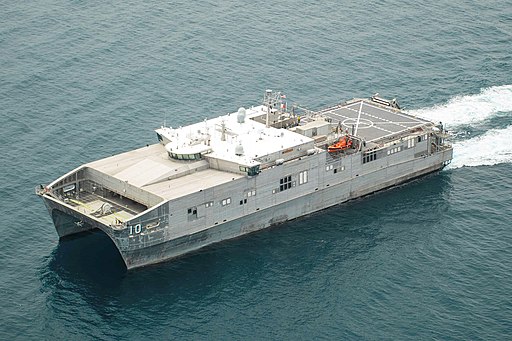
USNS Burlington (T-EPF-10) is a Spearhead-class Expeditionary Fast Transport (EPF) vessel operated by the United States Navy’s Military Sealift Command (MSC). Designed for rapid intra-theater transport of personnel, vehicles, and equipment, Burlington embodies the Navy’s drive for agile maritime mobility and flexible logistics. The ship supports diverse mission profiles ranging from combat logistics and joint operations to humanitarian assistance and disaster relief.
Named after the city of Burlington, Vermont, the vessel continues the legacy of partnership between American communities and the maritime service. Its combination of high speed, shallow draft, and large cargo capacity makes it a vital enabler for operations in littoral regions and underdeveloped port environments.
Construction and Development
USNS Burlington was built by Austal USA at its shipyard in Mobile, Alabama, as part of the U.S. Navy’s effort to expand its fleet of expeditionary support vessels. It is the tenth ship of the Spearhead-class, following a proven high-speed aluminum catamaran design derived from commercial ferry technology.
The keel for Burlington was laid in February 2017, the ship was launched in November 2017, and it was delivered to the U.S. Navy in November 2018. Following sea trials that demonstrated excellent performance and handling characteristics, Burlington was accepted into operational service under the Military Sealift Command as T-EPF-10.
General Characteristics
-
Class and Type: Spearhead-class Expeditionary Fast Transport (EPF)
-
Hull Number: T-EPF-10
-
Builder: Austal USA, Mobile, Alabama
-
Operator: Military Sealift Command (MSC)
-
Delivered: November 14, 2018
-
Homeport: Norfolk, Virginia (assigned to MSC’s Sealift Program)
Physical Specifications
-
Displacement (full load): Approximately 2,400 metric tons
-
Length overall: 338 feet (103 meters)
-
Beam: 93.5 feet (28.5 meters)
-
Draft: 12.5 feet (3.8 meters)
-
Hull type: Aluminum twin-hull (catamaran)
-
Flight deck: Capable of supporting a CH-53E Super Stallion or MH-60 Seahawk helicopter
-
Vehicle deck area: Over 20,000 square feet (1,860 square meters)
-
Payload capacity: Up to 600 short tons of vehicles, containers, or equipment
-
Ramp system: Stern ramp capable of supporting combat vehicles up to M1A2 Abrams tank weight for roll-on/roll-off operations
The vessel’s lightweight aluminum structure and catamaran hull provide excellent hydrodynamic efficiency, high speed, and shallow-water access, enabling it to deliver forces and supplies directly to austere coastal areas.
Propulsion and Performance
USNS Burlington is powered by a diesel-driven waterjet propulsion system, providing both speed and maneuverability suitable for a range of environments.
-
Propulsion type: Four steerable waterjets
-
Engines: Four MTU 20V 8000 M71L diesel engines
-
Power output: 9,100 kW (approximately 12,200 hp) per engine
-
Maximum speed: Over 40 knots (74 km/h) when lightly loaded
-
Sustained speed: 35 knots under full operational load
-
Range: 1,200 nautical miles at 35 knots; over 5,500 nautical miles at reduced speeds
-
Fuel capacity: Approximately 135,000 gallons (511,000 liters)
-
Endurance: 5 to 10 days of continuous operation
The waterjet propulsion allows the ship to operate efficiently in shallow waters and maneuver easily in confined coastal regions, while minimizing the risk of damage from debris or grounding.
Navigation and Control Systems
Burlington is equipped with advanced integrated bridge and control systems to ensure precision handling and safety during high-speed operations:
-
Integrated Bridge System (IBS) with multiple multifunctional displays
-
Electronic Chart Display and Information System (ECDIS)
-
Dynamic Positioning (DP) system for station-keeping and offshore loading
-
Automatic Identification System (AIS) for maritime tracking
-
Global Positioning System (GPS) and inertial navigation suite
-
Voyage Data Recorder (VDR) and radar integration
Automation allows for efficient ship control with a small bridge team, enhancing mission efficiency and reducing crew fatigue during long operations.
Crew and Accommodations
-
Core MSC civilian crew: 26 to 30
-
Mission personnel capacity: Up to 312 embarked troops or passengers
-
Additional mission crew: Space for approximately 100 extra mission-specific staff
-
Crew amenities: Fully air-conditioned berthing, galley, medical bay, gym, and recreational areas
The ship’s interior design focuses on flexibility and comfort, allowing rapid conversion between troop transport, medical support, or logistics missions.
Cargo and Mission Capabilities
USNS Burlington features a reconfigurable mission bay and vehicle deck designed for modular operations:
-
20,000+ square feet of cargo space with tie-downs for ISO containers or military vehicles
-
Stern ramp compatible with roll-on/roll-off operations
-
Adjustable ramp height for interfacing with small piers, causeways, or floating docks
-
Cargo elevator and cranes for container movement and deck reconfiguration
-
Capability to embark pallets, tactical vehicles, light armored vehicles, and relief supplies
The large open vehicle deck allows for rapid loading and offloading operations in support of amphibious or humanitarian missions.
Aviation Facilities
-
Flight deck: Capable of supporting operations by large helicopters such as the CH-53E Super Stallion or MH-60 Seahawk
-
Refueling capability: Flight deck refueling system for embarked rotary aircraft
-
Flight operations control: Compact flight operations room with communication links
-
No hangar: The ship can launch and recover aircraft but does not provide enclosed maintenance or storage facilities
The flight deck enhances Burlington’s utility for logistics support, medical evacuation, and rapid personnel transport.
Communications and Electronics
Burlington’s communication suite is designed for both military and humanitarian coordination:
-
Secure and non-secure satellite communication systems (Inmarsat, VSAT)
-
HF/VHF/UHF voice and data radios
-
Internal LAN for command and control
-
Mission data link capability (Link-16 compatible in some configurations)
-
Shipboard Wi-Fi and data processing network
These systems ensure real-time coordination with joint forces, naval task groups, or civilian relief organizations.
Mission Roles
USNS Burlington performs a wide range of missions across multiple operational environments:
-
Rapid intra-theater transport of troops, vehicles, and supplies
-
Humanitarian assistance and disaster relief (HADR)
-
Medical evacuation and mobile medical support
-
Special operations and joint force insertion
-
Maritime security and partner-nation training exercises
-
Joint logistics over-the-shore (JLOTS) operations
The ship’s high speed and shallow draft make it particularly valuable in regions lacking deep-water ports or during crisis response in coastal areas.
Operational Highlights
Since entering service, Burlington has been deployed in both the Atlantic and Indo-Pacific theaters, demonstrating the versatility of the EPF class. Notable activities include:
-
Caribbean and Latin America deployments in support of humanitarian exercises and disaster relief readiness
-
Pacific Partnership operations, enhancing interoperability with regional allies
-
U.S. Southern Command missions focusing on logistics mobility and naval diplomacy
-
Medical outreach and civic assistance exercises with partner nations
These missions highlight Burlington’s ability to serve as both a military logistics vessel and a platform for soft-power projection.
Maintenance and Upgrades
Routine maintenance and refits are conducted by Austal USA and Navy shipyards to preserve operational readiness. Upgrades and sustainment efforts include:
-
Enhanced communications and network security systems
-
Improved automation and monitoring controls
-
Upgrades to mission bay and cargo handling systems
-
Energy efficiency modifications for reduced fuel consumption
Continual modernization ensures that Burlington remains capable of supporting evolving Navy and joint force mission requirements.
Role in the Spearhead-Class Fleet
USNS Burlington (T-EPF-10) is part of the Navy’s growing fleet of Spearhead-class expeditionary transports, which includes ships such as USNS Spearhead (T-EPF-1), USNS Fall River (T-EPF-4), and USNS Carson City (T-EPF-7). Collectively, the class provides distributed, flexible, and cost-effective maritime mobility across all combatant commands.
Each vessel in the class shares a common design philosophy: fast, adaptable, and mission-configurable transport capability that complements larger amphibious and logistics ships.
Strategic Importance
In modern naval doctrine, agility and speed are as crucial as tonnage. USNS Burlington provides the Navy with an unmatched ability to move forces and equipment quickly across vast operational theaters. Its shallow draft enables access to secondary and underdeveloped ports, while its large cargo capacity ensures mission continuity even in disrupted environments.
This capability is particularly critical for distributed maritime operations, humanitarian disaster response, and expeditionary logistics—cornerstones of the Navy’s 21st-century strategy.
Summary
USNS Burlington (T-EPF-10) represents the U.S. Navy’s vision for agile, high-speed maritime logistics. Built by Austal USA and operated by the Military Sealift Command, the ship combines aluminum catamaran design, powerful waterjet propulsion, and modular cargo systems to deliver rapid, reliable support across global theaters.
.jpg)