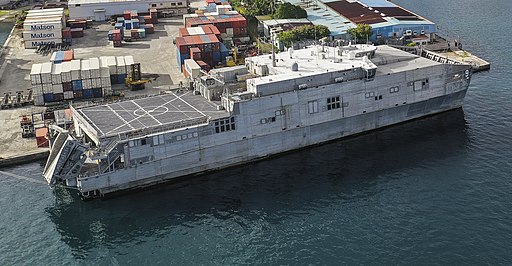
The USNS City of Bismarck (JHSV-9/T-EPF-9) is a Spearhead-class expeditionary fast transport (EPF) operated by the United States Navy’s Military Sealift Command (MSC). Designed for rapid intra-theater transport of troops, vehicles, and equipment, the ship embodies speed, agility, and versatility in modern naval logistics. It is one of a new generation of high-speed aluminum catamarans that enable the Navy to move forces and supplies quickly between forward operating bases and coastal locations with limited infrastructure.
The ship is named in honor of Bismarck, North Dakota, recognizing the city’s enduring support for the U.S. Armed Forces and its contribution to the nation’s defense community. As the ninth ship in the Spearhead class, the City of Bismarck plays a vital role in supporting distributed maritime operations, humanitarian missions, and joint-force mobility across global regions.
Design and Construction
The USNS City of Bismarck was constructed by Austal USA at its shipyard in Mobile, Alabama, which specializes in lightweight, high-speed aluminum vessels. Its design is based on Austal’s proven Auto Express 107-meter high-speed ferry, modified for U.S. Navy operations. The vessel’s catamaran hull form delivers excellent stability, efficiency, and shallow-water access, allowing it to operate in ports and coastal areas that are inaccessible to deeper-draft ships.
-
Keel Laid: January 18, 2017
-
Launched: June 7, 2017
-
Delivered to MSC: December 19, 2017
-
Builder: Austal USA
-
Class: Spearhead-class Expeditionary Fast Transport
The ship was built under the Joint High Speed Vessel (JHSV) program, later renamed Expeditionary Fast Transport (EPF) to reflect its multi-mission capabilities.
Technical Specifications
-
Class and Type: Spearhead-class Expeditionary Fast Transport (EPF)
-
Hull Number: JHSV-9 / T-EPF-9
-
Displacement: Approximately 2,400 tons (light); 2,700 tons (full load)
-
Length: 338 feet (103 meters)
-
Beam: 93.5 feet (28.5 meters)
-
Draft: 12.5 feet (3.8 meters)
-
Hull Type: Aluminum twin-hull catamaran
-
Propulsion System:
-
Four MTU 20V8000 M71L diesel engines
-
Combined power output: 36,000 horsepower (26.8 megawatts)
-
Four Wärtsilä waterjets for propulsion and steering
-
-
Speed: 35–40 knots (maximum, depending on load)
-
Range:
-
1,200 nautical miles at 35 knots
-
Up to 5,600 nautical miles at 15 knots
-
-
Crew Complement:
-
22 civilian mariners (MSC)
-
Up to 104 mission personnel or embarked troops
-
-
Endurance: 14 days at sea without resupply
Structural Design and Features
The USNS City of Bismarck utilizes a lightweight aluminum catamaran hull that provides high speed, low fuel consumption, and excellent stability. The wide beam enhances cargo-carrying capacity and offers superior maneuverability. The shallow draft allows the ship to access ports, beaches, and austere coastal environments, making it ideal for expeditionary and humanitarian operations.
Key structural features include:
-
Vehicle Deck: 20,000 square feet (1,858 square meters) of open mission deck space for vehicles and cargo.
-
Cargo Capacity: 600 short tons of vehicles, containers, or supplies.
-
Ramp System:
-
Stern-mounted ramp for roll-on/roll-off loading.
-
Adjustable for various pier heights and capable of supporting M1A2 Abrams main battle tanks.
-
-
Mission Bay: Modular and reconfigurable for vehicles, containerized cargo, or humanitarian supplies.
-
Flight Deck: Accommodates one MH-60 Seahawk or CH-53E Super Stallion helicopter for vertical replenishment and personnel transfer.
Propulsion and Performance
The vessel’s propulsion system consists of four high-speed diesel engines driving waterjet propulsors, allowing exceptional acceleration, maneuverability, and reduced draft compared to propeller-driven ships. This design enables the City of Bismarck to reach speeds above 35 knots while maintaining fuel efficiency at cruising speeds.
The waterjet propulsion also allows for precise control in shallow waters and during dynamic positioning maneuvers, making the vessel highly effective for littoral operations.
Automation and Technology
The City of Bismarck incorporates advanced maritime automation systems for navigation, propulsion management, and cargo handling, reducing crew workload and improving reliability.
-
Integrated Bridge System (IBS): Centralized control of navigation, radar, propulsion, and communications systems.
-
Ship Control and Monitoring System (SCMS): Monitors engine performance, fuel management, electrical systems, and auxiliary machinery in real time.
-
Communications Suite: Secure military and satellite communication systems for joint and coalition interoperability.
-
Dynamic Positioning Capability: Uses GPS and thruster control to maintain precise station-keeping during operations at sea or alongside other vessels.
-
Modular Mission Configurations: The open-deck layout and container-compatible fittings allow reconfiguration for missions such as medical support, troop transport, or cargo delivery.
Cargo and Logistics Capabilities
The City of Bismarck is primarily designed to move personnel, light vehicles, and cargo rapidly within a theater of operations. Its large mission bay and internal cargo decks are optimized for roll-on/roll-off (Ro-Ro) operations, minimizing port time.
-
Cargo Deck Load: Up to 600 short tons.
-
Deck Strength: Capable of supporting armored vehicles and heavy equipment.
-
Loading Time: Rapid turnaround through stern ramp and internal cargo-handling equipment.
-
Container Handling: Fitted for 20-foot and 40-foot ISO containers with tie-down points and modular cargo fittings.
The combination of vehicle deck space, flexible configuration, and speed allows the ship to function as a maritime “bridge” between larger sealift ships and shore-based forces.
Aviation Facilities
While the City of Bismarck does not feature a permanent hangar, it possesses a large flight deck certified for both day and night operations.
-
Helicopter Compatibility: MH-60 Seahawk, CH-53E Super Stallion, or similar-sized aircraft.
-
Flight Deck Systems:
-
JP-5 aviation fuel system for refueling.
-
Portable firefighting equipment and crash-rescue gear.
-
Secure communications and deck lighting for nighttime operations.
-
These facilities enhance the ship’s capability to support vertical replenishment (VERTREP), medical evacuation (MEDEVAC), and surveillance operations.
Habitability and Crew Facilities
The City of Bismarck provides modern living and working accommodations for both the core civilian crew and embarked mission personnel. Spaces are modular and climate-controlled, designed for long-duration comfort during high-speed transits.
-
Berthing Capacity: Up to 312 personnel (combined crew, troops, or embarked units).
-
Crew Amenities:
-
Private and shared staterooms
-
Galley and mess areas
-
Recreational lounges and fitness facilities
-
Medical treatment and triage spaces
-
Secure communications and operations rooms
-
Mission Roles and Operational Flexibility
The USNS City of Bismarck supports a wide range of missions across different operational environments. Its high speed and shallow draft make it a critical asset for both military and humanitarian operations.
Primary Missions:
-
Intra-theater transport of troops, vehicles, and supplies
-
Logistical support for expeditionary strike groups and joint task forces
Secondary Missions:
-
Humanitarian assistance and disaster relief (HADR)
-
Medical evacuation and support
-
Partner nation training and maritime security operations
-
Special operations support
-
Coastal surveillance and rapid response
The ship’s modular layout allows rapid reconfiguration for mission-specific needs, including containerized command centers, field hospitals, or mobile supply hubs.
Operational History
Since its delivery to the Navy in 2017, the USNS City of Bismarck has operated under the Military Sealift Command’s Sealift Program, primarily supporting fleet logistics, joint exercises, and humanitarian efforts.
It has participated in missions within the U.S. Southern Command (SOUTHCOM) and U.S. Africa Command (AFRICOM) areas of responsibility, conducting operations in coastal and shallow-water regions. The ship has also supported multinational exercises that enhance interoperability between U.S. forces and partner nations.
Namesake Significance
The vessel honors Bismarck, North Dakota, a city named for German statesman Otto von Bismarck and renowned for its strong military heritage. The naming reflects the Navy’s tradition of recognizing American cities with deep ties to the armed forces. The City of Bismarck represents not only the resilience and patriotism of North Dakota’s citizens but also the spirit of unity and service that defines America’s heartland.
Strategic Importance
The USNS City of Bismarck (JHSV-9/T-EPF-9) exemplifies the modern logistics philosophy of the U.S. Navy—speed, flexibility, and adaptability. Its ability to deploy rapidly, operate in austere environments, and support a wide spectrum of missions gives U.S. forces a decisive logistical advantage.
As the global security environment evolves toward distributed maritime operations, vessels like the City of Bismarck ensure that the Navy can respond swiftly to crises, deliver aid to disaster-stricken regions, and sustain forces operating far from established bases.
Summary
The USNS City of Bismarck (JHSV-9/T-EPF-9) stands as a testament to the U.S. Navy’s innovation in high-speed maritime transport. Combining commercial efficiency with military capability, it provides unmatched operational flexibility for a wide array of missions—from combat logistics to humanitarian assistance.
_is_docked_at_the_Commercial_Seaport_of_Palau_in_Koror,_Palau._(51667607803)_(cropped).jpg)