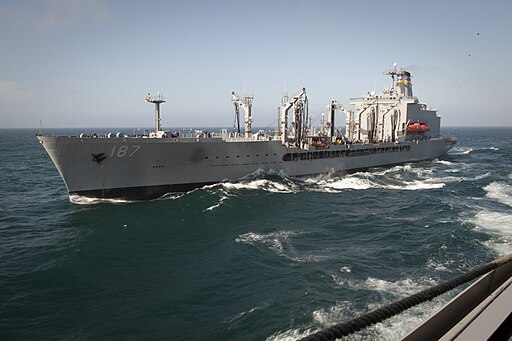
USNS Henry J. Kaiser (T-AO-187) is the lead ship of the Henry J. Kaiser‑class fleet replenishment oiler — a class of U.S. Navy oilers designed during the 1980s to provide underway replenishment (UNREP) of fuel, stores and supplies to deployed naval forces. As a “fleet replenishment oiler,” her primary mission is logistical: carrying large quantities of fuel (diesel, jet fuel, lubricants), potable water, and dry or refrigerated stores — then transferring them at sea to combatants, carriers, or other support ships. This capability enables naval task forces to remain operational for extended periods without returning to port.
Commissioned in the late Cold War period, Henry J. Kaiser entered service in December 1986. Built to civilian-mariner standards under the oversight of the Military Sealift Command (MSC), the ship leverages efficient diesel propulsion and commercial-style design principles to maximize cargo capacity and operational economy. This design philosophy reflects a shift toward more cost-effective sustainment ships capable of supporting carrier strike groups, amphibious groups, and surface combatants alike.
Over decades of service, Henry J. Kaiser has proven to be a vital backbone asset for the U.S. Navy’s logistical fleet. Her large cargo capacity, dependable underway replenishment systems, and relatively efficient crew structure make her well-suited for long deployments. As newer replenishment ships gradually enter service, she remains a reminder of a transitional generation — built to commercial standards, but optimized for naval logistics support during extended deployments worldwide.
Technical Specifications — Dimensions, Propulsion, and Load Capacity
Henry J. Kaiser measures approximately 677 to 677.5 feet in overall length (about 206–207 meters), with a beam of roughly 97 to 97.5 feet (≈ 29.6–29.7 meters). Her maximum draft when fully loaded reaches around 35 feet (≈ 10.6 m), suitable for open-ocean operations while still allowing access to many naval ports.
Her displacement at full load is typically around 40,900 to 41,225 tons, depending on load and configuration. Light-ship displacement (empty) is much less, reflecting the volume of fuel, water, and stores she is meant to carry.
Propulsion is provided by two medium-speed diesel engines — specifically Colt-Pielstick 10 PC4.2 V 570 diesels — driving two shafts with controllable-pitch propellers. The total sustained power output is on the order of 34,442 metric horsepower (≈ 24.3 MW), yielding a maximum speed of about 20 knots (≈ 37 km/h).
In terms of cargo capacity, Henry J. Kaiser can carry approximately 180,000 barrels of fuel oil and aviation fuel. Complementing fuel carriage, she also offers dry cargo space — including around 7,400 square feet for dry cargo and the ability to house eight 20-foot refrigerated containers (enough for roughly 128 pallets). This makes her capable of delivering fuel, food, spare parts, and other vital supplies.
Her aviation capability is limited — she does not carry fixed-wing aircraft, but has a helicopter landing platform (HELO deck) to support vertical replenishment (VERTREP) operations, enabling transfer of pallets and supplies by helicopter when alongside underway replenishment (CONREP) is not feasible or sufficient.
Replenishment Capabilities & Operational Role
The core value of Henry J. Kaiser lies in her underway replenishment capabilities — the ability to resupply other vessels while at sea, without requiring those vessels to return to port. She is equipped with multiple refueling stations (on both port and starboard, and typically an astern rig) that allow she can conduct connected replenishment (CONREP), transferring liquid cargo (fuel, lubricants) via hoses while ships sail side by side. The configuration supports simultaneous fueling of multiple ships, essential during high-tempo operations or when servicing a carrier strike group.
In addition to fuel, her capacity for dry cargo and refrigerated supplies — along with the HELO deck for vertical replenishment — enables delivery of food, spare parts, mail, supplies, and other essentials. This dual logistics capability (fuel + stores) allows her to sustain fleets with a wide range of needs beyond propulsion and aviation fuel. Because she carries both diesel and aviation fuel, she can support surface ships as well as aircraft carriers with embarked air wings.
Her operational role within the fleet is therefore critical: by enabling long-duration deployments far from friendly ports, the ship extends the endurance and operational reach of naval task forces. In times of conflict or extended presence missions, replenishment oilers like Henry J. Kaiser become indispensable for maintaining readiness, supplying fuel, and providing logistical sustainability for ships on station.
Crew, Organization, and Mission Profile
Henry J. Kaiser is operated by the Military Sealift Command and primarily crewed by civilian mariners (CIVMARS), supplemented by a small contingent of U.S. Navy personnel to oversee communications, coordination, and any required defense systems. This hybrid crew model reflects the ship’s logistical nature — not a combatant, but a supply asset enabling combatant operations.
Crew accommodations and onboard systems are arranged more along commercial-shipping lines than warship standards. This includes living quarters, mess halls, storage, and environmental systems suitable for long periods at sea. This arrangement allows the vessel to operate efficiently over extended cruises, delivering supplies wherever needed without the burden of full combat-ship requirements.
Historically, Henry J. Kaiser has been deployed worldwide in support of U.S. Navy operations, providing underway replenishment to carrier battle groups, amphibious groups, and surface combatant squadrons. She has proven valuable during peacetime presence operations, humanitarian missions, and high-tempo deployments — offering a logistical lifeline to ships operating far from home ports. Her relatively large fuel and cargo capacity, combined with reliable propulsion, make her among the more versatile oilers in the Navy’s auxiliary fleet.
Design Philosophy, Construction, and Class Background
The Henry J. Kaiser class was conceived in the late 1970s to mid-1980s as a cost-effective, commercially built class of fleet oilers, intended to replace older AO-class oilers. The design requirements called for ships built to commercial standards — to reduce costs — but tailored with features for naval underway replenishment: large fuel tanks, multiple cargo holds, refueling rigs, STREAM CONREP stations, and a helicopter deck for VERTREP. (shipscribe.com)
Construction of USS Henry J. Kaiser itself began with the keel laid on 22 August 1984 at Avondale Shipyards in Louisiana. She was launched on 5 October 1985, and delivered to the Navy on 19 December 1986. As the lead ship of her class, she set the standard for subsequent vessels (T-AO 188, 189, etc.) in terms of dimensions, capacity, and replenishment configuration.
While built to commercial standards, the design also included allowances for use in higher-threat environments: space, weight, and power reserves exist for defensive armament (such as close-in weapons systems) if necessary, though in peacetime, she typically sails unarmed. The combination of commercial economy and expanded naval-logistics capability exemplifies the hybrid nature of MSC-operated fleet oilers.
Limitations and Modern Context
Despite her robust capabilities, Henry J. Kaiser (and her class) reflects a generation of naval auxiliary design that now faces evolving regulatory and operational challenges. Many older oilers — especially those with single-hull fuel tanks — are subject to increasingly stringent environmental and safety regulations, particularly regarding double-hull requirements for oil transport. This affects port access in some regions and complicates long-term viability for older designs. Experienced observers note that the class was constructed as single-hull tankers.
As newer replenishment ships are introduced, with modern double-hull designs, updated hazard containment systems, and enhanced logistical flexibility, older members of the Henry J. Kaiser class may be gradually phased out or relegated to reduced operating status. Nevertheless, as long as they remain in service they continue to provide essential logistical support — especially in regions where port infrastructure is limited or access is restricted.
Moreover, while Henry J. Kaiser can support helicopter-based VERTREP and multiple UNREP rigs, the evolution of naval logistics — including supply via undersea pipelines, high-capacity supply ships, or multi-mission replenishment vessels — challenges the older singular-oiler paradigm. Yet for many years, Henry J. Kaiser and her sister ships have represented a reliable, proven solution to sustaining global naval operations.
Conclusion
USNS Henry J. Kaiser (T-AO-187) exemplifies a generation of Navy fleet replenishment oilers built for efficiency, capacity, and longevity. With substantial fuel and cargo capacity, dependable diesel propulsion, and underway replenishment capabilities, she has served as a critical enabler for U.S. Navy deployments worldwide.
Her design strikes a balance between commercial economy and naval logistics requirements — leveraging civilian mariner operation under MSC for cost-effective support while equipping the ship with the tanks, rigs, and helicopter deck needed for modern naval logistics. While regulatory and technological changes pose challenges for her long-term role, as long as she remains active she provides a vital logistical backbone for naval task forces.
In the broader context of naval operations, ships like Henry J. Kaiser remain indispensable: quietly enabling the movements and operations of combatants, carriers, and support vessels — delivering the fuel, supplies, and endurance that make global deployment possible.
