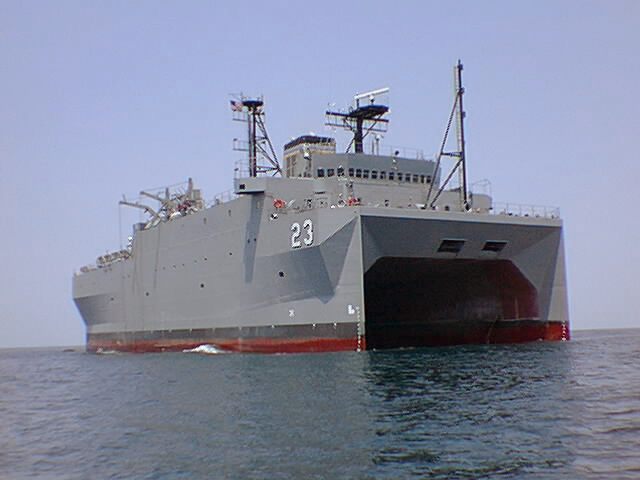
USNS Impeccable (T-AGOS-23) is a specialized ocean-surveillance ship operated by the Military Sealift Command (MSC) for the U.S. Navy, designed to conduct undersea acoustic surveillance using passive and active low-frequency sonar arrays. It serves as a dedicated platform for anti-submarine warfare (ASW) support, environmental acoustic data collection, and long-range undersea monitoring — operations that require patience, stability, and specialized equipment rather than speed or offensive armament. Impeccable is unique: she is the only ship built of her class (the “Impeccable class”), following cancellation of sister-ship orders due to shifting budgets and strategic priorities.
The ship’s design reflects her specialized mission. Rather than a conventional monohull, Impeccable employs a small-waterplane area twin hull (SWATH) configuration — essentially a catamaran-type layout with two submerged hulls connected to an above-water platform. This hull design dramatically reduces motion (heave, pitch, roll) in rough seas and at slow speeds, which is critical for deploying and towing long, sensitive acoustic arrays without interference from surface waves.
Since entering service in 2001, Impeccable has become a quietly essential asset in the Navy’s undersea surveillance network. By deploying its sophisticated sonar systems, the ship helps detect and track submarines or other undersea contacts at range, contributing acoustic data to the Navy’s broader anti-submarine warfare capabilities and undersea situational awareness. Her value lies in subtlety, persistence and high-tech sensors rather than combat power.
Technical Specifications — Hull, Propulsion and Dimensions
Impeccable’s hull and structural design depart from conventional warship architecture. She uses a SWATH configuration, meaning two submerged torpedo-like hulls support the superstructure above the water via narrow struts. This minimizes the ship’s waterplane area, reducing reaction to waves and increasing stability especially at low speeds — ideal for acoustic surveillance operations. The hull is steel and constructed to accommodate heavy onboard acoustic equipment and array-handling systems.
In terms of dimensions, her overall length is approximately 281.6 feet (about 85.8 meters), with a beam (overall width) around 95.8 feet (≈ 29.2 meters). The maximum draft (depth below waterline) is around 26 feet (≈ 7.9 meters). At full load, displacement is about 5,370 long tons (≈ 5,456 metric tons).
For propulsion, Impeccable employs a diesel-electric plant: three diesel generator sets supply electricity that powers two Westinghouse (or equivalent) electric motors driving twin screw shafts. The installed power gives about 5,000 shaft horsepower (shp). Auxiliary propulsion/ maneuvering is supported by hydro-jet bow thrusters (or omni-thruster hydrojets) for low-speed maneuvering. The maximum transit speed is around 12 to 13 knots, while during towing and surveillance operations the vessel moves much more slowly (e.g. ~3 knots when towing sonar arrays).
Regarding complement, typical crew size includes around 20 civilian mariners, a handful of technicians (e.g. 5), and up to ~20 Navy personnel — though exact numbers vary depending on mission requirements.
Sonar Systems, Sensors and Surveillance Capability
The core mission of Impeccable depends on its acoustic sensor suite. The primary system is the SURTASS (Surveillance Towed Array Sensor System), designed for long-range passive detection of undersea contacts. The ship tows long linear hydrophone arrays — cables hundreds to thousands of meters long — which passively “listen” for acoustic signatures emitted by submarines, ships, or undersea objects. This passive mode is stealthy and can detect targets at very long ranges under favorable conditions, without alerting those targets.
In addition to passive surveillance, Impeccable was built to support a low-frequency active (LFA) sonar capability. This involves an active transmitted sound pulse from a specialized LFA array, followed by reception via the towed or horizontal arrays to detect and classify contacts — useful when passive surveillance may be ineffective (e.g. against very quiet submarines or in noisy ocean environments). The active array and handling systems are integrated into the ship’s design, requiring additional power, structural support, and environmental/acoustic processing infrastructure.
The SWATH hull design — with low waterplane area and submerged twin hulls — plays a critical role in ensuring the sonar array remains stable, with minimal motion-induced noise or array distortions. This increases detection reliability and array lifespan, especially in rough seas or high-latitude operations.
Beyond sonar, the ship carries necessary navigation, communication, command, control, and data processing systems. Acoustic data received through SURTASS and LFA are processed onboard and can be relayed via satellite/secure communications links to shore-based analysis centers — enabling near-real-time undersea surveillance intelligence for fleet commanders.
Operational Role, Mission Profile, and History
Impeccable was originally planned as the lead of a class of several new-generation ocean surveillance ships, but she ended up as a singleton after budget constraints and changing strategic priorities cancelled follow-on hulls. Construction began in March 1992 under contract to an American shipbuilding yard, but after the yard went bankrupt, final construction was subcontracted to another shipyard. The hull eventually was completed, launched in August 1998, and the ship formally entered service in March 2001 under the MSC Special Missions Program.
Her mission profile includes long-duration surveillance patrols — typically lasting 60 to 90 days — during which she tows passive and/or active sonar arrays while moving slowly through designated ocean areas, collecting continuous acoustic data supporting undersea domain awareness and anti-submarine warfare posture. The collected data may include submarine tracks, acoustic environment characterization, and undersea traffic monitoring, feeding into the broader undersea surveillance network of the Navy.
Because of her low acoustic signature (diesel-electric drive, quiet hull, SWATH stability), Impeccable is among the quietest surface vessels operated by the U.S. government — outside submarines — which enhances her ability to conduct covert acoustic surveillance without masking or contaminating the data. Over her service life, she has contributed to the Navy’s anti-submarine warfare readiness, strategic undersea monitoring, and acoustic intelligence gathering, providing a stable, specialized platform that supports both passive and active sonar operations across ocean theaters.
Design Philosophy, Strengths and Limitations
Impeccable’s design reflects a clear prioritization of surveillance performance, acoustic stealth, and array deployment capability over speed, armament, or multi-role flexibility. The SWATH hull ensures minimal wave-induced motion, preserving array integrity and improving sonar performance under harsh conditions — a critical advantage for undersea surveillance. Her diesel-electric propulsion reduces mechanical and propeller noise, and allows quieter operation than typical diesel-drive or gas-turbine warships, reinforcing her stealthy acoustic profile.
The space, displacement, and power margins built into her design accommodate both passive and active sonar systems, with room for winches, handling gear, cable drums, processing labs, and communications gear. This makes Impeccable a versatile undersea surveillance platform that can adapt to both traditional passive acoustic monitoring and more aggressive active search and classification tasks when needed.
However, these strengths come with trade-offs. The vessel is relatively slow (top ~12–13 knots), making redeployment over long distances slower than more conventional ships. Her hull and superstructure — optimized for stability and acoustic performance — sacrifice any real capacity for self-defense, armament, or multi-mission flexibility. She is not built for combat, evacuation, transport, or amphibious support; her mission set is narrowly focused on undersea surveillance. If confronted in contested waters, she would require protection from escort vessels.
Also, operating sophisticated sonar arrays — especially active low-frequency array systems — requires strict environmental and operational considerations (mitigation for marine mammals, underwater noise regulations, acoustic conditions), as well as long periods at sea with specialized technical crew. The nature of acoustic detection also means that performance can be heavily influenced by oceanographic conditions (temperature layers, salinity, sea states), which may limit detection range or the effectiveness of passive listening.
Strategic Relevance and Contribution to Undersea Awareness
In an era where submarine proliferation, quiet diesel-electric and air-independent propulsion (AIP) boats, and advanced undersea threats challenge traditional detection paradigms, a ship like Impeccable remains strategically valuable. By providing a low-noise, stable, high-sensitivity surveillance platform, she augments the undersea awareness of the Navy and allied forces. Her ability to conduct persistent acoustic monitoring — often far from home ports — gives commanders intelligence on submarine movements, undersea traffic, and ambient acoustic environment data that is essential for ASW planning, mine-warfare preparation, and undersea domain control.
Moreover, because Impeccable can deploy both passive and active sonar arrays, she offers flexibility: passive mode for covert surveillance and classification, and active mode when passive detection fails or when a more aggressive search is necessary. This dual-mode capacity ensures she remains relevant even as adversaries invest in quieter submarines or try to exploit acoustic “dead spots.”
As a civilian-crewed vessel under MSC, Impeccable allows the Navy to maintain undersea surveillance capability without committing warship resources: a cost-effective specialization that permits more efficient use of combatants while ensuring that the undersea domain is continuously monitored. For decades to come, she is likely to remain a silent sentinel beneath the waves.
Conclusion
USNS Impeccable (T-AGOS-23) stands as a singular but vital element of the U.S. Navy’s undersea surveillance architecture. Her SWATH hull, quiet diesel-electric propulsion, and sophisticated sonar suite (both passive SURTASS and low-frequency active capabilities) make her exceptionally well suited for the slow, steady, covert work of undersea acoustic monitoring — a mission quite different from the high-speed, high-power operations of combat ships.
Although she lacks armament, speed, or multi-mission flexibility, in the realm of acoustic intelligence and undersea awareness, Impeccable delivers capabilities that few other vessels can match. Her presence strengthens anti-submarine warfare posture, undersea environmental understanding, and strategic detection reach — often unseen, but deeply important for naval operations and maritime security.
