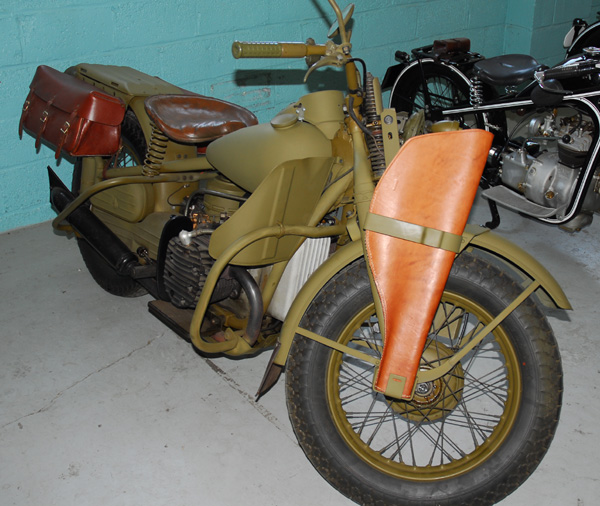
The Harley-Davidson XA occupies a unique and highly technical niche in the company’s history, representing a rare departure from traditional American V-twin design principles. Developed during the early 1940s for military use, the XA was Harley-Davidson’s response to operational challenges faced by Allied forces in harsh and hot environments. Conventional Harley-Davidson motorcycles of the era, powered by air-cooled 45-degree V-twin engines, suffered from excessive heat buildup and reduced reliability when deployed in desert and tropical theaters. The XA project was initiated to address these shortcomings through a fundamentally different mechanical architecture optimized for thermal efficiency, durability, and ease of maintenance in field conditions.
The design brief emphasized consistent cooling, mechanical simplicity, and the ability to withstand prolonged operation under load. As a result, the XA shares more conceptual similarities with European military motorcycles than with other Harley-Davidson models. Its engineering reflects a pragmatic approach driven by wartime necessity rather than brand tradition, making it one of the most technically intriguing motorcycles ever produced by the company.
Engine Architecture and Cooling Strategy
At the heart of the Harley-Davidson XA is a horizontally opposed, air-cooled twin-cylinder engine, commonly referred to as a flat-twin configuration. This layout places the cylinders on opposite sides of the crankshaft, allowing both to receive equal airflow during operation. The design significantly improves cooling efficiency compared to V-twin engines, especially in low-speed or high-temperature environments. The engine displacement is approximately 740 cubic centimeters, with bore and stroke dimensions chosen to balance torque output and mechanical longevity.
The flat-twin configuration results in a lower center of gravity and improved mass distribution, which enhances stability and handling, particularly on uneven terrain. The crankshaft design minimizes vibration by balancing reciprocating forces between the opposing pistons. Valve actuation is achieved through a side-valve system, prioritizing simplicity and reliability over maximum power output. Compression ratios are modest, allowing the engine to operate on lower-quality fuels commonly available in wartime conditions.
Fuel Delivery and Combustion Characteristics
Fuel delivery on the XA is managed through a single carburetor positioned centrally to ensure equal mixture distribution to both cylinders. The intake system is designed for consistency rather than performance, with emphasis on smooth throttle response and dependable operation under variable atmospheric conditions. Air filtration systems are robust and optimized to prevent dust and debris ingestion, a critical requirement for desert operations.
Combustion characteristics are tuned to provide steady torque across a broad range of engine speeds. Rather than producing high peak output, the XA engine delivers predictable and controllable power suitable for military convoy duties, reconnaissance, and cargo transport. The conservative combustion tuning also contributes to reduced thermal stress and extended service life.
Transmission and Power Transfer System
The Harley-Davidson XA utilizes a four-speed manual transmission designed to handle a wide range of operating conditions. Gear ratios are selected to provide strong low-speed pulling power while maintaining reasonable cruising capability on paved roads. The transmission casing is reinforced to withstand shock loads encountered during off-road use, and gear engagement is designed for durability rather than rapid shifting.
Power is transmitted to the rear wheel via a shaft drive system, a significant departure from Harley-Davidson’s traditional chain drive approach. The shaft drive offers several technical advantages in a military context, including reduced maintenance, improved resistance to dirt and sand, and increased reliability over long distances. Enclosed final drive components protect critical moving parts from environmental exposure, further enhancing operational durability.
Frame Design and Structural Layout
The XA is built on a rigid steel frame engineered to support both on-road and off-road operation. Frame geometry prioritizes stability and load-carrying capability rather than agility. The horizontally opposed engine integrates naturally into the frame structure, allowing for a compact and well-balanced layout. Mounting points are reinforced to support auxiliary equipment such as saddlebags, tool kits, and military accessories.
Ground clearance is higher than that of contemporary civilian motorcycles, enabling the XA to traverse rough terrain without excessive risk of undercarriage damage. The frame’s structural simplicity allows for straightforward field repairs, an essential consideration in wartime logistics. Welds and joints are deliberately overbuilt to ensure reliability under sustained stress.
Suspension Systems and Terrain Adaptability
Front suspension on the Harley-Davidson XA typically consists of a leading-link fork system, chosen for its strength and predictable behavior on uneven surfaces. This design provides improved resistance to brake dive and maintains consistent wheel contact over rough terrain. Rear suspension is rigid, reflecting the technological limitations of the era and the military preference for mechanical simplicity.
While the lack of rear suspension limits comfort, the overall suspension setup provides reliable handling characteristics in off-road conditions. Tire selection and wheel construction are optimized for durability, with heavy-duty spokes and reinforced rims capable of handling impacts and heavy loads. Suspension tuning emphasizes control and resilience rather than rider comfort.
Braking Systems and Operational Control
Braking on the XA is managed through mechanically actuated drum brakes at both the front and rear. Drum diameters are relatively large to provide sufficient stopping power for the motorcycle’s weight and cargo capacity. The braking system is designed for gradual, controlled deceleration rather than aggressive stopping performance.
Control interfaces are simple and robust, featuring large levers and pedals that can be operated while wearing military gear. The layout ensures intuitive operation under stress and minimizes the risk of mechanical failure. Brake components are enclosed to reduce contamination from dust and debris, contributing to consistent performance in adverse conditions.
Ergonomics and Military Functionality
Ergonomic design on the Harley-Davidson XA is driven entirely by functional requirements. The seating position is upright, providing good visibility and control during low-speed maneuvering. Handlebars are wide and positioned to offer leverage when navigating rough terrain or tight spaces. Foot controls are centrally mounted, supporting balanced weight distribution and stable rider posture.
Instrumentation is minimal, typically limited to a speedometer and basic indicator lights. This simplicity reduces potential failure points and ensures the rider can focus on navigation and situational awareness. The overall rider interface reflects the XA’s utilitarian purpose rather than comfort or aesthetics.
Technical Significance and Engineering Legacy
The Harley-Davidson XA stands as a rare example of the company embracing an entirely different engineering philosophy in response to external demands. Its flat-twin engine, shaft drive, and emphasis on thermal efficiency represent a clear departure from Harley-Davidson tradition, demonstrating the company’s technical adaptability. Although the XA did not enter large-scale production due to the end of wartime demand and changing logistical priorities, its engineering solutions remain highly respected.
