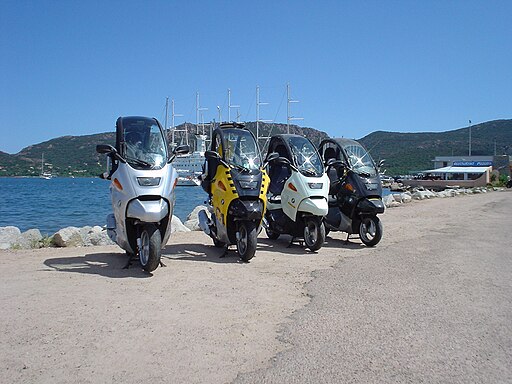
The BMW C1 was a revolutionary approach to scooter design introduced at the turn of the millennium. Produced between 2000 and 2002, this unusual vehicle was the result of collaborative engineering between BMW and Italian design house Bertone. Instead of following the traditional scooter blueprint, engineers applied automobile-grade safety principles to a two-wheeled platform, creating a vehicle that blurred the lines between motorcycle agility and car-like occupant protection. The C1 was conceived primarily for urban commuters who sought the convenience and efficiency of a scooter without compromising safety and comfort. Although its market success was limited, the C1’s engineering philosophy left a lasting impression on the design of urban transport.
Innovative Safety Architecture
At the heart of the BMW C1’s differentiating character was its safety architecture. Unlike conventional scooters, which leave the rider exposed, the C1 incorporated a torsionally rigid aluminium space frame forming a protective safety cell around the rider. This cell featured integrated roll bars and crumple zones engineered to absorb energy in a collision. The concept borrowed heavily from automotive crash-safety strategies, ensuring that frontal impacts—where motorcycles are most vulnerable—had a dedicated energy-absorbing structure to reduce transmitted force. Additionally, the rider was secured with a multi-point seatbelt system, an unprecedented feature on a two-wheeled vehicle.
The vehicle’s design also included side impact protection structures and a reinforced occupant cell that could theoretically support the roof load of a compact car. These features were intended to minimize the probability of head and torso injury in a crash scenario, and together with an optional Anti-Lock Braking System (ABS), the C1 offered an advanced active and passive safety package for its class.
Powertrain and Engine Specifications
Underneath its distinctive bodywork, the BMW C1 relied on compact, liquid-cooled four-stroke, single-cylinder engines with dual overhead camshafts (DOHC) and four valves per cylinder—technology typical of modern small motorcycles. Two main engine variants were available:
- The 125 cc model produced approximately 11 kW (15 hp) at 9,250 rpm and generated 12 Nm of torque at 6,500 rpm. This configuration offered a sensible balance of efficiency and urban acceleration suitable for city traffic.
- The 200 cc version increased displacement to 176 cc, resulting in roughly 13 kW (18 hp) at 9,250 rpm and 17 Nm at 6,500 rpm, delivering improved mid-range response and slightly better freeway capability.
Both engines used electronic fuel injection with digital motor electronics to ensure precise fuel metering, improved cold starting, and consistent emissions performance. The compression ratios varied between models, with the smaller unit around 13.0:1 and the larger at 11.5:1, tuned for a mix of power and fuel economy.
The C1’s power was transmitted through a continuously variable transmission (CVT), typical for scooters, which provided seamless acceleration without manual shifting, and delivered final drive via a belt system for smooth operation and reduced maintenance.
Performance and Driving Dynamics
Performance figures for the BMW C1 reflected its urban focus. The 125 cc variant could typically achieve top speeds of around 100–105 km/h (62–65 mph), while the 200 cc version could reach close to 115 km/h (71 mph) under ideal conditions. Acceleration from standstill to moderate speeds was brisk enough for city traffic, with the larger engine shaving critical fractions of a second off the 0-50 km/h (0-31 mph) benchmark.
The C1’s Telelever front suspension, a BMW hallmark derived from their motorcycle range, utilized a wishbone link and single shock arrangement. This layout reduced dive under braking and improved high-speed stability relative to traditional telescopic forks. Coupled with an engine-mounted swinging arm rear suspension, the C1 delivered a predictable and composed ride, although the added mass of the safety cell and bodywork contributed to a higher curb weight—around 185–202 kg (408–445 lbs)—compared to conventional scooters.
Dimensions, Weight, and Structural Engineering
The BMW C1 was compact yet substantial in its structural footprint. Typical dimensions placed the vehicle in the range of about 2,080–2,180 mm in length and roughly 1,030 mm in width. Its wheelbase was approximately 1,465–1,488 mm, and the total height with roll-over structure extended just over 1,300 mm. These figures facilitated maneuverability in tight urban environments while also offering a planted, stable feel on straight roads.
The mass of the C1 was influenced heavily by the integrated safety cell and reinforced bodywork. Weights ranged around 185 kg dry and up to 202 kg in running order, significantly above that of typical 125–200 cc scooters. While this added weight meant less “flickability” through congested traffic, it also contributed to a more planted ride in crosswinds and under braking.
Braking, Wheels, and Tires
The braking system on the BMW C1 was designed to match its safety ethos. Both the front and rear used disc brakes, with rotor diameters in the region of 220–225 mm, providing generous stopping power for the vehicle’s weight class. Optional ABS was a noteworthy feature, granting riders enhanced control during heavy braking or in poor traction conditions.
Wheel and tire specifications included a 120/70-13 front tire and a 140/70-12 rear tire, mounted on wheels that balanced stability with agility. The relatively large contact patches for the class improved grip and confidence during acceleration, cornering, and deceleration—essential for navigating unpredictable urban surfaces.
Fuel System, Range, and Emissions
Fuel efficiency was a highlight of the BMW C1’s design. With a usable fuel tank around 9.5–10 liters, the vehicle could return impressive economy figures—often reported around 2.9–3.3 liters per 100 km (equivalent to roughly 85–97 miles per gallon Imperial) under steady urban cruising. This resulted in a potential range approaching 280–300 km on a single tank under favorable conditions.
Emissions were minimized through the use of a three-way catalytic converter, which made the C1 one of the cleanest petrol-powered two-wheelers of its time, with CO₂ emissions in the low double digits (around 64–66 g/km) when measured under appropriate test standards.
Ergonomics, Comfort, and Practical Features
The BMW C1 was as much about comfort as it was about safety. Its feet-forward seating posture mimicked the ergonomics of small cars more than traditional scooters, allowing riders to sit in a relaxed position that reduced fatigue on longer urban runs. The well-padded seat included built-in support and headrest contours, and behind it sat provisions for luggage carriers or special-purpose storage, enhancing practicality.
Climate comfort features such as roof-mounted heating systems and optional sound systems were available as accessories, further expanding the C1’s role from a bare-bones urban commuter to a more comfortable all-weather transport solution. (BMW Group PressClub)
Market Impact and Legacy
Despite its technical sophistication and novel safety strategy, the BMW C1 struggled with commercial adoption. Factors included its higher cost compared to conventional scooters, mixed regulatory environments impacting helmet exemption laws in some markets, and consumer hesitation around the unconventional concept. As a result, production lasted for only a few years before discontinuation.
Nevertheless, the BMW C1 remains an intriguing case study in transport innovation—a bold experiment that challenged conventional wisdom about urban mobility. Its influence can still be seen in discussions around safety-focused two-wheelers and in concept designs such as BMW’s more recent Vision CE, which reimagines the safety cell concept with electric propulsion for future urban riders.
