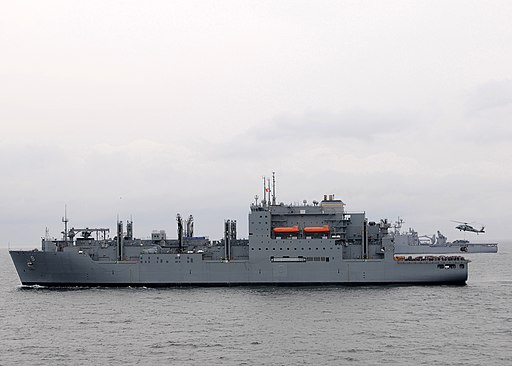
USNS Matthew Perry (T-AKE-9) is a Lewis and Clark-class dry cargo ship operated by the United States Navy’s Military Sealift Command and crewed primarily by civilian mariners. The vessel is named after Commodore Matthew Perry, whose 19th-century expeditions played a major role in opening Japan to international trade and diplomacy. As a dry cargo and ammunition ship, USNS Matthew Perry is designed to provide sustained logistical support to U.S. Navy carrier strike groups, amphibious ready groups, and other deployed naval forces. Its core mission is underway replenishment, delivering food, spare parts, repair materials, and ordnance to combatant ships without requiring them to return to port, thereby extending operational reach and persistence.
Ship Design and Hull Configuration
The design of USNS Matthew Perry reflects the need for high cargo capacity, seakeeping stability, and safe handling of diverse supplies. The hull is large and robust, optimized for open-ocean operations alongside aircraft carriers, destroyers, and cruisers during replenishment at sea. The ship features multiple cargo holds configured to carry dry stores, refrigerated goods, and ammunition in segregated and environmentally controlled spaces. Structural reinforcement and modern damage-control systems enhance survivability, while the overall layout prioritizes efficient cargo flow from storage areas to transfer stations. The superstructure is arranged to provide clear sightlines and safe working areas during replenishment operations, even in challenging sea states.
Propulsion and Power Systems
USNS Matthew Perry is powered by an integrated diesel propulsion system designed for reliability and efficiency over long deployments. The ship uses multiple medium-speed diesel engines driving a single shaft through reduction gearing, providing a balance between fuel economy and sustained cruising speed. This propulsion arrangement allows the vessel to maintain formation speeds with carrier strike groups while also supporting precise speed control during replenishment alongside other ships. Electrical power generation is handled by ship service diesel generators that support navigation systems, cargo handling equipment, environmental controls, and habitability services. The propulsion and power systems are engineered for redundancy, ensuring continuous operation even in the event of equipment failures.
Cargo Handling and Replenishment Capabilities
The defining feature of USNS Matthew Perry is its advanced replenishment-at-sea capability. The ship is equipped with multiple connected replenishment stations on both port and starboard sides, allowing it to simultaneously transfer cargo to more than one receiving ship. Heavy-duty cranes, automated cargo elevators, and internal conveyor systems enable rapid movement of supplies from storage holds to transfer points. The vessel can carry a wide range of materials, including packaged food, refrigerated and frozen provisions, repair parts, and ammunition, all handled in compliance with strict safety standards. Vertical replenishment support is provided through flight deck facilities that allow helicopters to transfer cargo to ships unable to conduct alongside operations.
Aviation Facilities and Support
USNS Matthew Perry includes a flight deck and aviation support facilities designed to accommodate helicopters used for vertical replenishment. While the ship does not permanently embark aviation units, it can support flight operations for Navy and allied helicopters during logistics missions. The flight deck is integrated into the ship’s replenishment workflow, allowing time-critical or high-priority supplies to be transferred rapidly. Aviation fuel storage and handling systems are designed with safety and compatibility in mind, supporting sustained helicopter operations as part of the broader logistics mission.
Crew, Automation, and Habitability
The ship is operated by a relatively small crew compared to its size, made possible by a high degree of automation in engineering, navigation, and cargo handling systems. USNS Matthew Perry typically carries a core complement of civilian mariners, augmented by a small military detachment responsible for communications and mission coordination. Habitability standards are modern and designed for long deployments, with comfortable berthing, dining facilities, fitness spaces, and recreational areas. These features support crew endurance and effectiveness during extended operations at sea, often lasting several months without returning to port.
Technical Specifications
USNS Matthew Perry (T-AKE-9) has a full-load displacement of approximately 41,000 tons. The ship measures about 689 feet in length, with a beam of roughly 106 feet and a draft of approximately 30 feet. Its propulsion system enables a maximum sustained speed of around 20 knots, allowing it to keep pace with carrier strike groups. The vessel has a range exceeding 14,000 nautical miles at economical cruising speed. Cargo capacity includes several thousand tons of dry stores and ammunition, along with significant refrigerated and frozen storage volume. The standard crew consists of approximately 120 to 130 civilian mariners, with accommodations for additional mission personnel as required.
Strategic Importance and Operational Value
USNS Matthew Perry plays a critical role in enabling forward-deployed naval forces to operate independently of shore-based logistics for extended periods. By delivering supplies directly at sea, the ship reduces the need for combatants to break formation or leave operational areas, enhancing fleet readiness and flexibility. Its combination of large cargo capacity, efficient replenishment systems, and global endurance makes it an essential component of U.S. naval logistics. In an era where sustained presence and rapid response are central to maritime strategy, USNS Matthew Perry represents a vital link in maintaining the operational effectiveness of the United States Navy across the world’s oceans.
