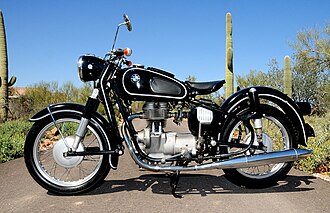
BMW R27 – The Classic Single-Cylinder Boxer
The BMW R27, produced between 1960 and 1966, occupies a special place in BMW Motorrad’s history. It was the last single-cylinder four-stroke motorcycle that BMW produced before focusing almost exclusively on its signature twin-cylinder boxer engines. The R27 was designed to be a reliable, versatile, and economical motorcycle that could serve urban commuters, touring enthusiasts, and motorcycle learners alike. Despite its modest size and output, the R27 embodied BMW’s legendary engineering philosophy: precision, simplicity, and durability.
With a 247 cc single-cylinder engine, the R27 may seem small by modern standards, but it delivered smooth power, excellent handling, and longevity that rivaled larger machines. Its shaft-driven rear wheel and high-quality construction made it a favorite among riders who valued reliability over flashy performance. Today, the R27 is a prized classic, celebrated for its engineering elegance and historical significance.
Historical Context: BMW Motorcycles in the Early 1960s
By the late 1950s, BMW had already established itself as a premier motorcycle manufacturer with models like the R50, R60, and R69 series. These motorcycles featured robust boxer-twin engines and shaft drive, appealing to riders seeking touring capabilities and durability. However, there was a gap in the market for smaller, lighter, and more affordable motorcycles.
The R27 was BMW’s response to this market need. It combined the reliability of BMW engineering with a smaller, more manageable engine size, targeting commuters, beginner riders, and those interested in economical touring. It was produced alongside the larger twins, providing a complementary option for riders who preferred simplicity and lower running costs. The R27 reflected BMW’s commitment to delivering mechanical excellence across a range of engine sizes.
Design Philosophy and Engineering Principles
The BMW R27’s design was guided by several core principles: reliability, ease of maintenance, and functional simplicity. BMW chose a single-cylinder configuration, which reduced the complexity of the engine while retaining the smooth operation characteristic of BMW boxers. The horizontally opposed layout, although consisting of a single cylinder, helped maintain the brand’s signature low center of gravity, contributing to stable handling and balanced weight distribution.
The R27 featured a shaft drive instead of a chain, a rarity for motorcycles in this displacement range. This decision reinforced BMW’s focus on low-maintenance reliability and durability. The tubular steel frame provided structural rigidity while keeping the bike light and agile. Components were engineered for long-term serviceability, ensuring that even decades later, well-maintained R27s remain mechanically sound.
Engine Architecture: The Single-Cylinder Boxer
The engine of the BMW R27 is a 247 cc, single-cylinder, four-stroke boxer unit with overhead valves. Despite its modest displacement, the engine produces approximately 12 horsepower at 6,800 rpm, which was sufficient for urban commuting and moderate touring. The engine’s torque is tuned for low- to mid-range performance, making it responsive to rider inputs and manageable in varied riding conditions.
Cooling is achieved through air alone, aided by the horizontally opposed cylinder design that exposes the engine surface to airflow. The simplicity of the engine contributes to ease of maintenance, as there are fewer moving parts and the pushrod valve actuation system is straightforward to service. A kickstarter initiates engine ignition, reflecting the technology standards of the era.
Transmission and Final Drive
The R27 is equipped with a four-speed manual transmission. Gear ratios were selected to provide a balance between acceleration, cruising comfort, and fuel economy. The gearbox delivers smooth engagement, allowing riders to navigate city streets or country roads efficiently.
Power is transferred to the rear wheel through BMW’s signature shaft drive system, which encloses the drive shaft within a lubricated housing. This configuration reduces wear and tear, eliminates chain maintenance, and provides a smooth, quiet transfer of power. The shaft drive is particularly notable because it appears on a lightweight, small-displacement motorcycle, demonstrating BMW’s commitment to quality even at lower engine capacities.
Frame, Suspension, and Ride Quality
The BMW R27 features a tubular steel frame with a rigid construction that provides both stability and lightweight agility. The geometry ensures that the bike handles predictably at city speeds while remaining comfortable for longer trips.
Front suspension is provided by telescopic forks, a significant innovation for BMW at the time, improving comfort and front-wheel contact with the road. The rear suspension uses a swingarm with twin shock absorbers, offering a balance between rigidity and ride compliance. The combination of suspension components ensures that the R27 absorbs bumps efficiently while maintaining a connected feel to the road, making it enjoyable to ride on varying surfaces.
Wheels, Tires, and Braking
The R27 rides on 18-inch wire-spoke wheels, a common standard for motorcycles in the 1960s. Tires were narrow by modern standards but adequate for the bike’s lightweight design, providing nimble handling and predictable traction.
Braking is achieved through drum brakes at both the front and rear wheels. While the braking performance is modest compared to contemporary hydraulic disc brakes, it was entirely appropriate for the R27’s top speed of approximately 120 km/h. The braking system is mechanically simple, reliable, and easy to service, aligning with BMW’s design philosophy.
Fuel System and Efficiency
The BMW R27 uses a simple, downdraft carburetor to deliver the fuel-air mixture to the cylinder. The small engine combined with an efficient carburetor allows fuel consumption to be impressively low, averaging around 3.5–4 liters per 100 km. The fuel tank capacity of 14 liters is sufficient for a range of nearly 350 km, making the bike practical for commuting and moderate touring.
Electrical System and Ignition
The R27 employs a 6-volt electrical system, including a magneto for ignition, ensuring reliability without dependency on a battery. Lighting includes a basic headlamp and taillight system, suitable for night riding and compliance with road regulations. The simplicity of the electrical system contributes to the motorcycle’s ease of maintenance and long-term durability.
Ergonomics and Rider Experience
The ergonomics of the R27 were designed for comfort and usability. The saddle provides adequate padding for daily riding, and the upright riding position reduces fatigue on longer trips. Handlebars are positioned to allow natural wrist angles, while footpegs offer a comfortable stance.
The bike’s lightweight construction and manageable power make it ideal for learners or riders seeking a responsive yet forgiving motorcycle. The linear torque delivery ensures smooth acceleration, and the shaft drive contributes to a refined, vibration-minimized riding experience.
Production and Variants
BMW produced approximately 15,000 units of the R27 between 1960 and 1966. The model was offered in limited variations, including different color schemes and minor changes in accessories like luggage racks or handlebar grips. Despite its modest production volume, the R27 has remained highly sought after by collectors due to its engineering integrity, historical significance, and riding experience.
Legacy and Historical Significance
The BMW R27 represents the culmination of BMW’s single-cylinder boxer development. It set standards in reliability, engineering, and mechanical elegance that influenced BMW motorcycles for decades. Its combination of shaft drive, durable engine, and manageable handling cemented BMW’s reputation for producing motorcycles that are practical, long-lasting, and pleasurable to ride.
Collectors value the R27 not only for its rarity but also for its representation of BMW’s engineering philosophy in the 1960s—a period when motorcycles were transitioning from purely utilitarian vehicles to lifestyle and leisure machines.
Comparison with Contemporary Motorcycles
During its production era, the R27 competed with lightweight motorcycles from DKW, NSU, and Jawa. While many competitors used chain drives and two-stroke engines, the BMW R27 stood out due to its four-stroke single-cylinder reliability and shaft-driven power delivery. This combination of longevity, smooth operation, and low maintenance made it appealing to discerning riders who valued quality and durability over sheer speed.
Maintenance and Collectibility
Modern owners of the R27 appreciate its simplicity and durability. The shaft drive eliminates chain adjustments, and the engine’s pushrod architecture is straightforward to service. Parts availability can be a challenge, but many collectors specialize in restoring and maintaining these motorcycles, ensuring they remain operational decades after production ended.
The R27 is highly collectible, often fetching premium prices at classic motorcycle auctions. Its historical value, combined with mechanical integrity and iconic BMW styling, make it a must-have for enthusiasts of vintage motorcycles.
Technical Parameters of the BMW R27 (1960–1966)
| Parameter | Specification |
|---|---|
| Model | BMW R27 |
| Production Years | 1960–1966 |
| Engine Type | Single-cylinder, four-stroke, OHV boxer |
| Displacement | 247 cc |
| Bore x Stroke | 68 mm x 68 mm |
| Compression Ratio | 8.2:1 |
| Max Power | 12 hp @ 6,800 rpm |
| Max Torque | 18 Nm @ 5,000 rpm |
| Transmission | 4-speed manual |
| Final Drive | Shaft drive |
| Frame Type | Tubular steel double cradle |
| Front Suspension | Telescopic fork |
| Rear Suspension | Swingarm with twin shock absorbers |
| Brakes | Drum brakes front and rear |
| Wheelbase | 1,350 mm |
| Seat Height | 780 mm |
| Dry Weight | 130 kg |
| Fuel Capacity | 14 liters |
| Top Speed | ~120 km/h |
| Fuel Consumption | 3.5–4 L/100 km |
| Tires | 3.25 x 18 front / 3.50 x 18 rear |
