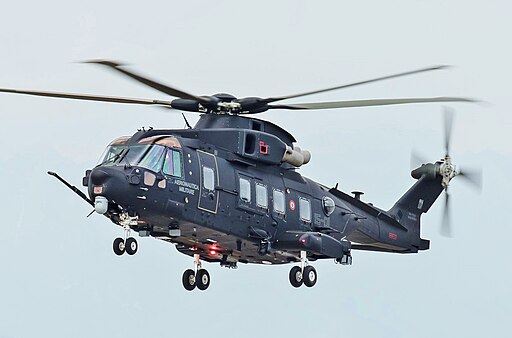
AgustaWestland AW101
AgustaWestland AW101: A Comprehensive Overview
The AgustaWestland AW101, originally known as the EH101, is a state-of-the-art, multi-role, medium-lift helicopter designed and manufactured by the Italian company AgustaWestland, a division of Leonardo S.p.A. The AW101 is a versatile aircraft that has been developed for a wide range of roles including military, search and rescue (SAR), offshore oil and gas support, and VIP transportation. With its advanced technology, robust construction, and high performance, the AW101 has become one of the leading helicopters in the global market, serving in both military and civilian sectors.
First entering service in the late 1990s, the AW101 was designed to meet the growing demand for a more capable, larger helicopter that could handle heavier payloads, longer ranges, and a broader variety of mission profiles. The aircraft is known for its exceptional performance in demanding environments, particularly for operations that require long endurance, high lift capacity, and advanced avionics.
Introduction to the AgustaWestland AW101
The AgustaWestland AW101 was developed as a response to the need for a versatile, multi-role rotorcraft capable of handling demanding tasks across different sectors. The helicopter is primarily used by military forces, government agencies, and civilian companies for missions ranging from combat search and rescue (CSAR), anti-submarine warfare (ASW), and troop transport, to offshore oil and gas operations and executive transport.
The AW101’s design features three powerful engines, a spacious cabin, and a sophisticated avionics suite. The aircraft is well-suited for operations in challenging environments such as harsh weather, high altitudes, and extended-range missions. Its robust construction and excellent lift capabilities make it a trusted platform for high-performance operations.
Technical Specifications of the AgustaWestland AW101
The AgustaWestland AW101 has several key technical features that enhance its performance, making it one of the most reliable and versatile helicopters in its class. Below are some of the most important technical parameters of the AW101:
1. Dimensions and Capacity
- Length (with rotor blades turning): 19.50 meters (63.9 feet)
- Fuselage Length: 15.65 meters (51.3 feet)
- Width (with rotor blades turning): 16.30 meters (53.5 feet)
- Height (main rotor to ground): 6.70 meters (22 feet)
- Main Rotor Diameter: 17.28 meters (56.7 feet)
- Tail Rotor Diameter: 4.48 meters (14.7 feet)
- Wheelbase: 9.30 meters (30.5 feet)
The AW101 features a large and spacious cabin that can accommodate up to 30 passengers in a standard seating configuration. This capacity can be adjusted depending on the mission requirements, allowing it to carry a variety of personnel and cargo. In addition to passenger transport, the AW101 can be configured to carry various payloads, such as cargo or specialized equipment.
2. Engines
The AW101 is powered by three engines, offering enhanced power and redundancy. The three-engine configuration not only provides improved lift capacity but also ensures operational safety by reducing the likelihood of complete engine failure. The engines used on the AW101 are the highly reliable Rolls-Royce Turbomeca RTM322 turboshaft engines, known for their fuel efficiency and high thrust-to-weight ratio.
- Engine Type: 3 × Rolls-Royce Turbomeca RTM322-01/9 or 3 × General Electric CT7-8A turboshaft engines (depending on the variant)
- Power Output: 2,350 shaft horsepower (shp) per engine
- Total Power (triple engines): 7,050 shp
- Transmission System: The power from the engines is transmitted to the main and tail rotors via a dual-redundant transmission system that ensures continued flight in the event of a single engine failure.
The three-engine configuration provides enhanced power for heavy-lift operations and extended-range missions, making the AW101 an ideal choice for long-haul transport, search and rescue, and offshore operations.
3. Performance Parameters
The AW101 offers impressive performance capabilities, allowing it to operate in various mission profiles. The key performance parameters are as follows:
- Maximum Speed: 278 km/h (173 mph)
- Cruise Speed: 240 km/h (149 mph)
- Service Ceiling: 4,572 meters (15,000 feet)
- Range: 1,000 km (621 miles)
- Maximum Takeoff Weight (MTOW): 15,600 kg (34,400 lbs)
- Hover Ceiling (in ground effect): 3,000 meters (9,843 feet)
- Rate of Climb: 10.5 meters per second (2,060 feet per minute)
The AW101’s impressive speed, range, and lifting capacity make it highly effective in various operational environments, particularly in search and rescue (SAR) missions and offshore transport. Its ability to operate in challenging environments, including high altitudes and adverse weather, ensures its versatility for different sectors.
4. Rotor System
The rotor system of the AW101 is designed for maximum efficiency and stability. It features a five-blade, fully articulated main rotor, which provides excellent lift and stability during operations. The tail rotor is a four-blade design that contributes to smooth operation and optimal control.
- Main Rotor Type: Five-blade, fully articulated design
- Tail Rotor Type: Four-blade, semi-rigid design
- Main Rotor Diameter: 17.28 meters (56.7 feet)
- Tail Rotor Diameter: 4.48 meters (14.7 feet)
The advanced rotor system design ensures that the AW101 can operate smoothly even under heavy loads and in turbulent conditions. The fully articulated main rotor provides excellent control in all phases of flight, from takeoff to hovering and landing.
Design Features of the AgustaWestland AW101
The design of the AW101 is a blend of cutting-edge technology, durability, and versatility. This helicopter is built to withstand a wide range of operational environments and mission types, making it a go-to choice for military, government, and commercial operators.
1. Airframe and Fuselage
The AW101’s airframe is designed for strength and flexibility. Constructed from advanced composites and high-strength alloys, the airframe provides the necessary durability for demanding missions, whether in combat zones or harsh offshore conditions. The fuselage is spacious and can be easily configured for a variety of mission roles, including transport, SAR, medical evacuation (MEDEVAC), or even VIP transport.
- Fuselage Construction: Composite materials and lightweight alloys for strength and durability
- Cabin Configuration: The cabin can be configured for various roles, such as up to 30 passengers, cargo, or specialized mission equipment.
The spacious cabin allows the AW101 to carry a variety of cargo, equipment, and personnel. The large sliding doors enable quick and efficient loading and unloading, which is especially important for SAR and offshore oil platform missions.
2. Avionics and Instrumentation
The AW101 is equipped with advanced avionics systems that improve flight safety, situational awareness, and mission effectiveness. Key avionics and instrumentation features include:
- Flight Management System (FMS): Provides route planning, navigation, and fuel management.
- Advanced Navigation Suite: Includes GPS, Inertial Navigation System (INS), and other sensors for accurate positioning and navigation in all conditions.
- Weather Radar and Traffic Collision Avoidance System (TCAS): Enhances situational awareness and helps avoid potential mid-air collisions.
- Automatic Flight Control System (AFCS): Reduces pilot workload and ensures stability during difficult maneuvers.
The sophisticated avionics suite allows the AW101 to operate safely in any environment, whether in high-traffic airspace or during low-visibility operations, such as those commonly encountered in SAR missions.
3. Safety Features
Safety is a key consideration in the design of the AW101. The helicopter is equipped with a variety of safety systems to protect both the crew and passengers. These include:
- Triple-engine redundancy: The three-engine configuration provides enhanced safety, ensuring continued flight in the event of an engine failure.
- Crashworthy seats and fuel systems: Designed to minimize the risk of injury during emergency landings.
- Flotation devices: The AW101 can be equipped with emergency flotation systems for over-water operations, allowing it to remain buoyant in case of ditching.
- Advanced rotor system: The fully articulated main rotor ensures greater stability and control during low-altitude or high-speed maneuvers.
These safety features make the AW101 a highly reliable and safe helicopter for both military and civilian missions, even in hazardous conditions or emergency situations.
Applications of the AgustaWestland AW101
The AgustaWestland AW101 is used in a wide range of applications across the military, civilian, and commercial sectors. Below are some of the primary uses of the AW101:
1. Military and Defense
The AW101 is widely used by armed forces for roles such as anti-submarine warfare (ASW), combat search and rescue (CSAR), troop transport, and logistics. Its advanced avionics, powerful engines, and multi-role capabilities make it a crucial asset for modern military operations. The helicopter can be equipped with various weapon systems, such as torpedoes and missiles, for anti-submarine and anti-surface warfare.
2. Search and Rescue (SAR)
One of the key roles of the AW101 is search and rescue. It is equipped with the necessary tools, such as hoists, winches, and medical equipment, to carry out complex SAR missions in difficult environments. Its large cabin allows for the transportation of injured individuals, while its long-range capabilities ensure it can operate far from base in challenging weather conditions.
3. Offshore Oil and Gas Support
The AW101 is regularly used to transport workers, equipment, and supplies to and from offshore oil and gas platforms. The helicopter’s large payload capacity, long endurance, and powerful engines make it ideal for long-distance flights in over-water conditions, ensuring workers and supplies can be transported quickly and safely.
4. VIP and Executive Transport
In addition to its military and offshore roles, the AW101 is also used for VIP and executive transport. The large, luxurious cabin can be configured for VIPs, ensuring a comfortable and secure journey. The helicopter’s long-range capabilities make it ideal for transporting high-ranking government officials or business executives to remote locations.
Conclusion
The AgustaWestland AW101 is a versatile, high-performance helicopter that continues to serve in a wide range of demanding roles across military, commercial, and civilian sectors. Its three-engine design, powerful avionics suite, and robust construction make it an ideal choice for missions that require long endurance, high payload capacity, and adaptability to different environments. Whether used for search and rescue, offshore support, military operations, or VIP transport, the AW101 continues to be one of the most trusted helicopters in the world.
