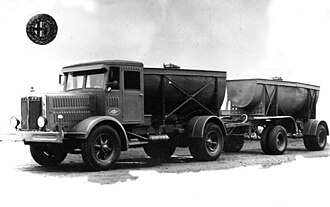
Alfa Romeo 50: The Forgotten Truck That Started Alfa Romeo’s Heavy Commercial-Vehicle Story
When people hear the name Alfa Romeo, they usually think of elegant Italian sports cars, racing victories, distinctive grilles and the famous Biscione emblem. Far fewer people realize that Alfa Romeo also had a long and fascinating history as a manufacturer of trucks and other commercial vehicles. One of the most important vehicles in that story was the Alfa Romeo 50, a medium-duty truck introduced in the early 1930s and produced at the company’s Portello plant in Milan. It was not a high-volume success, but historically it was extremely significant: the 50 represented Alfa Romeo’s first genuine move into heavy industrial vehicle production and established the foundation for a commercial-vehicle branch that would eventually produce numerous trucks, buses and specialist vehicles.
The Alfa Romeo 50 is sometimes referred to as the “Biscione”, a nickname inspired by the serpent depicted in Alfa Romeo’s emblem. It emerged from an agreement Alfa Romeo made with the German manufacturer Büssing in 1929, allowing the Italian company to build heavy trucks based on German designs. The resulting vehicle was closely related to the Büssing-NAG 50 and combined a substantial 10.6-liter six-cylinder diesel engine with a two-axle chassis, a five-tonne payload rating and a remarkably low maximum speed by modern standards. Only around 115 examples were produced, making surviving examples exceptionally unusual today.
The Origins of the Alfa Romeo 50
Alfa Romeo Moves Into Heavy Trucks
The story of the Alfa Romeo 50 begins at a time when the automobile industry was undergoing major changes. During the late 1920s, commercial transportation was becoming increasingly important, while governments and military organizations across Europe were interested in strengthening domestic industrial capabilities. Trucks were no longer regarded simply as enlarged passenger vehicles; they were becoming specialized machines with heavy-duty frames, diesel engines and purpose-built drivetrains.
Alfa Romeo already possessed considerable engineering expertise, particularly in passenger cars, racing vehicles and aircraft engines, but it did not yet have the same experience in heavy commercial vehicles as established truck manufacturers. Rather than developing a heavy truck entirely from scratch, Alfa Romeo entered into an agreement with the German companies Büssing and Deutz in 1929. Büssing supplied the basis for the truck design, while the relationship with Deutz was associated with diesel-engine technology. The Alfa Romeo 50 that emerged from this cooperation was therefore an Italian-built truck with strong German engineering influences.
Production took place at Alfa Romeo’s Portello factory in Milan. The vehicle represented an important change in the company’s industrial direction because it was a purpose-built commercial vehicle rather than merely a utility adaptation of one of Alfa Romeo’s passenger cars. The model appeared around 1931, with sources generally giving 1931–1934 as its production period, although some historical references describe the project and introduction as beginning around 1930.
A Licensed Relative of the Büssing-NAG 50
The connection with Büssing is immediately apparent when examining the Alfa Romeo 50’s design. The truck featured a very angular cab and hood, reflecting the industrial styling of the period and its German origins. Rather than the flowing shapes associated with later Alfa Romeo passenger cars, the 50 looked exactly like what it was: a serious commercial machine designed primarily around mechanical function.
The relationship was more than a superficial styling exercise. Historical sources describe the Alfa Romeo 50 as essentially a licensed version of the Büssing-NAG 50. This arrangement allowed Alfa Romeo to enter the heavy-truck market using an established design while adapting production to its own factory and commercial ambitions.
For Alfa Romeo, this was a sensible strategy. Developing a completely new heavy truck would have required substantial investment and specialized knowledge, whereas a licensed design offered a faster route into a market that the company had not previously dominated.
Engineering of the Alfa Romeo 50
A Large Six-Cylinder Diesel
The heart of the Alfa Romeo 50 was its large diesel engine. The truck used the F6M 217, a six-cylinder diesel with a displacement of approximately 10,600 cubic centimeters, or 10.6 liters. Published historical specifications give an output of approximately 80 horsepower at 1,200 rpm.
By modern standards, 80 horsepower from a 10.6-liter engine sounds extraordinarily low. In the context of the early 1930s, however, the specification makes considerably more sense. Diesel engines of the era were valued for their durability, relatively economical fuel consumption and ability to produce useful torque at low engine speeds. They were not designed to spin at the high rpm levels common in contemporary engines.
The Alfa Romeo 50’s very low rated engine speed also explains why the truck’s performance figures appear so modest. The engine was designed to move substantial weight rather than to provide rapid acceleration or high-speed cruising. Its purpose was to deliver steady pulling power over long periods while operating within the limitations of early heavy-duty diesel technology.
Four-Speed Manual Transmission
Power was transmitted through a four-speed manual gearbox, a specification confirmed by several historical sources.
A four-speed transmission may appear extremely simple today, but it was appropriate for a truck with a relatively narrow useful engine-speed range. The driver had to select gears according to load, gradient and road conditions, and the low-revving diesel engine placed considerable emphasis on choosing the correct ratio.
The mechanical simplicity of the transmission was also characteristic of heavy vehicles of the period. Electronic control systems, automated transmissions and sophisticated driver assistance were decades away. The driver was directly involved in managing the engine and drivetrain, and successful operation depended heavily on experience.
Dimensions and Chassis
A Surprisingly Large Truck
One of the most striking characteristics of the Alfa Romeo 50 was its size relative to its payload. Historical specifications give a wheelbase of approximately 5.2 meters, a width of around 2.45 meters and an overall length of approximately 8.95 meters.
Those dimensions made the truck a substantial machine for its era. The long wheelbase provided a useful foundation for cargo bodies and contributed to stability, while the relatively wide chassis was appropriate for a vehicle intended to carry several tonnes.
Yet the large dimensions also became one of the model’s weaknesses. Historical accounts note that the Alfa Romeo 50 was comparatively large and expensive for its payload. The combination of high manufacturing costs and relatively modest carrying capacity limited its commercial appeal.
This is an important reminder that truck design is always a compromise. Increasing chassis strength and overall dimensions can improve durability and carrying capability, but it can also increase production costs and vehicle weight. In the competitive commercial-vehicle market of the 1930s, customers had to consider these factors just as operators do today.
Two Axles and Rear-Wheel Drive
The Alfa Romeo 50 was a two-axle 4×2 truck, with the rear axle providing propulsion. Its standard payload was approximately 5,000 kilograms according to historical specifications.
The 4×2 arrangement was conventional for a medium-duty road truck of the time. It provided a relatively straightforward mechanical layout and was suitable for transporting goods over established roads. The vehicle could also be used with a trailer, and some historical references state that a common configuration was capable of towing a trailer weighing up to approximately 14 tonnes.
The ability to tow a substantial trailer was significant because it allowed operators to increase the amount of freight transported without requiring the truck itself to carry all of the load. For an early commercial vehicle, combination transport could therefore be an important way of improving productivity.
Performance on the Road
A Maximum Speed of Only 33 km/h
Perhaps the most surprising number associated with the Alfa Romeo 50 is its maximum speed. Published specifications generally give a top speed of approximately 33 km/h.
For a modern truck driver, 33 km/h is extraordinarily slow. In the early 1930s, however, road infrastructure, tire technology, braking systems, engine characteristics and traffic conditions were completely different. Heavy commercial vehicles were not expected to travel at today’s highway speeds.
The low maximum speed also reflects the truck’s mission. The Alfa Romeo 50 was designed primarily to carry heavy loads rather than to cover long distances rapidly. Its large diesel engine operated at only 1,200 rpm, reinforcing the emphasis on slow, steady transportation.
The truck’s speed limitation could nevertheless have been a commercial disadvantage. Faster competitors could potentially complete routes more quickly, reducing delivery times and improving vehicle utilization. For a truck that was already expensive to manufacture, limited speed would have made its economic proposition harder to justify.
The Alfa Romeo 50 and Military Ambitions
A Truck Developed During a Period of Military Modernization
The introduction of the Alfa Romeo 50 coincided with growing Italian interest in modernizing military transport. After the First World War, the Italian military possessed a fleet containing older truck designs and was increasingly interested in replacing them with more capable vehicles.
Historical accounts indicate that Italian authorities encouraged domestic manufacturers to develop modern trucks for military purposes. Alfa Romeo’s decision to enter the heavy-truck sector therefore had potential military as well as civilian significance. (Wikipedie)
The 50 was offered in both civilian and military-related configurations, but it ultimately failed to secure the kind of military adoption that could have transformed its production numbers. The Italian military favored competing products from manufacturers such as Fiat and Lancia, and the Alfa Romeo 50 was not adopted as a major standardized vehicle by the Regio Esercito.
This lack of large-scale military procurement was an important factor in the truck’s limited production. Military contracts could generate enormous volumes during this era, so failing to win such a contract left Alfa Romeo dependent on a comparatively small civilian market.
Limited Production and Commercial Challenges
Only 115 Examples
The Alfa Romeo 50 was produced in very small numbers. Historical records cited by specialist sources indicate that approximately 115 examples were built between 1931 and 1934.
That production figure is remarkably small when compared with the volumes associated with successful commercial trucks. The low number makes the 50 an especially interesting vehicle for historians because it represents an early and relatively short-lived stage of Alfa Romeo’s industrial development.
Several factors contributed to the limited success. The truck was large for its payload, relatively expensive to manufacture and comparatively slow. It also faced competition from manufacturers with longer experience in commercial vehicles and stronger positions in the Italian market.
The model’s limited sales should therefore not necessarily be interpreted as evidence that it was technically unsuccessful. Instead, it demonstrates how commercial success depends on the entire package: purchase price, operating cost, payload, speed, reliability, service network and customer confidence.
From the 50 to the Alfa Romeo 80
Developing a Three-Axle Successor
The Alfa Romeo 50 did not remain alone for long. Alfa Romeo developed related vehicles using the same general commercial-vehicle philosophy, including the Alfa Romeo 80, a three-axle model with greater capacity and a larger engine. Specialist historical sources report that the 80 used an approximately 11.56-liter engine producing around 110 horsepower.
The development of the 80 demonstrates how Alfa Romeo responded to the limitations of the 50. A three-axle chassis offered greater load-carrying potential and allowed the company to move toward heavier commercial applications.
Historical records indicate that approximately 29 examples of the 80 were produced. Although still a low-volume vehicle, it formed part of Alfa Romeo’s continuing experimentation with heavy commercial transport and helped establish the foundation for later models such as the 85 and 110. (Trucksplanet)
Why the Alfa Romeo 50 Matters Today
More Than a Forgotten Truck
It would be easy to dismiss the Alfa Romeo 50 because of its tiny production run and limited performance. That would overlook its historical importance. The truck represents the moment when Alfa Romeo began developing a serious identity in the commercial-vehicle industry.
The company would eventually produce a surprisingly broad range of trucks and buses. Its commercial-vehicle activities continued for decades, including models such as the 85, 110, 350, 430 and 500, as well as buses and trolleybuses. Alfa Romeo’s industrial history therefore extends far beyond the sports cars for which the company is now primarily famous.
The 50 was the beginning of that journey. Its German-derived engineering, large diesel engine and substantial chassis provided Alfa Romeo with practical experience in an entirely different category of vehicle.
A Fascinating Piece of Alfa Romeo History
The Alfa Romeo 50 also illustrates how international automotive cooperation existed long before the modern era of global car manufacturing. The vehicle was Italian-built, based on German engineering, and powered by technology associated with German diesel-engine development. This cooperation took place nearly a century ago, demonstrating that the automotive industry has long depended on sharing technology and manufacturing expertise across national boundaries.
Its angular appearance, low-speed diesel power and enormous proportions also give the 50 a distinctive character. It does not have the visual glamour of a classic Alfa Romeo sports car, but it has something arguably more unusual: authenticity as an industrial machine from a fascinating period of automotive development.
Alfa Romeo 50 Technical Specifications
The following figures represent commonly published specifications for the Alfa Romeo 50 “Biscione.” Historical sources occasionally differ in terminology or individual measurements, so these should be regarded as representative period specifications rather than a modern manufacturer’s specification sheet.
| Specification | Alfa Romeo 50 |
|---|---|
| Manufacturer | Alfa Romeo |
| Production period | 1931–1934 |
| Production volume | Approximately 115 units |
| Vehicle type | Medium-duty commercial truck |
| Nickname | “Biscione” |
| Origin of design | Based on Büssing-NAG 50 |
| Assembly plant | Portello, Milan, Italy |
| Axle configuration | 4×2 |
| Number of axles | 2 |
| Engine | F6M 217 diesel |
| Engine type | Six-cylinder diesel |
| Displacement | 10,600 cc / 10.6 L |
| Maximum power | Approximately 80 hp |
| Rated engine speed | 1,200 rpm |
| Transmission | 4-speed manual |
| Payload | Approximately 5,000 kg |
| Maximum speed | Approximately 33 km/h |
| Wheelbase | Approximately 5,200 mm |
| Overall length | Approximately 8,950 mm |
| Width | Approximately 2,450 mm |
| Typical role | General-purpose freight and military/civilian transport |
| Trailer capability | Up to approximately 14 tonnes in cited configurations |
Conclusion
The Alfa Romeo 50 occupies a fascinating but often overlooked place in the history of one of Italy’s most famous automotive brands. Built in the early 1930s, it was the company’s first serious heavy commercial truck and the product of a licensing partnership with Büssing and Deutz. Its 10.6-liter six-cylinder diesel, five-tonne payload, four-speed transmission and 33 km/h top speed may look primitive today, but they represented a serious attempt to establish Alfa Romeo in a new industrial field.
Commercially, the experiment was modest. Only around 115 examples were produced, and the truck’s large dimensions, high production cost and limited performance prevented it from becoming a major competitor. It also failed to secure the large-scale military adoption that might have dramatically increased production. Nevertheless, the Alfa Romeo 50 laid important groundwork for subsequent commercial vehicles, including the three-axle Alfa Romeo 80 and later generations of Alfa Romeo trucks.
Today, the 50 is valuable precisely because it is so rare. It reveals a side of Alfa Romeo that is easy to forget: the company was not always concerned exclusively with sports cars and luxury automobiles. It was also an ambitious industrial manufacturer that experimented with trucks, buses, aircraft engines and other forms of heavy engineering. The Alfa Romeo 50 was the first major step into that world, and although its production career was short, its historical significance has lasted far longer.
