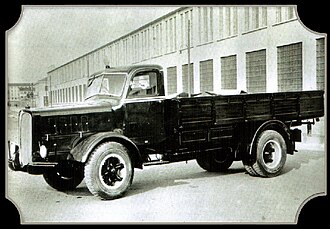
Alfa Romeo 85: The Italian Workhorse Behind Alfa Romeo’s Early Truck Ambitions
When the name Alfa Romeo is mentioned, most people immediately picture elegant Italian sports cars, racing machines and beautifully styled grand tourers. Yet the history of Alfa Romeo is considerably broader than its passenger cars. During the interwar period, the company expanded into commercial vehicles and developed a series of trucks that played an important role in its industrial history. Among these vehicles, the Alfa Romeo 85 stands out as one of the company’s significant pre-war heavy trucks. Introduced during the 1930s, it represented an evolution of Alfa Romeo’s earlier commercial-vehicle projects and demonstrated the company’s growing ability to design and manufacture trucks for both civilian and military applications.
The Alfa Romeo 85 emerged from a period when Italy was investing heavily in domestic industrial production and motorization. Trucks were becoming increasingly important for transporting goods, supporting construction and agriculture, and supplying military organizations. Alfa Romeo’s earlier experience with the Alfa Romeo 50 and 80 had provided valuable knowledge, but the company needed vehicles with greater capability if it wanted to compete seriously in the commercial-vehicle sector. The 85 was part of that progression, combining a substantially sized diesel engine with a robust chassis and a configuration suited to demanding transport work. Its story also illustrates the difficult commercial environment faced by manufacturers attempting to compete with established truck producers such as Fiat and Lancia.
The Origins of the Alfa Romeo 85
Building on the Alfa Romeo 50 and 80
The development of the Alfa Romeo 85 cannot be separated from the company’s earlier attempts to enter the truck market. Alfa Romeo’s first significant heavy truck, the Alfa Romeo 50, appeared in the early 1930s and was based on technology originating from the German Büssing-NAG organization. It featured a large six-cylinder diesel engine and a two-axle chassis, but its substantial size, limited payload relative to its dimensions and high production cost restricted its commercial success.
Alfa Romeo subsequently developed the three-axle Alfa Romeo 80, which increased the company’s experience with heavy-duty chassis design and higher payload applications. Although the 80 was itself produced in small numbers, it represented a logical step toward the more capable trucks that would follow. The Alfa Romeo 85 continued this development and formed part of a growing family of commercial vehicles intended to establish Alfa Romeo as a serious industrial manufacturer beyond the passenger-car and racing sectors.
This progression was important because designing a truck requires a very different approach from designing a sports car. A truck must tolerate heavy loads, repeated low-speed operation, rough roads and long periods of continuous use. The chassis, suspension, axles, cooling system and drivetrain all have to withstand stresses that would be unusual in a passenger vehicle. Alfa Romeo’s move into this sector therefore required the company to develop a new area of engineering expertise.
The Italian Commercial-Vehicle Market
The Italian truck market of the 1930s was highly competitive. Fiat had a particularly strong position, while Lancia and other manufacturers also produced established commercial vehicles. Alfa Romeo therefore entered a market in which customers already had access to proven alternatives.
At the same time, government policy and military requirements created opportunities for domestic manufacturers. Italy was increasingly interested in strengthening its industrial independence, and trucks were strategically important because they could support military logistics, transport equipment and personnel, and serve civilian infrastructure projects.
The Alfa Romeo 85 was consequently developed during a period when commercial trucks had importance beyond ordinary freight transportation. A successful truck could find customers among civilian operators, government organizations and the armed forces.
Engineering of the Alfa Romeo 85
A Large Diesel Powerplant
One of the defining features of the Alfa Romeo 85 was its diesel engine. Historical sources generally associate the model with a large six-cylinder diesel producing approximately 110 horsepower, while specialist references commonly give a displacement of around 11.6 litres. These specifications represented a substantial powerplant for a truck of the period.
The large engine reflected the requirements of heavy transport. Unlike modern engines that can produce substantial power from relatively small displacements through sophisticated turbocharging and electronic management, early diesel engines relied heavily on displacement and conservative operating speeds. A large engine could provide strong torque at relatively low rpm, allowing a heavily loaded truck to pull steadily without requiring the high engine speeds familiar in contemporary vehicles.
The 85’s engine was therefore designed around durability and pulling power rather than outright speed. This was appropriate for the roads of the 1930s, when heavy trucks were expected to travel at relatively modest speeds and road surfaces could be far less consistent than those found today.
Power Delivered Through a Conventional Drivetrain
The Alfa Romeo 85 used a conventional mechanical drivetrain appropriate for the era. Manual transmission technology was relatively simple compared with modern gearboxes, and the driver was responsible for selecting the correct gear according to road gradient, vehicle weight and engine speed.
This direct mechanical approach had both advantages and disadvantages. On the positive side, the system could be robust and relatively straightforward to service. On the negative side, driving a heavily loaded truck required considerable skill and physical effort. There were no automated transmissions, electronic driving modes or sophisticated engine-management systems to assist the driver.
The relationship between engine and transmission was especially important because the diesel’s low-speed operating characteristics meant that the driver needed to keep the engine within its useful torque range. On steep roads, choosing the correct gear could make the difference between maintaining forward progress and losing momentum.
Chassis and Load-Carrying Capability
A Heavy-Duty Three-Axle Concept
The Alfa Romeo 85 belonged to the heavier end of Alfa Romeo’s early commercial-vehicle development and was associated with a multi-axle configuration. The use of three axles allowed the truck to distribute its weight more effectively than a conventional two-axle vehicle.
This was particularly important as payloads increased. Concentrating a large load over only two axles can create excessive stress on individual tires, suspension components and road surfaces. A third axle allows the vehicle’s mass to be distributed across a greater number of wheels.
The multi-axle arrangement also contributed to stability. A heavy truck carrying several tonnes of cargo needs a chassis capable of resisting the forces created during braking, cornering and uneven-road operation. The Alfa Romeo 85 was therefore a product of an era when chassis strength was one of the most important considerations in truck engineering.
Designed for Different Bodies
Like most commercial trucks of its period, the Alfa Romeo 85 was essentially a chassis platform onto which different bodies could be installed. This allowed the same basic mechanical vehicle to serve different purposes.
A cargo body could transform the truck into a general freight carrier, while specialized bodies could adapt it for military supply, engineering work or other industrial roles. This flexibility was particularly valuable in an era when truck manufacturers did not necessarily sell vehicles as highly integrated finished products in the way many modern manufacturers do.
The ability to mount different bodies also made the 85 more attractive to operators who needed a truck capable of performing several types of work throughout its service life.
The Alfa Romeo 85 and Military Transportation
A Strategic Vehicle in a Changing Europe
The 1930s were a period of rapid military modernization throughout Europe, and trucks played a critical role in this process. Armies increasingly relied on motor transport to move ammunition, fuel, food, spare parts and personnel. The ability to move supplies quickly over long distances was becoming just as important as the capabilities of combat vehicles themselves.
Italy’s military therefore represented a potentially important customer for domestic truck manufacturers. Alfa Romeo’s commercial-vehicle activities existed within this broader environment, and the 85 could serve purposes beyond civilian freight transportation.
Heavy trucks were especially useful for transporting bulky equipment and supplies. Their high-capacity chassis made them suitable for logistical tasks that lighter vehicles could not perform efficiently. Although the 85 did not achieve the enormous production volumes associated with some of Fiat’s military trucks, its development reflected Alfa Romeo’s willingness to participate in this strategically important sector.
The Importance of Standardization
One of the difficulties facing manufacturers such as Alfa Romeo was the fragmented nature of military procurement. Armies benefited from standardizing on a limited number of truck types because standardized vehicles simplified training, spare-parts supply and maintenance.
A manufacturer that could not secure a major standardized contract might therefore struggle to achieve the production scale necessary to compete with larger rivals. This was one reason why Alfa Romeo’s commercial vehicles remained relatively specialized despite the company’s considerable engineering expertise.
Performance and Driving Characteristics
Built for Pulling Rather Than Speed
The Alfa Romeo 85 should be understood in the context of its era. Modern readers may look at its engine output and expect performance similar to a contemporary truck, but that comparison is misleading. The 85 was designed to operate at relatively low speeds, and its large diesel engine was primarily intended to provide reliable pulling power.
A heavy commercial vehicle did not need to accelerate rapidly. What mattered was its ability to maintain steady progress while carrying a substantial load. On a long uphill section, a strong low-speed torque curve was far more valuable than a high top-speed figure.
This also meant that drivers had to plan ahead. Momentum was important, and selecting the appropriate gear before entering a steep climb could prevent the engine from falling outside its useful operating range. Truck driving in this period was as much a mechanical skill as it was a means of transportation.
Mechanical Durability
The Alfa Romeo 85’s heavy-duty construction reflected the harsh conditions under which trucks were expected to operate. Roads could be rough, tire technology was relatively primitive, and maintenance facilities were not always readily available.
A truck therefore needed a chassis and drivetrain capable of tolerating considerable abuse. Heavy components and conservative engine design could increase weight and manufacturing cost, but they also provided a degree of durability that was essential for commercial transportation.
This engineering philosophy would remain important in Alfa Romeo’s later commercial vehicles. The company gradually developed a broader truck range, eventually producing vehicles with significantly greater capacities and more specialized applications.
Alfa Romeo’s Growing Commercial-Vehicle Family
From the 85 to Larger Trucks
The Alfa Romeo 85 was not the end of the company’s truck development. Instead, it formed part of a continuing progression that eventually produced larger and more capable models.
Among the later vehicles were the Alfa Romeo 110, 350, 430 and 500, as well as buses and trolleybuses. These vehicles demonstrated that Alfa Romeo’s commercial-vehicle activities had evolved from a small experimental program into a broader industrial operation.
The importance of the 85 is therefore partly historical. It belongs to a generation of vehicles that helped Alfa Romeo learn how to compete in a sector very different from the glamorous world of racing and passenger cars.
The Broader Alfa Romeo Industrial Story
The truck division also reveals something important about Alfa Romeo as a company. During the first half of the twentieth century, Alfa Romeo was not simply a sports-car manufacturer. Its industrial activities included aircraft engines, commercial vehicles, buses and other engineering projects.
The company possessed substantial technical expertise, but it also operated in a difficult economic and political environment. Commercial vehicles could provide a more stable industrial base than racing or luxury cars, while government and military contracts could support production during periods of economic uncertainty.
The Alfa Romeo 85 therefore belongs to a much larger story about how Italian industrial companies adapted to changing economic and political demands.
Why the Alfa Romeo 85 Is Important Today
An Overlooked Part of Alfa Romeo History
The Alfa Romeo 85 is not nearly as famous as the company’s legendary passenger cars, yet that relative obscurity is precisely what makes it fascinating. It represents a side of Alfa Romeo that many enthusiasts never encounter.
The truck demonstrates that Alfa Romeo’s engineering ambitions extended into practical heavy transportation. Its large diesel engine, multi-axle chassis and commercial configuration were far removed from the lightweight sports cars associated with the Alfa Romeo name, but they were products of the same engineering culture.
For historians, the 85 also provides insight into the development of European heavy trucks during the 1930s. At a time when diesel engines were becoming increasingly important, manufacturers were experimenting with larger engines, heavier chassis and multi-axle configurations to meet the demands of increasingly motorized economies.
A Rare Historical Vehicle
Because Alfa Romeo’s early trucks were produced in comparatively small numbers, surviving examples are much rarer than the company’s famous automobiles. This scarcity makes historical documentation especially important.
Images and technical references are often less comprehensive than those available for Alfa Romeo passenger cars, and specifications can vary between sources. Nevertheless, the surviving information gives a clear picture of the 85 as a substantial, diesel-powered commercial vehicle that represented a significant stage in Alfa Romeo’s industrial development.
For collectors and historians, the truck is valuable not because it was a commercial bestseller, but because it represents a period when Alfa Romeo was still defining its role as a diversified industrial manufacturer.
Alfa Romeo 85 Technical Specifications
Historical specifications for the Alfa Romeo 85 vary somewhat between sources and individual configurations. The table below summarizes commonly cited figures and should be treated as a representative historical specification rather than a modern factory data sheet.
| Specification | Alfa Romeo 85 |
|---|---|
| Manufacturer | Alfa Romeo |
| Country of manufacture | Italy |
| Production era | 1930s |
| Vehicle type | Heavy commercial truck |
| Engine type | Six-cylinder diesel |
| Engine displacement | Approximately 11.6 litres |
| Maximum power | Approximately 110 hp |
| Number of cylinders | 6 |
| Fuel type | Diesel |
| Drive configuration | Multi-axle rear-wheel drive |
| Axle arrangement | 6×2 / three-axle configuration, depending on version |
| Transmission | Manual |
| Primary applications | Freight, industrial transport and military logistics |
| Chassis type | Heavy-duty ladder-frame |
| Body configuration | Flexible chassis for cargo and specialist bodies |
| Production | Limited-volume historical model |
Conclusion
The Alfa Romeo 85 is a fascinating reminder that the history of Alfa Romeo extends far beyond sports cars and racing. Developed during the company’s early expansion into commercial vehicles, the 85 represented a serious attempt to establish a presence in the heavy-truck market. Its large six-cylinder diesel engine, multi-axle chassis and emphasis on durability reflected the practical requirements of commercial transportation during the 1930s.
The truck also occupies an important place in the evolution of Alfa Romeo’s industrial activities. Earlier models such as the 50 and 80 had introduced the company to heavy commercial vehicles, while the 85 helped continue that development toward larger and more capable trucks. Later models would expand the range further, proving that Alfa Romeo’s engineering ambitions reached well beyond passenger cars.
Although the Alfa Romeo 85 never became as famous as the company’s celebrated automobiles, it remains historically significant. It shows Alfa Romeo as an ambitious industrial manufacturer willing to explore unfamiliar markets and apply its engineering expertise to completely different types of machinery. For enthusiasts interested in the lesser-known chapters of automotive history, the 85 is therefore much more than an obscure old truck: it is an important piece of the story of how Alfa Romeo became the multifaceted engineering company remembered today.
