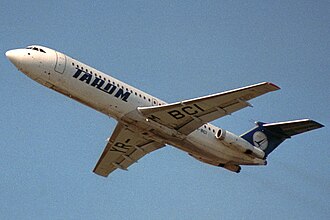
BAC One-Eleven: The British Jetliner That Made Short-Haul Flying Faster
The BAC One-Eleven, often written as the BAC 1-11 or BAC-111, was one of Britain’s most successful post-war commercial aircraft. Developed during the transition from turboprop airliners to jet-powered passenger aircraft, it gave airlines a fast and efficient alternative for short- and medium-distance routes at a time when the aviation industry was changing rapidly. Although it was considerably smaller than aircraft such as the Boeing 707 and Britain’s own Vickers VC10, the One-Eleven was designed around a market that was arguably just as important: frequent regional and European passenger services where speed, turnaround time and operating economics mattered more than intercontinental range.
The aircraft’s story began with Hunting Aircraft, which had investigated a compact jet airliner concept known as the H107. When Hunting became part of the newly created British Aircraft Corporation in 1960, the project was developed into a substantially larger aircraft. Market research suggested that the original concept was too small for the emerging airline market, so BAC reshaped the design into an approximately 80-seat jet. The result was a low-wing aircraft with two engines mounted at the rear of the fuselage and a distinctive T-tail. The configuration was well suited to short-haul airline operations because it provided a relatively clean wing and left the main landing gear and engines positioned conveniently for airport operations.
Development of the BAC One-Eleven
From Hunting H107 to a Commercial Jet
The One-Eleven was not created to satisfy the requirements of a single airline. This was an important difference from several contemporary British airliner projects, which had been heavily influenced by particular operator specifications. BAC instead attempted to create a flexible commercial aircraft that could serve a range of airlines and route networks. The company’s engineers progressively increased the size of the original Hunting concept, eventually settling on an aircraft capable of carrying around 80 passengers in its initial form. The use of Rolls-Royce Spey engines gave the design a British powerplant and provided the performance necessary for a new generation of short-haul jet services.
British United Airways became an important launch customer, ordering ten aircraft in 1961. The order demonstrated that there was commercial interest in replacing turboprop aircraft with jets on busy short-range routes. Other customers followed, and American airlines also became interested. The American market was particularly significant because foreign-built aircraft faced restrictions, yet the One-Eleven arrived at an interesting moment when American operators were looking for efficient short-haul jets. American Airlines ultimately became one of the type’s most important customers, helping establish the One-Eleven as a genuine international commercial success rather than simply a British regional aircraft.
The prototype, registered G-ASHG, made its first flight from Hurn on 20 August 1963. This was a major milestone for British commercial aviation, but the subsequent flight-test programme encountered a serious and tragic problem. On 22 October 1963, the prototype was lost during stall testing. The accident revealed dangerous deep-stall characteristics associated with the aircraft’s T-tail configuration. Rather than abandoning the project, BAC undertook major development work to improve the aircraft’s stall-warning and recovery characteristics. The One-Eleven subsequently incorporated stick-shakers and stick-pushers, technologies that became an important part of its flight-control system and helped prevent pilots from inadvertently entering an unrecoverable stall condition.
Entering Airline Service
Following the extensive redesign and testing programme, the One-Eleven received certification and entered passenger service in 1965. British United Airways became the first operator, with the first customer handover taking place in January 1965. The aircraft was particularly well suited to airlines looking for a jet capable of operating frequent sectors without the capacity or operating characteristics of a larger mainline airliner. Its rear-mounted engines, relatively compact dimensions and two-pilot flight deck made it an attractive proposition for the rapidly developing short-haul market.
The One-Eleven’s arrival also placed Britain directly into competition with American and European manufacturers developing similar short-haul jet aircraft. The Douglas DC-9 became its most obvious American rival, while other aircraft such as the Sud Aviation Caravelle occupied related parts of the market. The British aircraft nevertheless had a strong selling point: it combined respectable passenger capacity with the high cruise speeds expected from a jet while remaining compact enough for regional airline networks. Its Rolls-Royce Spey engines were low-bypass turbofans, representing an intermediate stage between early pure turbojets and the much larger, quieter and more efficient high-bypass turbofans that would dominate later generations of airliners.
The Different One-Eleven Variants
Series 200, 300 and 400
The original production aircraft was the Series 200. Powered by Rolls-Royce Spey engines producing around 10,410 pounds-force each, the aircraft could carry up to approximately 79 passengers and had a cruise speed of roughly 548 mph according to BAE Systems Heritage data. Its maximum weight was about 78,500 pounds, while its range was approximately 830 miles. These figures gave the aircraft a useful combination of speed and capacity for the short-haul routes for which it had been designed.
BAC then developed more powerful versions. The Series 300 introduced uprated Spey engines and additional fuel capacity, improving range and payload flexibility. The Series 400 was broadly similar but incorporated instrumentation and equipment intended for the American market. This distinction was commercially important because American airline operations and certification requirements differed from those in Britain and Europe. The Series 400 became a major export version, with American Airlines and other US operators giving the aircraft valuable exposure in one of the world’s most competitive aviation markets.
The Larger Series 500
The most significant development was the Series 500, sometimes called the Super One-Eleven. Rather than simply improving the original aircraft’s engines or avionics, BAC lengthened the fuselage and increased the aircraft’s passenger capacity. The stretched version first flew on 30 June 1967 and could accommodate as many as 119 passengers. It also received longer-span wings and more powerful Rolls-Royce Spey 512 engines producing approximately 12,550 pounds-force each.
The Series 500 made the One-Eleven particularly attractive for European inter-city routes and the rapidly expanding package-tour industry. More seats meant that airlines could spread the aircraft’s operating costs across a larger passenger load, while the aircraft retained the basic characteristics that had made the original version useful. The 500 therefore became one of the most recognizable One-Eleven variants and extended the commercial life of the design considerably.
A specialized Series 475 was also developed for demanding hot-and-high and short-field operations. It combined the fuselage characteristics of the Series 400 with the larger wing and powerplant arrangement associated with the Series 500, while receiving modifications intended for rougher airfields. Only a small number were sold, demonstrating how the One-Eleven could be adapted for very different operating environments even though the basic design was already several years old.
Engineering and Flight Characteristics
One of the defining features of the BAC One-Eleven was its rear-engine configuration. Mounting the two Spey engines on either side of the rear fuselage kept the engines away from the wing and gave the aircraft a clean low-wing aerodynamic layout. The configuration also contributed to the aircraft’s distinctive appearance, particularly when viewed from the front or side. A T-tail completed the design, placing the horizontal stabilizer high above the fuselage.
The aircraft was designed around the practical realities of airline operations. It used retractable tricycle landing gear and a pressurized passenger cabin, allowing it to operate at jet-airliner cruising altitudes while maintaining a comfortable cabin environment. Depending on the variant and seating arrangement, the One-Eleven could carry a little over 100 passengers, with the stretched Series 500 reaching a maximum seating capacity of 119.
The aircraft’s performance was impressive for its period. Later One-Eleven variants could cruise at around Mach 0.71, while the Series 500 had a maximum operating ceiling around 35,000 feet. EUROCONTROL’s performance data for the Series 500 lists a cruise speed of approximately 425 knots true airspeed and a maximum range of about 1,500 nautical miles under the database’s representative performance assumptions. These figures illustrate why the aircraft was so effective on European and regional routes rather than very long sectors.
The One-Eleven Around the World
Although strongly associated with Britain, the BAC One-Eleven became an international aircraft. It served airlines in Europe, North America, Africa, Asia, Australia and other regions. Its combination of capacity, speed and relatively compact dimensions allowed it to operate both scheduled passenger services and charter flights. In some markets, particularly where airport infrastructure was less developed, versions optimized for demanding runway conditions provided additional flexibility.
The aircraft also found unusual roles outside conventional airline service. One-Eleven airframes were used for research, testing and military-related work. A particularly interesting example was aircraft XX105, a Series 201 acquired by the Royal Aircraft Establishment in 1973 for the Blind Landing Experimental Unit. It participated in development work associated with blind-landing technology, contributing to the evolution of systems that would become fundamental to modern instrument landing operations.
The type also gained an unexpected second manufacturing life in Romania. In 1979, an agreement was signed for licensed production of the One-Eleven, and the Romanian-built Rombac 1-11 made its first flight in 1982. Production continued until 1989, with nine complete aircraft ultimately produced. This extended the story of the British design beyond the end of UK production and demonstrated that the basic One-Eleven concept still possessed value more than two decades after its original development.
Decline and Legacy
By the 1980s, however, the commercial environment was changing. Newer aircraft offered improved fuel economy, greater passenger capacity, lower noise and more advanced systems. Aircraft such as later generations of the Boeing 737 and the emerging Airbus A320 family gradually made early short-haul jets less competitive. The One-Eleven remained useful for many years because of its sturdy construction and operational versatility, but its age eventually became increasingly apparent.
UK production ended in 1984, with BAE Systems Heritage recording 244 aircraft produced when the Romanian production programme is included in the overall total. The aircraft nevertheless continued flying for many years after production ceased. Some remained in airline service into the 1990s and beyond, while others were adapted for specialist missions. The last examples survived into the twenty-first century, a remarkable lifespan for an airliner whose prototype had first flown in 1963.
The BAC One-Eleven deserves recognition not simply because it was a successful British aircraft, but because it represented an important stage in the development of commercial aviation. It helped airlines make the transition from turboprop-powered regional aircraft to fast jet transportation, while its development also demonstrated how quickly the industry was learning about high-speed aerodynamics, flight-control systems and airline economics.
Its legacy can be seen in the principles that became standard on later generations of regional and short-haul jets: rear-mounted engines, two-pilot flight decks, efficient high-speed cruising and flexible passenger capacity. The One-Eleven may now be a historic aircraft, but during its heyday it was an important part of the transformation of short-haul air travel.
BAC One-Eleven Technical Specifications
The following figures summarize the principal characteristics of the aircraft, with the table focusing primarily on the Series 200 and Series 500 because specifications varied substantially between One-Eleven variants.
| Specification | BAC One-Eleven Series 200 | BAC One-Eleven Series 500 |
|---|---|---|
| Aircraft type | Short-haul jet airliner | Stretched short-haul jet airliner |
| Country of origin | United Kingdom | United Kingdom |
| Manufacturer | British Aircraft Corporation | British Aircraft Corporation |
| Prototype first flight | 20 August 1963 | 30 June 1967 |
| Crew | 2 flight crew + cabin crew | 2 flight crew + cabin crew |
| Typical passenger capacity | Up to 79 | Up to 119 |
| Engines | 2 × Rolls-Royce Spey | 2 × Rolls-Royce Spey 512 |
| Engine thrust | Approx. 10,410 lbf each | Approx. 12,550 lbf each |
| Wingspan | 88 ft 6 in / 27.0 m | Approx. 93 ft 6 in / 28.5 m |
| Length | Approx. 92 ft 6 in / 28.2 m | Approx. 106 ft 12 in / 32.6 m |
| Height | Approx. 23 ft 7 in / 7.2 m | Approx. 24 ft / 7.4 m |
| Maximum takeoff weight | Approx. 78,500 lb / 35,607 kg | Up to approximately 104,000 lb / 47,200 kg, depending on configuration |
| Cruise speed | Approx. 548 mph / 882 km/h | Approx. Mach 0.71 |
| Service ceiling | — | Approx. 35,000 ft / 10,668 m |
| Approximate range | 830 miles / 1,336 km | Up to roughly 1,500 nm under representative performance assumptions |
| Landing gear | Retractable tricycle | Retractable tricycle |
| Engine location | Rear fuselage | Rear fuselage |
| Tail configuration | T-tail | T-tail |
| UK production | Series production from 1963 | Series 500 from 1967 |
| Total production | 244 aircraft including Romanian production | Included in total of 244 |
| Primary role | Short-haul passenger transport | Short-haul passenger and charter transport |
Technical figures vary by series, equipment, payload and operating configuration; the One-Eleven family included numerous customer-specific versions.
