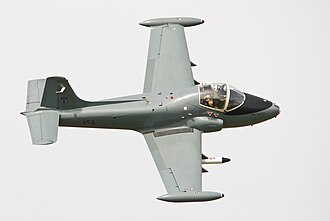
BAC Strikemaster: The Story of Britain’s Remarkable Jet Trainer and Light Attack Aircraft
The BAC Strikemaster occupies a fascinating place in aviation history. It was not designed to compete with the world’s most advanced supersonic fighters, nor was it intended to carry the heavy weapons loads of a dedicated strike aircraft. Instead, it combined the qualities of a dependable jet trainer with the practical capabilities of a light attack aircraft, creating a versatile machine that served air forces across several continents. Developed by the British Aircraft Corporation from the successful Jet Provost family, the Strikemaster offered straightforward handling, relatively low operating costs, rugged construction, and the ability to operate from less-developed airfields. These characteristics made it particularly attractive to countries that needed a flexible military aircraft without the expense and logistical demands associated with larger combat jets.
First flown in 1967, the BAC 167 Strikemaster became an important export product for Britain’s aviation industry. Its story encompasses engineering development, international military aviation, counter-insurgency operations, pilot training, and the enduring appeal of classic jet aircraft. Although production ended decades ago, surviving examples continue to attract attention among aviation enthusiasts and warbird operators. The Strikemaster demonstrates how an aircraft does not need to be the fastest or most technologically sophisticated machine of its era to become genuinely influential. Its success came from matching a carefully defined operational requirement with a robust and adaptable design.
The Origins of the BAC Strikemaster
From the Jet Provost to a More Capable Military Aircraft
The history of the BAC Strikemaster begins with the Hunting Jet Provost, a British jet trainer developed to introduce military pilots to the handling characteristics of jet-powered aircraft. The Jet Provost evolved into a widely respected training platform, and its relatively conventional configuration, reliable engine installation, and forgiving flying characteristics provided an excellent foundation for further development. As air forces around the world sought economical aircraft capable of both advanced training and limited combat duties, the possibility of adapting a trainer into a light attack aircraft became increasingly attractive.
The British Aircraft Corporation recognized that the Jet Provost’s basic airframe could serve as the starting point for a more powerful and militarily useful aircraft. The resulting Strikemaster retained the fundamental layout and general flying philosophy of its predecessor but incorporated important structural and mechanical improvements. The aircraft received a more powerful Rolls-Royce Viper engine, a strengthened wing, additional weapons capability, and military equipment suited to operational service. The changes were not simply cosmetic. They transformed a primarily instructional aircraft into a platform capable of carrying external stores and undertaking light ground-attack missions while preserving its training role.
According to BAE Systems Heritage, the Strikemaster was developed from the pressurized Jet Provost Mk.5 and benefited from testing conducted with an uprated Viper engine on an earlier Jet Provost. Rather than beginning with an entirely separate clean-sheet prototype, the development program made extensive use of the established Jet Provost design. This approach helped reduce risk and allowed the manufacturer to build upon an airframe whose handling characteristics and maintenance requirements were already familiar to potential customers.
A Design Focused on Practicality
The Strikemaster’s appeal was rooted in practicality. It was intended for air forces that required an aircraft able to perform several tasks without demanding the infrastructure of a sophisticated frontline fighter. The aircraft could train pilots, conduct reconnaissance, provide close air support, and carry out light strike missions. Its relatively simple single-engine arrangement also offered advantages in maintenance and operating costs.
The design included a reinforced wing capable of carrying external stores, along with four principal underwing weapon stations. Depending on the operator and mission, the aircraft could carry bombs, rocket pods, gun pods, fuel tanks, and other stores. Two 7.62-millimeter machine guns were installed in the lower intake-lip area, giving the aircraft an integrated offensive capability rather than relying exclusively on external weapons.
Another important feature was its two-seat arrangement. In the training role, an instructor and student could occupy the aircraft together, allowing the Strikemaster to support advanced instruction before pilots moved on to more demanding operational types. In the attack role, the aircraft could be flown by a single pilot, freeing weight and space for mission equipment or weapons. This dual-role flexibility was one of the most important reasons the aircraft appealed to export customers.
Development and First Flight
The BAC 167 Strikemaster Takes to the Air
The first Strikemaster flight took place on 26 October 1967, marking the beginning of a new chapter in the Jet Provost family. The aircraft was subsequently introduced to export customers, with deliveries beginning in the late 1960s. The development program focused on ensuring that the aircraft could retain the stable and predictable handling expected of a trainer while offering the structural strength and performance needed for combat-related duties.
The use of the Rolls-Royce Viper Mk.535 turbojet represented a major part of the aircraft’s development. The uprated engine delivered substantially more thrust than the powerplant used in earlier Jet Provost versions, allowing the Strikemaster to carry a meaningful external weapons load. The engine was not intended to provide supersonic performance, but it offered a useful balance between power, reliability, and maintainability. For air forces operating in regions where technical resources could be limited, this balance was particularly valuable.
The Strikemaster’s strengthened airframe also allowed it to withstand the additional stresses associated with carrying external stores. The aircraft’s design emphasized robustness rather than complexity, and its ability to operate from relatively austere airstrips was an important advantage. Many potential customers did not require an aircraft designed exclusively for large, modern air bases. They needed a machine that could be deployed with modest support and still perform useful operational work.
Balancing Training and Combat Requirements
Designing an aircraft to perform both training and attack missions involves several compromises. A trainer must be stable, predictable, and economical to operate, while a combat aircraft must be able to carry weapons, survive demanding flight conditions, and provide useful performance under operational loads. The Strikemaster’s designers sought to balance these requirements rather than prioritize one role completely.
The resulting aircraft was not a high-performance air-superiority fighter. Its maximum speed was in the subsonic range, and its weapons capacity was modest compared with larger strike aircraft. However, it offered a practical combination of maneuverability, visibility, relatively uncomplicated systems, and operational flexibility. These characteristics made it well suited to light attack, pilot conversion, and missions in which affordability and ease of support were more important than advanced avionics or extreme speed.
The Strikemaster also incorporated ejection seats for both crew positions. This was an important safety feature, especially because the aircraft could be used in demanding low-level training and operational environments. The ability to combine two-seat instruction with military equipment gave the type an advantage over aircraft that were designed exclusively for one role.
Technical Features and Performance
Engine and Airframe
At the heart of the BAC Strikemaster was its single Rolls-Royce Viper Mk.535 turbojet. Published specifications commonly give the engine a thrust rating of approximately 3,400 to 3,410 pounds-force, or roughly 15 kilonewtons, although figures can vary according to the reference and specification being quoted. The Viper was a compact and comparatively straightforward turbojet, and its established service history contributed to the Strikemaster’s reputation as a manageable aircraft for smaller air forces.
The aircraft had a length of approximately 10.27 meters and a wingspan of about 11.23 meters. Its maximum takeoff weight was approximately 5,216 kilograms, while its empty weight was around 2,810 kilograms in commonly cited specifications. These dimensions placed the Strikemaster firmly in the category of compact military jets. Its size made it easier to maintain and operate than many larger combat aircraft, while its strengthened structure provided the capacity to carry external stores.
The wing was particularly important to the aircraft’s military role. It was designed to accommodate weapons and fuel tanks, and its structure was reinforced to handle the loads associated with external carriage. The aircraft’s relatively compact proportions and conventional layout also contributed to its predictable handling, an attribute that remained valuable during training and operational flying.
Speed, Range, and Operating Ceiling
The Strikemaster’s maximum speed is often listed at approximately 774 kilometers per hour, or 481 miles per hour, at an altitude of around 18,000 feet. Its never-exceed speed is generally cited as approximately 834 kilometers per hour, or 518 miles per hour. These figures show that the aircraft was designed for effective subsonic operations rather than high-speed interception or supersonic combat.
Its published range was approximately 2,224 kilometers, or 1,382 miles, depending on the configuration and conditions used for the calculation. The aircraft’s operational combat radius was considerably shorter when carrying a substantial weapons load and operating at low altitude. One frequently cited figure gives a combat radius of about 233 kilometers, or 145 miles, with a 3,000-pound weapons load in a low-level mission profile. This distinction is important: ferry range and combat radius describe very different operating conditions.
The Strikemaster’s service ceiling was approximately 40,000 feet. While that altitude was respectable for a light jet trainer and attack aircraft, the Strikemaster’s principal value was not found in high-altitude performance. It was better suited to missions where pilots needed responsive handling, reliable systems, and the ability to operate close to the ground.
Armament and Military Capability
A Flexible Light Attack Platform
The BAC Strikemaster was equipped with two 7.62-millimeter machine guns, generally identified as FN weapons, installed near the lower air-intake lips. These guns provided a built-in offensive capability and could be used for training, strafing, and other light attack duties. The aircraft also had four underwing hardpoints, with the overall external stores capacity commonly stated as up to 3,000 pounds, or approximately 1,360 kilograms.
Its external stores could include bombs, rocket launchers, gun pods, practice weapons, and fuel tanks. Different customers could configure their aircraft according to their own operational requirements. Some air forces used the Strikemaster primarily for training, while others employed it for light combat, reconnaissance, or counter-insurgency missions. This adaptability was central to its export success.
The Strikemaster’s armament should be understood in the context of its intended role. It was not designed to defeat modern fighter aircraft or carry out deep-penetration strikes against heavily defended targets. Instead, it provided a comparatively economical means of delivering weapons against lightly defended ground targets and supporting military operations where a larger aircraft might have been unnecessary or too expensive.
Suitability for Counter-Insurgency Operations
Counter-insurgency missions often require aircraft that can remain available for extended periods, operate from modest airfields, and deliver relatively small weapons loads accurately and economically. The Strikemaster’s combination of low maintenance demands, two-seat training capability, and light attack equipment made it attractive for these missions.
Its ability to operate from less-developed airstrips was another important advantage. An aircraft that does not depend entirely on extensive base infrastructure can be useful in regions with limited logistical support. The Strikemaster’s ruggedness and relatively simple systems helped make it an appealing option for air forces seeking a practical combat aircraft rather than a highly sophisticated multirole fighter.
Although the aircraft’s performance and protection were limited compared with later-generation combat jets, it could still perform valuable duties when matched to an appropriate mission. Its effectiveness depended on the operational environment, the availability of ground support, the quality of pilot training, and the nature of the threat.
Export Success and International Service
A Popular Aircraft Among Smaller Air Forces
The BAC Strikemaster achieved a notable export presence. BAE Systems Heritage records a total of 151 aircraft built, including six assembled at Hurn and the remainder assembled at Warton. Other reference works cite different production totals, so the precise number can depend on the historical source and how individual aircraft are counted. Nevertheless, the type clearly enjoyed meaningful international success.
Customers included Saudi Arabia, Oman, Kuwait, Singapore, New Zealand, Ecuador, Kenya, South Yemen, and Sudan. These operators represented a wide range of geographical locations and military requirements. Some acquired the aircraft for advanced jet training, while others valued its light attack capabilities. The fact that so many countries selected the Strikemaster illustrates the flexibility of its design.
Saudi Arabia was among the most significant operators, receiving several versions of the aircraft. Oman also operated Strikemasters, and the type became associated with military aviation in the Middle East. New Zealand’s Royal New Zealand Air Force operated the Strikemaster Mk.88, making the aircraft an important part of the country’s military training and light attack aviation history.
Variants and Customer-Specific Versions
The Strikemaster was produced in a series of marks associated largely with individual export customers. These included the Mk.80 and Mk.80A for Saudi Arabia, the Mk.82 and Mk.82A for Oman, the Mk.83 for Kuwait, the Mk.84 for Singapore, the Mk.87 for Kenya, the Mk.88 for New Zealand, and several versions supplied to Ecuador and Sudan.
The existence of these variants reflects the aircraft’s export-oriented design philosophy. Different customers could request differences in equipment, communications systems, instruments, or other details while retaining the basic Strikemaster airframe and engine. This approach allowed the manufacturer to serve a variety of markets without developing an entirely new aircraft for each customer.
The Strikemaster’s Legacy
Retirement from Military Service
As military aviation technology advanced, the Strikemaster gradually became less competitive against newer aircraft. Improvements in avionics, navigation, weapons systems, pilot training, and aircraft survivability changed the requirements of modern air forces. The Strikemaster remained useful in appropriate roles, but it could not match the capabilities of more advanced aircraft introduced during the following decades.
The British military training system eventually moved toward newer aircraft, including the BAe Hawk, which offered greater performance and more modern capabilities. Export operators also retired their Strikemasters over time. By the end of the twentieth century, the aircraft had largely disappeared from active military service.
A Continuing Presence in the Warbird Community
Despite its retirement, the BAC Strikemaster has remained popular among aviation enthusiasts. Surviving aircraft are valued for their distinctive appearance, compact jet configuration, historical importance, and engaging flying characteristics. Warbird operators and museums have helped preserve examples of the type, allowing new generations to appreciate an aircraft that once played a significant role in international military aviation.
The Strikemaster is particularly interesting because it offers a connection between the age of classic jet trainers and the practical realities of Cold War-era military aviation. It represents a time when a relatively simple aircraft could serve several purposes and provide smaller air forces with an affordable means of developing and maintaining jet aviation capabilities.
Conclusion
The BAC Strikemaster was a remarkable example of purposeful aircraft design. Developed from the Jet Provost, it combined the predictable handling of a trainer with the structural strength, weapons capability, and operational flexibility of a light attack aircraft. Its Rolls-Royce Viper turbojet, strengthened wing, two-seat configuration, ejection seats, and ability to operate from austere airfields made it a valuable asset for numerous air forces.
Although it never sought to rival the world’s most advanced fighters, the Strikemaster succeeded by fulfilling a practical need. It helped train pilots, supported light combat missions, and provided an economical military aviation solution for international customers. Today, its surviving examples serve as reminders of an era when reliability, adaptability, and maintainability could be just as important as raw performance. The BAC Strikemaster’s enduring reputation is therefore not based on speed alone, but on the thoughtful engineering and operational versatility that made it useful for so many years.
.jpg)