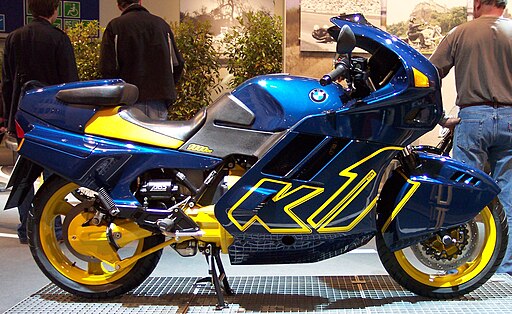
The BMW K1 represents a unique chapter in BMW Motorrad’s history, standing out as an ambitious attempt to redefine what a sport-touring motorcycle could be in the late 1980s. Unlike traditional motorcycles of its era, the K1 was designed not just for performance but also for aerodynamics, rider comfort, and long-distance stability. It was BMW’s response to the rising popularity of Japanese sportbikes, aiming to combine German engineering precision with radical styling. The K1 introduced a futuristic full-body fairing that not only provided significant aerodynamic advantages but also made a bold visual statement, challenging conventional motorcycle aesthetics. While the bike was intended for road use, its engineering choices—ranging from advanced engine configuration to innovative suspension components—highlight BMW’s commitment to pushing technological boundaries.
Engine and Powertrain
At the core of the BMW K1 is a longitudinally mounted 987cc inline-four engine, which was a significant departure from BMW’s traditional flat-twin designs. This engine utilizes a DOHC configuration with 4 valves per cylinder, allowing for high-revving efficiency and smooth power delivery. Producing roughly 100 horsepower at 8,000 rpm and around 88 Nm of torque at 6,000 rpm, the K1 was competitive with contemporary sportbikes in its displacement class. One of the distinctive features of the engine is the use of a toothed rubber belt to drive the camshafts, which reduced mechanical noise and required less maintenance compared to conventional chain-driven systems. The gearbox is a five-speed unit paired with a shaft drive, a BMW trademark, which enhances durability and lowers maintenance compared to chain-driven alternatives. The longitudinal engine orientation, combined with the shaft drive, also contributes to the K1’s unique handling characteristics, including torque reaction during acceleration and deceleration.
Chassis and Frame
The BMW K1 is built around a steel tubular frame designed for stability and comfort at high speeds. While heavier than modern sportbike frames, the K1’s chassis provides excellent rigidity and balance, enabling confident handling even on long stretches of highway. The frame integrates a large engine cradle and reinforced mounting points for the advanced suspension components, ensuring that weight distribution is optimized. The combination of frame geometry and aerodynamically designed body panels allows the K1 to achieve high-speed stability, minimizing lift and turbulence around the rider. The seat height is carefully calibrated to balance rider ergonomics with center-of-gravity considerations, making the bike comfortable for touring while still responsive during spirited cornering.
Suspension and Braking
The K1’s suspension system features BMW’s Telelever front suspension, which separates steering and suspension forces to enhance stability and reduce dive under braking. This setup consists of a wishbone linked to a central spring and damper, providing both comfort and precision handling. At the rear, a monoshock suspension system with adjustable preload and damping ensures that road irregularities are absorbed efficiently without compromising control. Braking performance is managed by dual front disc brakes and a single rear disc brake, all equipped with conventional calipers and integrated anti-dive geometry to maintain stability during aggressive braking. While modern electronic aids were absent due to the era, the suspension and braking systems were highly advanced for their time, offering riders a balanced and confident feel on both smooth highways and twisty backroads.
Aerodynamics and Bodywork
One of the defining characteristics of the BMW K1 is its radical full-body fairing, which covers nearly the entire front and sides of the bike. The fairing was designed to reduce drag and improve high-speed stability, allowing the K1 to reach speeds in excess of 240 km/h while maintaining rider comfort. Airflow management was carefully considered, with integrated vents and deflectors that reduce buffeting and channel cooling air to the engine. The design also contributes to noise reduction, making long-distance rides less fatiguing. The integrated fairing, combined with a tall windscreen and aerodynamic mirrors, emphasizes BMW’s commitment to combining speed, comfort, and futuristic design. The bodywork, while visually polarizing at the time, ultimately set a precedent for full-faired sport-touring motorcycles.
Wheels, Tires, and Ergonomics
The BMW K1 rides on cast alloy wheels designed for strength and lightness, fitted with sport-touring tires optimized for both grip and longevity. The front wheel measures 17 inches, while the rear is slightly wider at 18 inches, providing stability during high-speed maneuvers. Ergonomics were a major focus, with a seating position that balances rider comfort and control. Unlike typical sportbikes that force a forward-leaning posture, the K1 offers a slightly upright stance that reduces fatigue on long rides while still allowing precise handling inputs. Footpeg placement and handlebar design were engineered to provide a natural alignment of the rider’s limbs, ensuring comfort without sacrificing performance.
Electronics and Instrumentation
For a motorcycle of its era, the BMW K1 included relatively advanced instrumentation. The cockpit features an analog tachometer, speedometer, and fuel gauge, complemented by warning lights for oil pressure, temperature, and neutral status. Some later models also included an integrated fuel consumption gauge and trip computer, reflecting BMW’s focus on technology and rider convenience. While the K1 lacked modern electronic rider aids like traction control or ABS in its early iterations, the bike’s mechanical precision and engineering compensated by delivering predictable and controllable performance under most conditions. The instrumentation layout prioritizes readability and clarity, allowing riders to focus on the road without distraction.
Production and Legacy
Produced between 1988 and 1993, the BMW K1 was a limited-run motorcycle, with fewer than 7,000 units manufactured worldwide. Its radical styling, advanced engineering, and touring capabilities made it a niche product, appealing to riders who valued innovation and uniqueness over mass-market appeal. Today, the K1 is celebrated as a pioneering motorcycle that challenged conventional design norms and showcased BMW Motorrad’s engineering prowess. Collectors and enthusiasts appreciate the K1 not only for its historical significance but also for its distinctive aesthetics and combination of sport and touring capabilities, making it a symbol of BMW’s willingness to innovate boldly.
Conclusion
The BMW K1 stands as a remarkable example of 1980s motorcycle engineering, blending aerodynamics, advanced engine design, and rider-centric ergonomics into a singular package. Its full-faired design, longitudinal inline-four engine, shaft drive, and innovative suspension make it a unique motorcycle that defies traditional categorizations. Though it was polarizing at the time, the K1’s influence on sport-touring and high-speed motorcycle design is undeniable, and it remains a celebrated model among enthusiasts for its combination of performance, comfort, and forward-thinking engineering. Its legacy continues to inspire modern motorcycles that aim to balance speed, stability, and rider experience in innovative ways.
