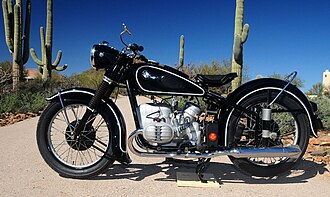
The BMW R51/3 represents far more than just a mid-century motorcycle—it is a symbol of technological rebirth, industrial resilience, and the redefinition of engineering standards in post-war Europe. Developed by BMW during a period of reconstruction and uncertainty, the R51/3 was not only a machine but a statement: precision engineering could survive disruption and emerge stronger.
This long-form technical article explores the R51/3 in detail, from its historical roots and mechanical architecture to its lasting legacy. It is written as a deep, blog-style exploration intended for enthusiasts, engineers, and historians who appreciate both technical nuance and historical context.
Post-War Reconstruction and the Need for Innovation
The development of the BMW R51/3 cannot be understood without considering the broader historical environment of post-World War II Germany. The country’s industrial infrastructure had been heavily damaged, and strict regulations initially prevented German manufacturers from producing motorcycles or automobiles. When these restrictions were gradually lifted, BMW found itself in a unique position: it had to rebuild not just its factories, but also its engineering knowledge base.
Many original blueprints and technical documents had been lost during the war, forcing engineers to rely on surviving pre-war models and reverse engineering techniques. The first post-war motorcycles, such as the R24 and later the R51/2, were heavily based on pre-war designs. However, these models were transitional—they served as stepping stones toward something more advanced.
The R51/3, introduced in 1951, marked the true beginning of BMW’s modern post-war motorcycle engineering. It replaced the short-lived R51/2 and introduced significant technical improvements, particularly in engine design and overall refinement.
Engineering Philosophy: Evolution Rather Than Revolution
BMW approached the R51/3 with a philosophy rooted in evolutionary improvement rather than radical reinvention. The company understood that reliability, durability, and mechanical coherence were more important than experimental features.
The goal was to refine the proven boxer engine concept while addressing weaknesses in earlier designs. Engineers focused on improving smoothness, reducing mechanical complexity, and enhancing long-term reliability. The result was a motorcycle that felt both familiar and advanced—a machine that respected its heritage while embracing modern engineering practices.
This philosophy is evident in every aspect of the R51/3, from its drivetrain to its frame construction. It was not designed to shock the market with radical innovation, but rather to quietly outperform competitors through superior engineering.
The Boxer Engine: Mechanical Precision and Balance
At the heart of the R51/3 lies its air-cooled, four-stroke flat-twin boxer engine. With a displacement of 494 cc, the engine was designed to deliver a balance of performance and reliability.
The horizontally opposed cylinder layout provided natural balance, significantly reducing vibration. This configuration also ensured effective air cooling, as both cylinders were exposed to airflow. The result was a smooth-running engine that could sustain long-distance travel without overheating.
The engine produced approximately 24 horsepower at around 5,800 rpm, enabling a top speed of roughly 135–140 km/h.
What truly set the R51/3 apart was its internal engineering. Unlike earlier models that relied on chain-driven camshafts, the R51/3 used a gear-driven camshaft system. This design eliminated the need for chains, reducing wear and improving long-term reliability.
Pushrods and rocker arms operated the overhead valves, creating a robust and easily serviceable valvetrain. This simplicity was a deliberate choice, ensuring that the engine could be maintained even in less-than-ideal conditions.
Ignition and Electrical System
Another notable feature of the R51/3 was its magneto ignition system. Instead of relying on a battery-dependent ignition, the motorcycle used a Noris magneto, which generated its own electrical current.
This system provided consistent ignition performance regardless of battery condition, enhancing reliability—especially important in an era when electrical systems were less dependable than today.
The magneto was integrated into the engine design in a compact and efficient manner, contributing to the overall robustness of the motorcycle. This approach reflected BMW’s focus on self-sufficiency and mechanical reliability.
Fuel System and Carburetion
The R51/3 utilized dual Bing carburetors, one for each cylinder. This setup ensured an even distribution of the air-fuel mixture, improving engine efficiency and performance.
Carburetors of this type were relatively simple but highly effective. They allowed for precise tuning and were easy to maintain, making them ideal for a motorcycle designed for both everyday use and long-distance travel.
Fuel delivery relied on a gravity-fed system, eliminating the need for complex fuel pumps. This simplicity further enhanced reliability and reduced potential points of failure.
Transmission and Shaft Drive
The transmission system of the R51/3 consisted of a four-speed manual gearbox paired with a single-plate dry clutch. This configuration provided smooth and reliable gear changes.
Power was transmitted to the rear wheel via a shaft drive system, one of BMW’s signature features. Unlike chain drives, the shaft drive required minimal maintenance and was protected from environmental factors.
The shaft drive also contributed to the motorcycle’s clean appearance and mechanical durability. It was particularly advantageous for long-distance touring and sidecar use, both of which were common applications for the R51/3.
Frame Design and Structural Integrity
The R51/3 featured a steel double-loop frame, designed for strength and versatility. This frame was capable of supporting not only solo riding but also the addition of a sidecar, a popular option at the time.
The frame included mounting points specifically designed for sidecar attachment, demonstrating BMW’s attention to practical use cases.
The use of high-quality materials and precise welding techniques ensured that the frame could withstand significant stress without compromising stability. This robustness was a key factor in the motorcycle’s longevity.
Suspension System: Blending Tradition and Functionality
The suspension system of the R51/3 combined traditional design elements with practical improvements. The front suspension used telescopic forks, which provided better handling and comfort compared to earlier designs.
At the rear, the motorcycle employed a plunger-type suspension system. While not as advanced as modern swingarm designs, it offered improved comfort over rigid frames and was relatively simple to maintain.
This combination allowed the R51/3 to handle a variety of road conditions, from smooth highways to rough rural paths. It also made the motorcycle suitable for sidecar use, where stability was particularly important.
Braking System and Safety Considerations
The braking system consisted of drum brakes on both the front and rear wheels, each with a diameter of approximately 200 mm. (Wikipedie)
While drum brakes may seem primitive by modern standards, they were effective and reliable for the performance levels of the time. The braking system was designed to provide consistent stopping power, even under heavy use.
The relatively large diameter of the drums improved heat dissipation, reducing the risk of brake fade during extended use.
Performance and Riding Characteristics
The R51/3 was designed to deliver a balanced riding experience. Its top speed of around 135–140 km/h made it competitive within the 500 cc class, while its smooth power delivery ensured ease of use.
The low center of gravity, a result of the boxer engine layout, contributed to excellent handling. The motorcycle felt stable at high speeds and manageable at low speeds, making it suitable for a wide range of riders.
Fuel consumption was approximately 4.5 liters per 100 km, reflecting the efficiency of the engine design.
The R51/3 was equally capable as a solo touring motorcycle or as a sidecar-equipped vehicle, demonstrating its versatility.
Production and Market Impact
The BMW R51/3 was produced between 1951 and 1954 (with some sources noting production extending into 1955), with approximately 18,420 units manufactured.
This production volume was significant for the time and reflected strong demand for reliable, high-quality motorcycles. The R51/3 helped reestablish BMW as a leading manufacturer in the global motorcycle market.
It also served as a foundation for future models, including the R67 and R68, which built upon its engineering principles.
Motorsport and Endurance Reputation
The R51/3 demonstrated its capabilities in endurance events such as the Six Days Trial, where reliability and durability were critical.
Success in these competitions reinforced BMW’s reputation for engineering excellence. The motorcycle’s ability to perform under demanding conditions highlighted the effectiveness of its design.
Design Aesthetics and Cultural Significance
Beyond its technical features, the R51/3 is widely regarded as a visually elegant motorcycle. Its clean lines, symmetrical engine layout, and minimalist design reflect a timeless aesthetic.
Even today, enthusiasts admire the R51/3 for its craftsmanship and attention to detail. It represents an era when engineering and design were closely intertwined, resulting in machines that were both functional and beautiful.
Legacy and Influence on Future BMW Motorcycles
The R51/3 played a crucial role in shaping the future of BMW motorcycles. Its engine design, drivetrain configuration, and overall philosophy influenced subsequent models for decades.
The boxer engine and shaft drive combination became defining characteristics of BMW motorcycles, continuing into modern models.
The R51/3 also demonstrated that BMW could successfully rebuild and innovate after a period of significant disruption, setting the stage for long-term success.
Technical Parameters Table
| Parameter | Specification |
|---|---|
| Model | BMW R51/3 |
| Production Years | 1951–1954 (some sources 1955) |
| Engine Type | Air-cooled, 4-stroke, flat-twin (boxer), OHV |
| Displacement | 494 cc |
| Bore x Stroke | 68 mm × 68 mm |
| Compression Ratio | ~6.3:1 |
| Power Output | 24 hp @ 5800 rpm |
| Top Speed | 135–140 km/h |
| Fuel System | Dual Bing carburetors |
| Ignition | Magneto (Noris) |
| Transmission | 4-speed manual |
| Clutch | Single-plate dry clutch |
| Final Drive | Shaft drive |
| Frame | Steel double-loop |
| Front Suspension | Telescopic fork |
| Rear Suspension | Plunger suspension |
| Front Brake | 200 mm drum |
| Rear Brake | 200 mm drum |
| Wheelbase | ~1400 mm |
| Length | ~2130 mm |
| Width | ~790 mm |
| Weight | ~190 kg (wet) |
| Fuel Capacity | 17 liters |
| Fuel Consumption | ~4.5 L/100 km |
Final Thoughts
The BMW R51/3 stands as one of the most important motorcycles in the history of BMW—not because it was the fastest or most powerful, but because it embodied the principles that would define the brand for decades.
It was a machine built during a time of rebuilding and uncertainty, yet it demonstrated confidence, precision, and forward-thinking engineering. Its influence can still be seen in modern BMW motorcycles, making it not just a historical artifact but a living legacy.
