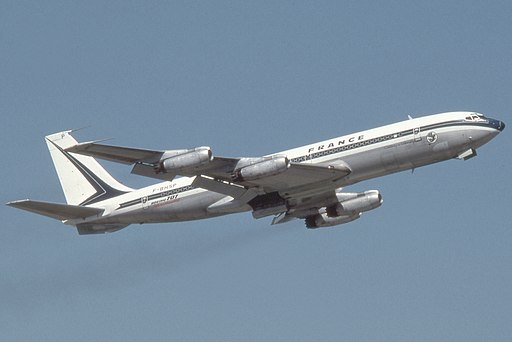
Boeing 707
Boeing 707 is a very important model not only for the American manufacturer. For Boeing, this is the first model of a jet airliner. This narrow-body four-engine airliner first flew on December 20, 1957.
technical parameters Boeing 707
| Manufacturer | Boeing Commercial Airplanes |
| Role | Narrow-body airliner |
| Primary users |
|
| First flight | December 20, 1957 |
| Introduction | October 26, 1958 , with Pan American World Airways |
| Produced | 19561978 |
| Cockpit crew | Three (Pilot, Copilot, and Flight Engineer) |
| 1- class / cargo |
|
| 2- class/cargo |
|
| Exit Limit |
|
| Fuselage width | 148 in (3.8 m) |
| Length |
|
| Wingspan |
|
| Wing area |
|
|
Maximum takeoff weight |
|
| Empty weight |
|
| Engines (x4) |
|
| Fuel capacity |
|
| Thrust per engine |
|
| Range |
|
| Cruise speed |
|
| Takeoff |
|
| Landing |
|
Boeing 707
.jpg)
History of the Boeing 707
The Boeing 707, a pioneering aircraft in the history of aviation, emerged as the first commercially successful jet-powered passenger plane, marking a transformative era in air travel. Introduced by Boeing in the late 1950s, the 707 revolutionized the aviation industry by providing a faster, more efficient, and longer-range alternative to propeller-driven aircraft. Making its maiden flight on December 20, 1957, the Boeing 707 entered commercial service with Pan American World Airways in 1958, inaugurating the Jet Age. Its introduction dramatically reduced travel times, making transcontinental and transatlantic flights more accessible and efficient.
The Boeing 707 served as a platform for various models, including those tailored for cargo transport and military applications. It played a pivotal role during the Cold War as a strategic transport aircraft and contributed significantly to global air travel connectivity. Over the years, advancements in technology and design, including the development of stretched variants like the 707-320 series, further enhanced its capabilities. The Boeing 707 left an enduring legacy, influencing subsequent jetliner designs and contributing to the expansion of international air travel. Its impact on the aviation industry remains profound, and the 707 is remembered as a trailblazer that paved the way for modern commercial jet travel.